For decades, a property dispute in Punjab has meant one thing: years, sometimes decades, of litigation. The provincial government has now built a parallel track designed to end that wait — a network of district-level Dispute Resolution Committees (DRCs) tasked with settling land and ownership conflicts within 90 days, before they ever reach a courtroom.
The move sits at the centre of one of the most closely watched legal experiments in the country. Here is what the new authority does, how it fits Pakistan’s wider push for out-of-court dispute resolution, and the legal questions still hanging over it.
Key Takeaways
- Punjab has created Dispute Resolution Committees in every district to settle property disputes within 90 days outside the regular court system.
- The committees are led by Deputy Commissioners and include police and revenue officials, with civil-court-like powers to summon parties and examine records.
- Unresolved cases move to a new Property Tribunal that must also decide within 90 days, but the law faces a Lahore High Court stay on enforcement.
What the new authority is
Under the Punjab Protection of Ownership of Immovable Property Ordinance 2025, approved by Chief Minister Maryam Nawaz Sharif and notified late in 2025, a Dispute Resolution Committee is to be constituted in every district of the province. The committees are administrative, not judicial — they are designed to resolve private land possession disputes through a fast administrative process rather than formal court trials.
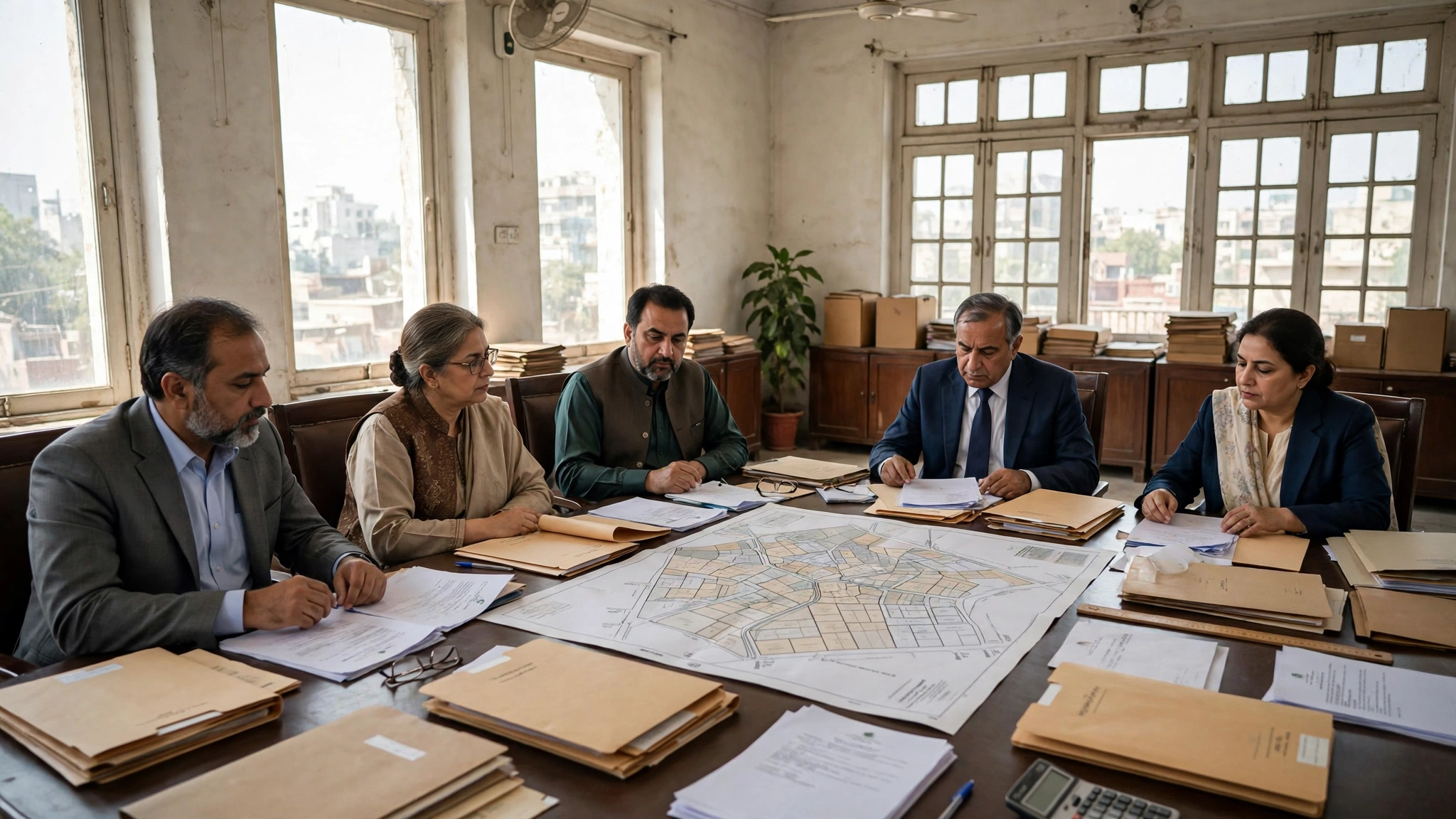
Each DRC is a six-member body. It is chaired by the Deputy Commissioner and includes the District Police Officer, the Additional Deputy Commissioner (Revenue), the Assistant Commissioner, the Sub-Divisional Police Officer, and a co-opted government officer. Crucially, the committees have been given powers similar to a civil court: they can summon individuals, examine revenue and property records, and take preventive measures to protect lawful possession while a complaint is being decided.
The headline promise is speed. Every complaint must be decided within 90 days. A single 90-day extension is possible, but only with written approval from the Divisional Commissioner. When a decision is made, the committee is legally required to arrange recovery of the property from illegal occupants within 24 hours.
How the two-tier system works
The DRC is only the first tier:
- District Dispute Resolution Committee — investigates the complaint, attempts an amicable settlement, and can take preventive steps such as obtaining surety from the concerned party or sealing the property while the matter is examined.
- Property Tribunal — if the committee cannot achieve a settlement, the case moves to a newly created Property Tribunal in every district, headed by a former judge of the Lahore High Court or a retired district judge, nominated by the Chief Justice of the Lahore High Court for a three-year term.
The tribunals hold exclusive jurisdiction over ownership and title disputes under the ordinance and function both as civil courts and courts of sessions. Their proceedings are held day-to-day and concluded within 90 days of receipt — so in theory a dispute could travel from complaint to final decision in about six months, a fraction of the time such cases typically take in the regular civil courts.
Why the government says it is needed
The provincial government frames the ordinance as a direct response to the land-grabbing problem — the qabza mafia — that has long exploited gaps in the system. The law makes illegal occupation punishable and holds company directors and responsible officers personally liable for offences committed through corporate entities or housing societies.
The government has linked enforcement to the Punjab Enforcement and Regulatory Authority (PERA), whose field force the chief minister has described as central to carrying out recovery operations. Proposals for digital land records and live-streamed proceedings were also reviewed as transparency measures.
The bigger ADR picture
This is not Punjab’s first attempt to move disputes out of the courts. The Punjab Alternate Dispute Resolution Act 2019 already created a framework for mediation, conciliation, and arbitration, with district ADR committees and an accreditation authority to regulate mediators. Amendments in 2023 streamlined timelines, and 2025 amendments tightened judicial oversight of mediator appointments. At the federal level, the Supreme Court has been piloting court-annexed mediation in family disputes, with plans to expand into labour and commercial cases.
The new DRCs differ in one important way: they are administrative bodies that act before litigation starts, rather than mediation tracks attached to courts. The practical appeal is obvious — a complaint filed at the district level, a decision in 90 days, and possession restored in 24 hours.
The legal cloud over the experiment
Honest reporting requires stating the caveat clearly: the ordinance is currently contested. The Lahore High Court has restrained its enforcement and ordered that possessions transferred under the law be returned, in a case raising separation-of-powers concerns — critics argue that handing adjudication of possession disputes to committees led by the Deputy Commissioner and police officials merges executive and judicial functions the Constitution reserves for the independent judiciary.
Chief Minister Maryam Nawaz has criticised the stay order, arguing it benefits land grabbers and hurts the poor and vulnerable property owners the law was meant to protect. The government has said it is considering challenging the order before higher courts.
A separate Lahore High Court ruling has also narrowed what the DRCs can do: it held that the committees cannot themselves order eviction, dispossession, or restoration of possession — those coercive steps can only flow from orders of the competent tribunal. Under this interpretation, the DRC’s powers are preventive and facilitative, while actual enforcement belongs to the judicial tier.
What this means for ordinary citizens
If you own property in Punjab and are locked in a possession dispute, the government’s message is that you no longer have to default to years of civil litigation. But until the courts resolve the legal status of the ordinance, the practical availability of the fast track remains uncertain. Keep your fard, registry, and mutation records organised — whichever forum decides your dispute, these records are the foundation — and follow the legal status of the ordinance rather than relying on social media summaries, which change as judgments are delivered.
Conclusion
Punjab’s Dispute Resolution Committees represent one of the boldest attempts anywhere in Pakistan to take disputes out of the courts and resolve them in months rather than decades. The design — district committees with investigative powers, strict 90-day clocks, and a judicial tribunal as backstop — directly targets the country’s most painful legal bottleneck: land. But speed cannot substitute for legitimacy. Until the Lahore High Court’s objections are resolved, the new authority exists in legal limbo: announced and partly functional, yet barred from enforcing the very outcomes it was built to deliver. Whether this becomes a model for fast, fair out-of-court justice or a cautionary tale about bypassing the judiciary will be decided in the months ahead.