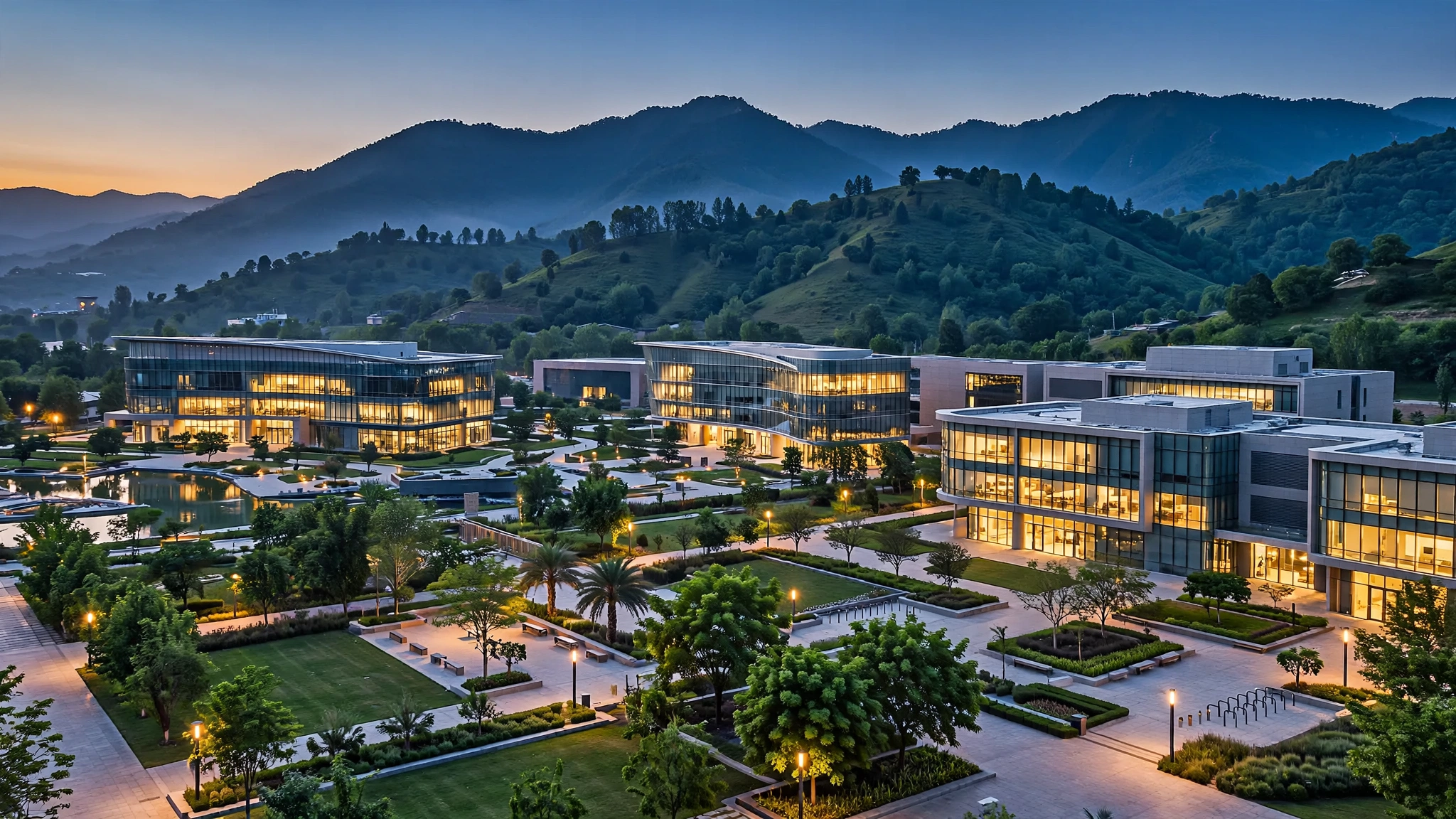
Two days after inaugurating Islamabad’s Daanish IT Park, Prime Minister Shehbaz Sharif chaired a review meeting on Monday and directed the authorities concerned to develop the facility into a world-class hub of technology — the centre of a modern IT ecosystem built on close cooperation between academia and industry.
The directive signals that the government wants the Rs. 23.3 billion park to be more than a building complex. It is expected to connect universities, private-sector companies, startups, and international technology firms under one roof, and to serve as the flagship of Pakistan’s push to grow IT exports and foreign investment.
Key Takeaways
- PM Shehbaz Sharif directed authorities to develop Daanish IT Park Islamabad into a world-class hub of technology.
- He wants operations launched with international tech companies, backed by an independent third-party audit.
- Officials reported 50 buildings converted into Software Technology Parks, 8 incubation centres, and 105 co-working spaces nationwide.
What the Prime Minister Ordered
At the meeting, the Prime Minister laid out a clear set of instructions for how the park should be developed and operated:
- World-class standards: Develop Daanish IT Park Islamabad into an internationally recognised technology hub that fosters innovation, investment, and collaboration between academia and industry.
- Modern ecosystem: Build a modern technological ecosystem at the facility by strengthening ties between educational institutions and the private sector.
- Global partnerships: Launch operations at the park in partnership with international technology companies. Officials told the meeting that talks with leading global tech firms are already underway.
- Independent audit: The Ministry of Information Technology was directed to prepare a comprehensive case study of the project and arrange an independent third-party audit to assess its performance and implementation.
- Youth skills: The government will continue efforts to equip young Pakistanis with modern skills in IT, artificial intelligence (AI), and financial technology (FinTech), while creating new opportunities for IT entrepreneurs.
The Bigger Picture: Pakistan’s IT Ecosystem Today
The briefing at the meeting gave a snapshot of how the surrounding infrastructure is taking shape beyond the Islamabad flagship. According to officials:
| Initiative | Scale |
|---|---|
| Private buildings converted into Software Technology Parks (PSEB) | 50 |
| Incubation centres established nationwide for startups | 8 |
| Co-working spaces operational for IT professionals | 105 |
These figures matter because a single park — however large — cannot carry Pakistan’s IT sector alone. Software Technology Parks, incubation centres, and co-working spaces spread across cities give freelancers and small software houses the registered workspace, tax benefits, and networking they need to serve foreign clients.
The stated goal tying all of this together is to boost Pakistan’s technology exports and attract greater foreign investment — a policy objective that has remained consistent across recent governments as IT exports have become one of the country’s few reliable sources of foreign exchange.
From Inauguration to Implementation
The review meeting followed closely on the inauguration ceremony held on Saturday, October 10, 2026, where the Prime Minister formally opened the National Technology Park and renamed it the “Daanish Technology Park.” Key facts from that ceremony:
- The park is located on a 14.9-acre site in Chak Shahzad, Islamabad.
- The Rs. 23.3 billion (about $92.7 million) project was built with financial assistance from the Export-Import Bank of South Korea; South Korean Ambassador Sungho Han attended the ceremony.
- The Prime Minister described the facility as a milestone toward Pakistan’s progress and prosperity, calling it a comprehensive ecosystem integrating incubation centres, industrialists, entrepreneurs, IT experts, academia, SMEs, and tech startups.
- He directed that a transparent bidding process be held to invite top national and international IT and AI companies to operate the facility.
- He announced that similar modern technology parks will be established across the country, including in Azad Jammu and Kashmir and Gilgit-Baltistan.
Minister for Information Technology and Telecommunication Shaza Fatima Khawaja told the inauguration ceremony that the park would serve as a digital business and technology ecosystem, and pointed to public-private partnerships that have established small technology centres in 65 districts over the past two years — 135 of which, she said, currently provide youth with round-the-clock internet access to polish their skills.
Why Academia-Industry Collaboration Is the Hard Part
The Prime Minister’s emphasis on cooperation between educational institutions and the private sector touches on a long-standing gap in Pakistan’s technology landscape. Universities produce large numbers of computer science graduates each year, but employers routinely complain about a skills mismatch: fresh graduates often lack hands-on experience with modern tools, cloud platforms, and real client workflows.
What a functioning ecosystem would need
For the park to deliver on the “modern IT ecosystem” promise, several pieces would have to fall into place:
- Anchor tenants: Credible international and local companies must actually take up space and bring real projects, not just signage.
- Skill pipelines: Universities nearby need structured internship and project programs with the companies inside the park.
- Startup support: Incubation centres need mentorship and funding access, not just desk space.
- Transparent management: The promised competitive bidding for operations — and the third-party audit now ordered — are designed to keep the facility from becoming another underused government complex.
The transparency test
The decision to commission an independent third-party audit of the project’s performance and implementation is notable. Large public-sector technology projects in Pakistan have often faced questions about delays, cost overruns, and utilisation. A published audit — and a genuine competitive bidding process for operations — would give the park credibility with the foreign companies the government wants to attract.
What Comes Next
The immediate milestones to watch are straightforward: the Ministry of Information Technology’s case study, the third-party audit, the bidding process for the facility’s operators, and the outcome of the ongoing talks with international technology companies. Beyond that, the government’s promise of similar parks in Azad Jammu and Kashmir, Gilgit-Baltistan, and other parts of the country will test whether Daanish IT Park becomes a replicable model or a one-off showcase.
For Pakistan’s young developers, freelancers, and startups, the park’s real value will be measured in something simpler than ribbon-cuttings: jobs, contracts, mentorship, and a credible address that helps Pakistani firms win work from clients abroad. The direction from the top is now on record — the ecosystem part is what will take years of work to build.