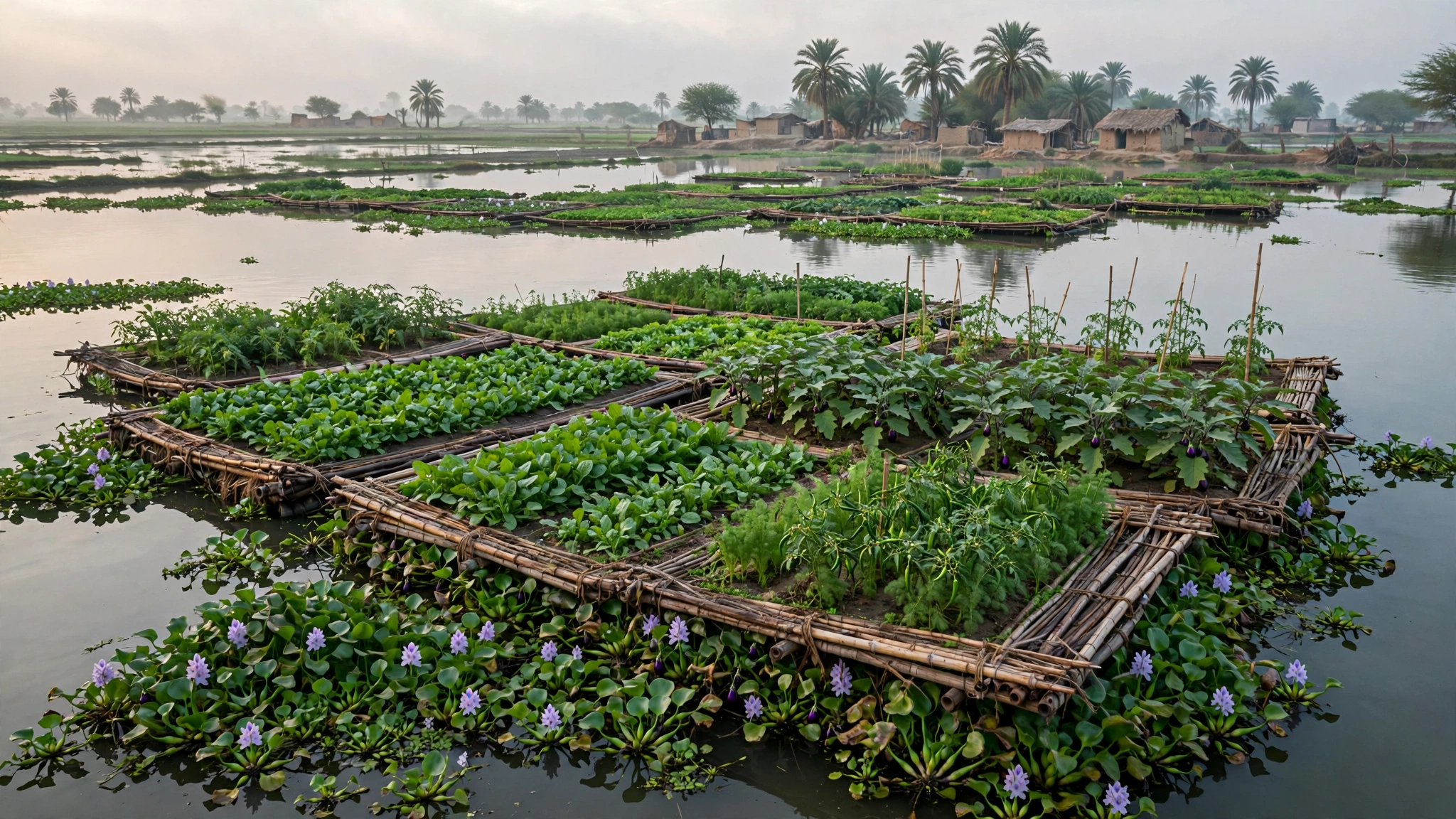
The Sindh government has proposed a $9.15 million climate-resilient floating agriculture project that would turn some of the province’s most flood-damaged land into productive farmland — not by draining the water away, but by farming on top of it.
The plan, titled “Climate Resilient Floating Agriculture Systems for Waterlogged and Flood Prone Areas of Lower Sindh,” aims to create 400 hectares of flood-resistant cropland across 100 waterlogged and flood-prone villages of lower Sindh by 2029 — growing vegetables, herbs and grains on organic rafts where standing water rules out conventional cultivation.
Key Takeaways
- Sindh has proposed a $9.15m project to create 400 hectares of floating farmland across 100 waterlogged villages in lower Sindh by 2029.
- The plan targets 10,000 trained farmers and 12,500 direct beneficiaries, with 20–30% of training places reserved for women.
- It is still a proposal — the project is being processed for inclusion in the World Bank’s Country Partnership Framework for FY2026–2035.
What the project proposes
According to official documents seen by Wealth Pakistan and reported via the Associated Press of Pakistan, the project sets ambitious headline targets:
| Target | Figure |
|---|---|
| Proposed budget | $9.15 million |
| Floating farmland | 400 hectares |
| Villages covered | 100 (lower Sindh) |
| Farmers to be trained | 10,000 |
| Direct beneficiaries | 12,500 people |
| Indirect beneficiaries | 50,000 people |
| Food security improvement target | 30% |
| Completion target | 2029 |
The farming method itself is the core of the proposal. Instead of fighting excess water, floating agriculture uses it. Crops are grown on rafts woven from locally available organic material — typically water hyacinth, bamboo and other plant matter — which rise and fall with water levels. The rotting plant matter beneath the raft doubles as fertiliser, so the beds are effectively self-nourishing.
Why lower Sindh needs this
Lower Sindh is arguably the part of Pakistan where climate change hits agriculture hardest. The 2022 floods affected around 18.6 million people in Sindh alone, according to the province’s own irrigation minister — destroying standing crops, washing away topsoil and leaving vast areas waterlogged for months afterward.
But even outside catastrophic flood years, large parts of lower Sindh suffer chronic waterlogging and salinity. Flat terrain, reduced freshwater flows down the Indus and coastal saltwater intrusion have left thousands of hectares uncultivable — and conventional drainage is beyond what most small farmers can afford.
That is the logic behind floating agriculture: where the land stays wet, grow food on the water instead. It needs little drainage, uses cheap local materials and can be built by small farming households.
The concept has a proven track record. In Bangladesh, floating gardens — locally called baira — have been practised in southern wetlands for centuries: farmers layer water hyacinth, bamboo and organic matter into floating beds and plant vegetables that rise with floodwater instead of drowning. The UN Food and Agriculture Organisation recognised the system as a Globally Important Agricultural Heritage System in 2015.
Who runs it, and who backs it
The documents name the Sindh Environment, Climate Change and Coastal Development Department as the executing agency. Supporting organisations listed include the United Nations Development Programme, the National Agriculture Research Centre, Sindh Agriculture University Tandojam and the Sindh Agriculture Department.
Notably, the proposal is among the projects being processed for inclusion in the World Bank’s Country Partnership Framework for Pakistan for fiscal years 2026–2035. That matters because the CPF is the bank’s main country strategy document — inclusion would open the door to financing, though it guarantees nothing. The Green Climate Fund has separately provided FAO with nearly $35 million for climate-resilient agriculture and water management in Sindh and Punjab, and IFAD is investing $100 million in a coastal resilience programme covering around 500 villages in Thatta, Sujawal and Badin.
Floating agriculture would slot into an already busy adaptation landscape in the province — the Green Climate Fund has given FAO nearly $35 million for climate-resilient agriculture in Sindh and Punjab, and IFAD is investing $100 million in coastal resilience across Thatta, Sujawal and Badin. At a fraction of the cost of conventional drainage works, floating rafts offer a cheaper route.
A notable role for women farmers
One of the proposal’s more distinctive features is its gender target: women are expected to make up 20 to 30 per cent of the 10,000 trainees, and women-led farmer groups would receive both training and seed capital.
That is significant because women do much of the agricultural work in rural Sindh but rarely control the land, credit or decision-making. A technology that needs no land ownership — a raft on a pond or a waterlogged field — is theoretically more accessible to women than conventional farming. Whether those commitments survive the journey from proposal to implementation will be worth watching.
What to watch next
For now, the honest status is: this is a proposal on paper. Several things need to happen before a single raft floats in lower Sindh.
Financing must be secured. The World Bank CPF inclusion is still being processed. Without bank financing or an equivalent funder, the $9.15 million figure is aspirational.
Pilot results matter. Floating agriculture works in Bangladesh’s freshwater wetlands, but Sindh’s waterlogged areas are often brackish or saline — especially near the coast. Whether floating beds can perform in saline standing water, and which crops they can support, is a technical question the project will have to answer early.
Scale is the hard part. Four hundred hectares across 100 villages is ambitious for a technology that is new to Pakistan. Training 10,000 farmers to build, maintain and harvest from floating rafts — and sustaining the practice after the project ends — will be the real test.
Cost per hectare. At roughly $22,875 per hectare proposed, the project is not cheap for a low-tech intervention. Its defenders would argue that reclaiming waterlogged land through drainage costs far more. Either way, the economics will shape whether it is replicated elsewhere.
The bigger picture
Sindh’s agriculture sector is caught between two futures. One is the familiar cycle: flood, damage, recovery, repeat — with each disaster taking more land out of production. The other is adaptation: changing what and how the province grows to fit the water it actually has.
Floating agriculture is a bet on the second future. It is still only a proposal, and it is small next to the billions spent on flood recovery — but it is exactly the kind of low-cost, locally built adaptation that Pakistan’s most vulnerable farming communities can actually use, if the financing comes through and the technology suits Sindh’s conditions.
The next milestone is whether the project makes it into the World Bank’s partnership framework, and with it, a budget. Until then, lower Sindh’s farmers will keep watching the water rise.