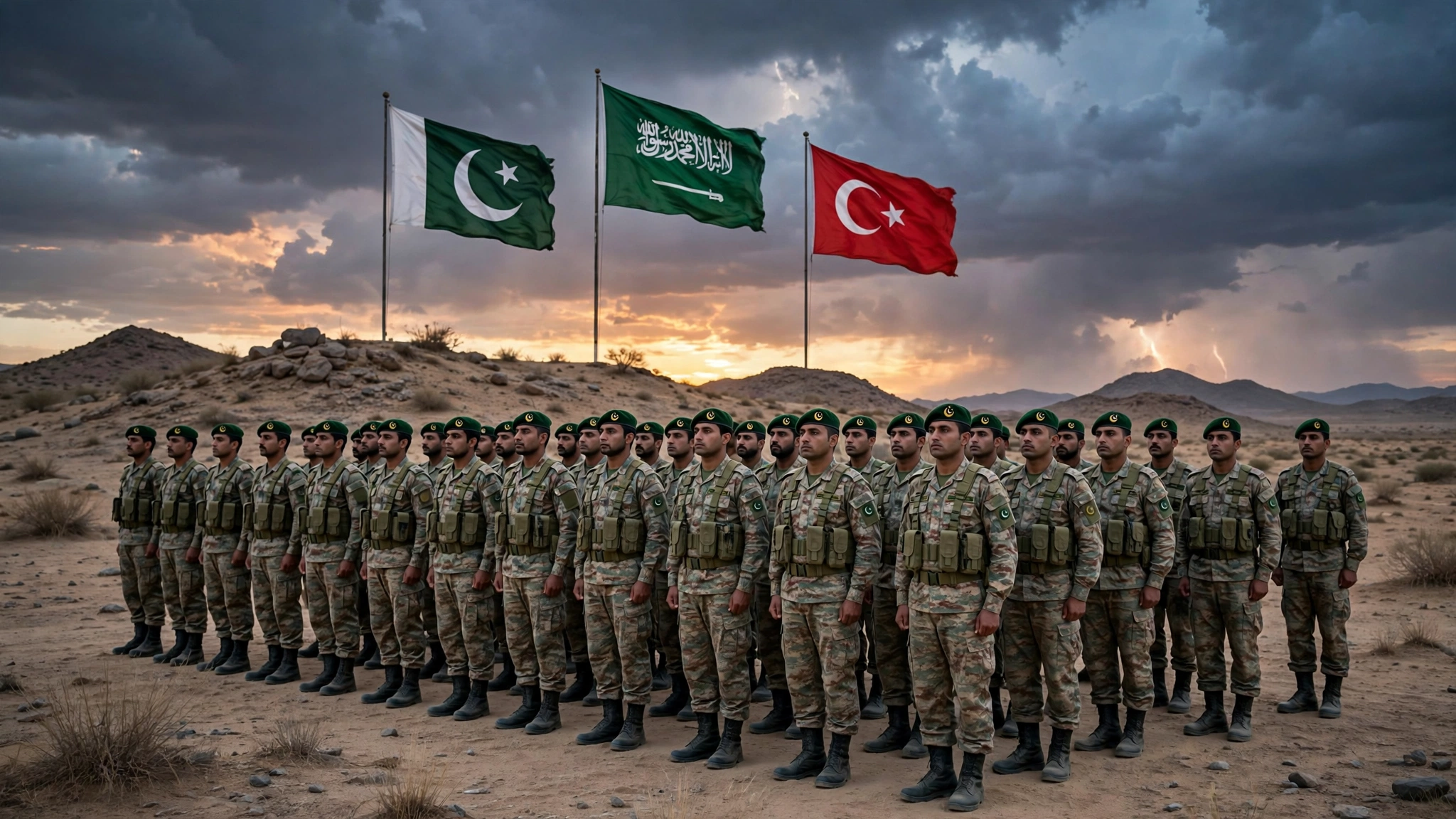
The Mecca defence pact has now moved from paper to boots on the ground — and Pakistan has crossed a line it drew for itself eleven years ago. On October 5, Pakistan, Saudi Arabia and Türkiye activated their mutual defence agreement for the first time, agreeing to the rapid deployment of military forces to Saudi Arabia. For Pakistan, this is a moment of extraordinary consequence. Islamabad has every reason to stand by Riyadh when its territory comes under attack. But it must not let a defensive pact become a doorway into Yemen’s war.
Key Takeaways
- The Mecca Joint Defence Agreement, signed on August 7, 2026, was activated on October 5 after Houthi attacks on Saudi Arabia — Pakistan and Türkiye agreed to rapid troop deployments.
- Unlike 2015, when parliament unanimously voted to stay out of the Yemen war, this deployment happened with no parliamentary debate.
- Türkiye has drawn a clear line: defensive support only, no offensive operations. Pakistan must publicly draw the same line.
What the Mecca Pact Actually Is
The Mecca Joint Defence Agreement was signed on August 7, 2026, by Pakistan, Saudi Arabia and Türkiye. Its central provision is stark: an armed attack against any one of the three countries is to be regarded as an attack against all three. It is a collective-defence framework modelled on the same principle that underpins NATO’s Article 5.
The trigger for its first activation was a series of attacks by Yemen’s Houthi movement. The Houthis claimed strikes on Saudi targets including King Khalid International Airport in Riyadh, an Aramco oil refinery in Rabigh and an airbase — claims Saudi authorities did not officially confirm. But a joint statement from the three countries condemned what it called the attempted targeting of Mecca and Madinah, Islam’s two holiest cities, along with continuing attacks on Saudi cities and civilian facilities.
Following an emergency meeting of the pact’s Strategic Political and Defence Committee in Riyadh, the three countries announced they would move immediately to the practical implementation of collective defence commitments — providing agreed military forces and capabilities for rapid deployment in Saudi Arabia, in accordance with each country’s national legislation.
A Troubled Parallel: The Yemen War Next Door
The pact’s activation is not happening in a vacuum. It coincides with a major Saudi-backed counteroffensive in Yemen, where forces loyal to Yemen’s internationally recognised government have claimed to retake the Red Sea port of Mocha and secure areas near the strategic Bab el-Mandeb strait, with around 100 coalition fighter jets reportedly supporting the operation. The Houthis, in turn, have declared a ban on Saudi shipping and struck Saudi tankers and oil facilities.
This is precisely the danger. The line between defending Saudi territory from cross-border attacks and becoming entangled in the Yemeni battlefield is razor thin. The military chiefs of the three countries met in Riyadh on September 25, retired Pakistani Lieutenant General Nauman Mahmood was appointed the alliance’s first secretary-general for a three-year term, and Pakistani troops are already present in Saudi Arabia — Pakistan’s army has acknowledged a military presence in the kingdom stretching back decades. The machinery for involvement is in place. What is missing is clarity about where defensive support ends.
The Ghost of 2015
In 2015, when Saudi Arabia asked Pakistan for troops, warplanes and ships for its Yemen campaign, the then-government took the request to parliament. Parliament’s response was unanimous: stay neutral, while pledging to defend the kingdom’s territory and its holy sites. That resolution was a masterstroke of Pakistani statecraft — honouring a deep alliance without being drawn into another country’s war.
This time there has been no such parliamentary debate. The deployment decision was taken at the government-to-government and military-to-military level. Reporting by Reuters noted that analysts see the difference from 2015 as political rather than legal: Pakistan’s constitution gives the federal government command and control of the armed forces then and now, and the agreement specifies action in line with national legislation. But legal authority and democratic legitimacy are not the same thing. Sending soldiers toward a conflict zone without the elected legislature’s deliberation is a serious precedent — especially when the opposition PTI has publicly said the matter should be decided with “political acumen.”
Türkiye Has Drawn the Line — Pakistan Should Too
The most useful precedent for Pakistan comes from its own alliance partner. Türkiye has been explicit: its support is defensive, and it will not take part in offensive operations. Foreign Minister Hakan Fidan stated plainly that Türkiye would not send troops to another country to carry out attacks, saying the pact was not an offensive agreement. Turkish officials have described Ankara’s contribution as limited to defensive and technical support — air defence systems, electronic warfare, intelligence sharing and equipment — much of it in a bilateral capacity since Türkiye’s parliament has not yet ratified the pact itself.
Pakistan should adopt and publicise the same bright line. There is nothing dishonourable about defending an ally’s territory and holy sites — indeed, Pakistan’s parliament pledged exactly that in 2015. But Pakistani troops must not take part in operations inside Yemen. When Pakistan’s ISPR spokesman discussed the deployment with international media, he described any involvement as “defensive in nature” but would not be drawn on whether Pakistani forces could operate across the border. That ambiguity is the problem. Ambiguity is what mission creep feeds on.
What Is at Stake for Pakistan
For ordinary Pakistanis, this is not an abstract diplomatic debate. Every foreign military commitment carries real costs:
- Economic exposure. Pakistan’s economy is fragile. Escalating regional conflict can spike oil prices, disrupt shipping through Bab el-Mandeb — one of the world’s most important maritime chokepoints — and threaten the remittances of millions of Pakistani workers in the Gulf.
- Relations with Iran. Pakistan shares a long border with Iran and has positioned itself as a mediator. Direct Pakistani involvement in fighting the Houthis, who are aligned with Tehran, could rupture that relationship.
- The deterrence trap. A pact that was supposed to deter attacks will fail if it invites Pakistan into a war the Houthis cannot be deterred from fighting — they have been at war for years and are, as analysts note, undeterrable by precisely this kind of coalition pressure.
- Democratic accountability. If casualties ever mount, the question “who authorised this?” must have an answer that includes parliament — not one that bypasses it.
Conclusion: Defend the Kingdom, Not the War
Pakistan’s friendship with Saudi Arabia is genuine and deep — cemented by shared faith, decades of military cooperation and millions of Pakistani workers in the kingdom. Honouring that alliance when Saudi cities come under attack is right and necessary. But Islamabad must insist — publicly and in writing — that its role under the Mecca pact stays strictly defensive.
Türkiye has shown how to hold that line. Pakistan’s own parliament showed how in 2015. The stakes of forgetting it now could not be higher.