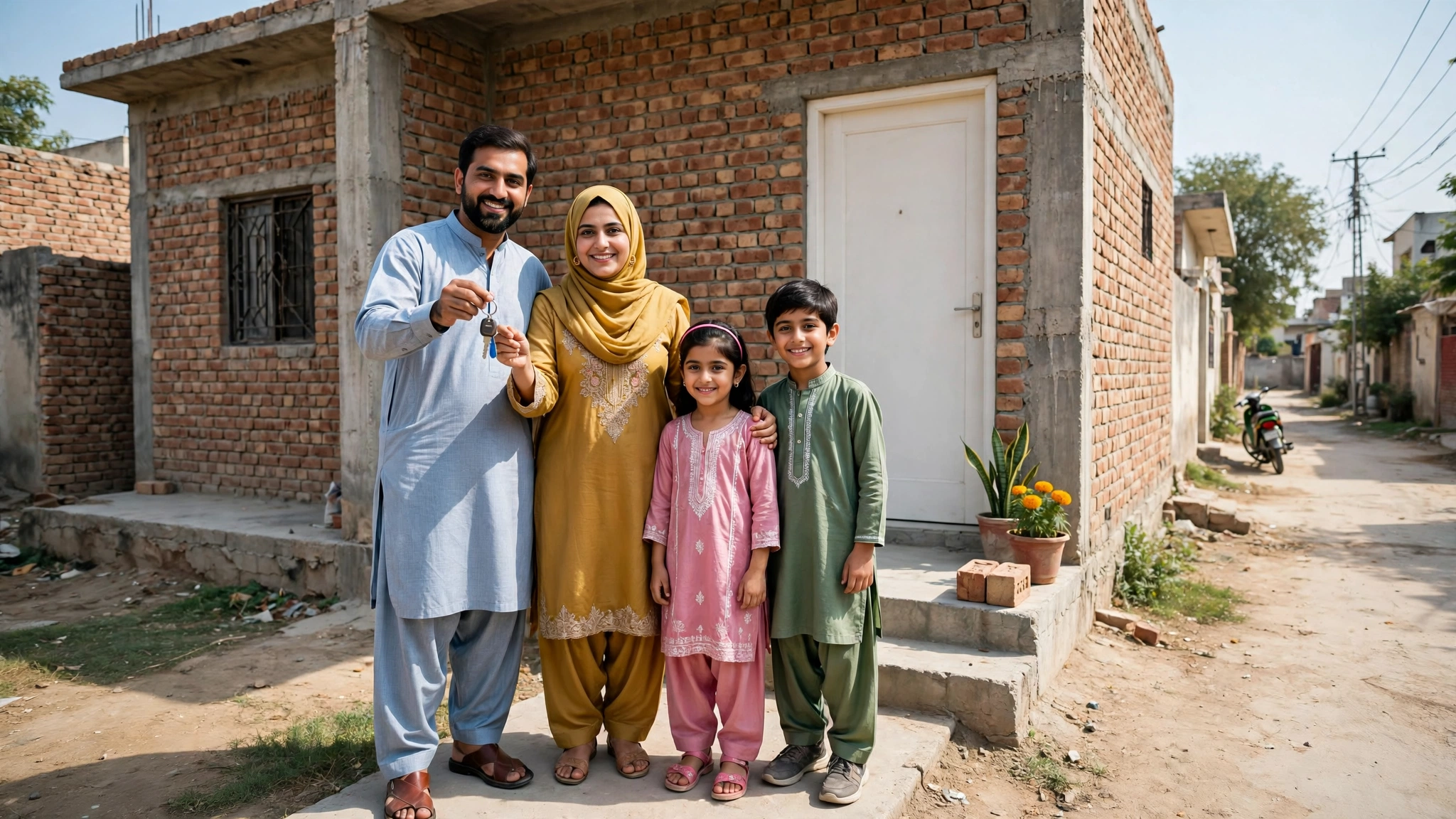
Pakistan’s housing finance push has a paradox at its heart: banks have approved more than Rs400 billion in affordable home loans, yet only about Rs76 billion — barely 19 percent — has actually reached first-time homebuyers. The figure, acknowledged at the highest levels of government this week, has triggered a fresh push to unclog the pipeline between loan approval and money in hand.
Key Takeaways
- Pakistan’s banks have approved more than Rs400 billion in affordable housing finance, but only about Rs76 billion — 19% — has actually been disbursed to first-time homebuyers.
- Prime Minister Shehbaz Sharif has directed the State Bank of Pakistan to speed up disbursements and simplify lending procedures.
- The bottleneck is not approvals but handovers: complex paperwork, property verification and administrative delays keep sanctioned loans from reaching borrowers.
The numbers behind the headline
Finance Minister Muhammad Aurangzeb laid out the gap while speaking virtually at the 10th annual microfinance conference organised by the Pakistan Microfinance Network on October 7. The banking sector, he said, had sanctioned upwards of Rs400 billion in affordable housing finance — but disbursements to first-time buyers stood at roughly Rs76 billion.
Days later, Prime Minister Shehbaz Sharif put the same problem in sharper relief at a meeting with the presidents and chief executives of leading commercial banks. Briefed that only Rs76 billion had been released against Rs426 billion in approved financing under the government’s Apna Ghar Programme — leaving some Rs350 billion stuck in the pipeline — the prime minister directed the State Bank of Pakistan to accelerate disbursements.
By the end of September, just 13,214 borrowers had received loans under the programme, which was launched on April 30, 2026 to widen access to affordable housing finance. The government’s own target for fiscal year 2026-27 is far more ambitious: Rs700 billion in housing finance and 125,000 housing units constructed or provided.
Approvals are not disbursements
The finance minister’s core message was that counting approvals is the wrong scoreboard. Sanctioning a loan and handing the money to a family are two very different things, and Pakistan’s housing finance system is currently much better at the first than the second.
Aurangzeb called for deeper cooperation between commercial banks and microfinance institutions, wider use of digital lending systems, and better credit assessment methods. Lending decisions, he argued, should weigh a borrower’s repayment capacity, income patterns and affordability — not rest so heavily on conventional collateral requirements. That shift, in his view, is what would bring more ordinary households into the formal financial system.
He also urged that financial programmes be judged by their economic and social outcomes rather than by loan volumes alone — a pointed remark given how impressive the Rs400 billion approval figure looks on paper.
A case study in the bottleneck: one bank’s ledger
The national figures are mirrored, almost precisely, in the books of individual lenders. Meezan Bank disclosed that it had approved 6,880 home financing cases worth about Rs49 billion under the prime minister’s Apna Ghar programme — yet only 1,000 families had actually received their money by the end of September, with disbursements standing at Rs7.34 billion.
The bank received more than 27,800 applications worth roughly Rs179 billion. In other words, about one application in four was approved — and only about one approved case in seven had reached the stage where a family was paid. Approvals are visibly moving faster than handovers: over five weeks from early September, approved cases grew by more than 2,400 while funded families rose by only about 350.
One applicant’s account captures the human side of the gap. Usman, who applied through Meezan in June, said he had waited a long time for a scheme of this kind — but that the bank’s process and the waiting had drained the excitement out of it.
Why the money gets stuck
Neither the minister nor the prime minister blamed a single cause, but the shape of the problem is familiar to anyone who has dealt with Pakistani banks:
- Documentation and verification — property titles, income proof and legal opinions take weeks or months to verify, particularly for first-time buyers with informal income.
- Administrative bottlenecks — files move between bank branches, legal departments and valuers, with little of the process digitised end to end.
- Risk aversion — banks remain cautious about long-tenor, low-margin subsidised lending, even with government risk-sharing in place.
- Applicant fatigue — lengthy, opaque processes cause eligible borrowers to give up or turn to informal borrowing instead.
The prime minister’s response was to order simpler lending procedures and the removal of administrative bottlenecks — an acknowledgement that the fixes needed are operational, not just financial.
The scheme behind the numbers
The financing in question flows mainly through the Wazir-e-Azam Apna Ghar Program — branded “Ghar Ho Tu Apna” — which began life in September 2025 as the Mera Ghar–Mera Ashiana markup subsidy and risk-sharing scheme. In March 2026 it was significantly expanded: the maximum loan rose to Rs10 million, the maximum house size to 10 marla, flats to 1,500 square feet, and the customer rate was standardised at a fixed 5 percent for the first ten years, with tenors of up to 20 years.
Borrowers put down 10 percent equity while banks finance 90 percent, with no processing fee and no prepayment penalty, and the government covers 10 percent of the outstanding portfolio on a first-loss basis. Participating lenders span commercial banks, Islamic banks, microfinance banks and the House Building Finance Company. The scheme covers buying a ready house or flat, building on an owned plot, or buying a plot with simultaneous construction.
On paper, it is among the most borrower-friendly housing finance products Pakistan has ever offered. The 19 percent figure shows how far the delivery still lags the design.
What happens next
The prime minister’s meeting produced two concrete directions: the SBP must speed up housing loan disbursements, and consultations are under way on a framework to improve developers’ access to financing — recognising that supply-side credit matters too.
The same meeting reviewed parallel lending drives. SME owners numbering 350,862 had received Rs1,137 billion in loans, with a target of Rs1,500 billion and 565,000 beneficiaries by June 2027. Agricultural lending had reached Rs1,352 billion by end-September, benefiting over 3.45 million people. Housing, by comparison, is the laggard — which is precisely why it is now getting the attention.
For aspiring homeowners, the takeaway is cautiously hopeful: the money exists, the approvals exist, and the political will to force disbursements now exists too. Whether the Rs350 billion sitting in the pipeline actually reaches families will be the number to watch in the coming months — not the next approval milestone.