Not exactly — but the world is changing what it wants to buy, and Pakistan’s biggest export industry is struggling to keep up. Textile and apparel shipments barely moved in the last fiscal year, buyers are quietly pivoting toward fabrics Pakistan does not dominate, and the country’s own exporters are warning of a sharp downturn in the current quarter. The alarm bells are real, even if the industry has not collapsed.
Key Takeaways
- Pakistan’s textile exports were essentially flat in FY2025-26 at about $18 billion, with value-added garments masking deep stress upstream.
- Buyers are shifting away from basic cotton and poly-cotton products toward microfiber, flannel and value-added finishes.
- Exporters warn of a sharp Q2 decline as freight charges surge 1.5–2.5x and Western demand weakens.
The headline number: flat at $18 billion
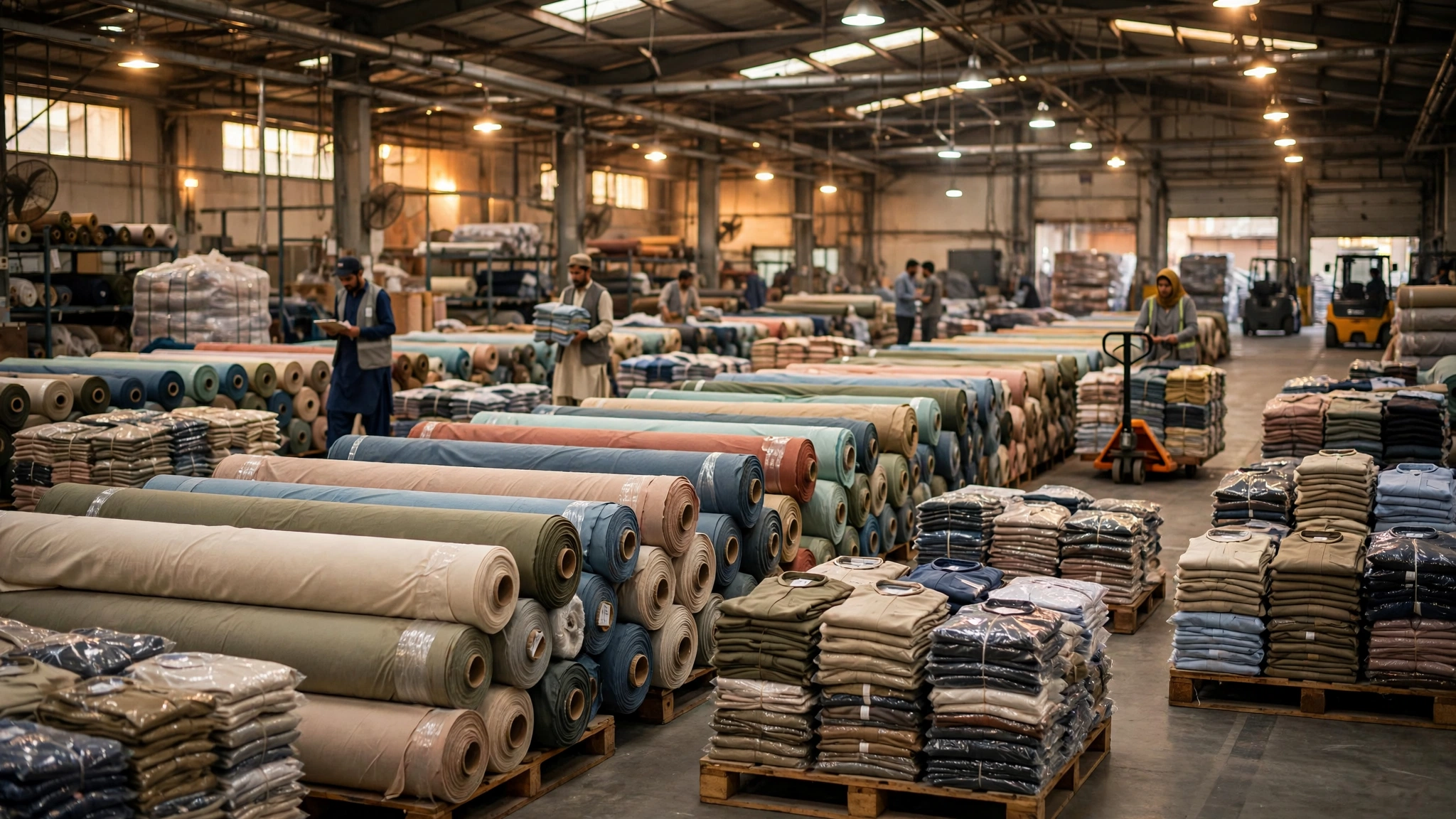
Pakistan’s textile and apparel exports grew just 0.3% in fiscal year 2025-26 to roughly $18 billion, according to the Pakistan Textile Council’s annual analysis, even as the country’s overall exports contracted. Official data from the Pakistan Bureau of Statistics put the figure at $17.93 billion, up 0.26% year on year.
The early months of the new fiscal year (2026-27) look slightly better: July–August exports reached $3.38 billion, up 5.55% from the same period a year earlier. But that recovery is fragile, and textiles still account for more than half of Pakistan’s total merchandise exports — when this sector sneezes, the country’s foreign-exchange earnings catch a cold.
What buyers actually want is shifting
The most important — and underreported — development comes from the Pakistan Textile Council’s own findings: international buyers are increasingly moving away from basic cotton and poly-cotton products toward microfiber, flannel and products with value-added finishes. Plain, undifferentiated products are losing market share.
This is the real “loss of interest” story. It is not that the world has stopped buying clothes — it is that demand is migrating into product categories where Pakistan has historically been weaker. Pakistan’s strength has long been bed linen, towels and basic apparel. The global market is now rewarding manufacturers who deliver performance fabrics, technical finishes and design-led apparel.
The numbers back this up. Non-knit apparel grew 3.9% to a record $4.295 billion, and home textiles edged up 0.6% to $5.705 billion — but knitwear, Pakistan’s biggest category, slipped 0.7% to $4.979 billion. Upstream, the damage is worse: knitted fabric exports collapsed 20.7%, man-made filament fell 26.2%, and raw/intermediate exports dropped to a five-year low of $3.026 billion.
Value-added products now make up 83.2% of textile exports, up from 77% in FY2021-22. That is partly progress — but the council warns it is also “masking deeper weaknesses” in the supply chain.
The cotton crisis at home
Pakistan cannot compete abroad when its raw material base is crumbling at home. Domestic cotton production fell to just 5.5 million bales — the lowest in three decades and nearly 70% below the 2011-12 peak of 14.8 million bales. One estimate puts the resulting cotton import bill at roughly $3 billion.
Imported cotton means higher costs before a single spindle turns. It also means the industry’s traditional cost advantage is eroding at exactly the moment buyers are squeezing prices. The spinning and weaving segment is under severe strain: industry proposals for the FY27 tariff regime say more than 40% of spinning and weaving units have already shut down.
Warning sirens for Q2: demand, freight, and costs
In early October, the Pakistan Textile Exporters Association (PTEA) issued an unusually stark warning. Patron-in-Chief Khurram Mukhtar said exporters expect a sharp decline in shipments during October–December 2026, driven by three pressures landing at once:
- Weak Western demand. Persistent inflation in the EU and the US has dampened buyer appetite — and those two markets, plus the UK, absorb the overwhelming majority of Pakistan’s textile exports ($7.1 billion from the EU, $4.9 billion from the US, and $1.7 billion from the UK in FY2025-26).
- Soaring freight charges. Sea freight rates have surged 1.5 to 2.5 times, shredding exporters’ already thin margins.
- Rising production costs. Expensive energy — exporters want cross-subsidies removed from industrial electricity tariffs — and high domestic inflation are pushing several value-chain segments under severe financial strain.
Mukhtar called the decline in export trade volume “unprecedented” and warned that only financially strong exporters would survive, adding that recovering lost market share afterward would be extremely difficult.
What exporters are demanding
- Temporary Duty Drawback of Local Taxes and Levies (DLTL) support at 6–8%.
- Immediate clearance of outstanding tax refunds to ease liquidity.
- Removal of cross-subsidies in industrial energy tariffs.
- Implementation of the 4.5% financing rate announced under the Export Finance Scheme — banks are reportedly charging 5.5–8.5% instead.
Rivals are not standing still
US import data for January–August 2026 shows a weak American apparel market — total imports fell 7.42%. Within it, Pakistan’s apparel shipments declined 3.83%, Bangladesh fell 4.43%, Vietnam barely slipped 0.76% — while Cambodia grew 6.91% and Indonesia rose 2.58%. China and India collapsed by 29% and 26% respectively, partly under tariff pressure.
The lesson for Pakistan: in a shrinking market, buyers consolidate orders with suppliers they see as cost-competitive and reliable. Heavy reliance on just three markets — the EU, US and UK — also leaves the industry exposed to demand shocks, which is why the council urges expansion into South America, Africa and the Far East.
So is the world really losing interest?
The honest answer: not yet — but the warning signs are flashing amber, not green.
Pakistan’s textile industry is not experiencing a collapse. It held exports at a record-adjacent $18 billion, pivoted further toward value-added goods, and opened the new fiscal year with 5.55% growth. That is not an industry the world has abandoned.
But “holding” is not the same as “competing.” The structural pressures are piling up: a cotton base at a 30-year low, buyer preferences shifting toward fabrics Pakistan underproduces, freight costs up 150%, energy costs that exporters say are uncompetitive, and rivals — Bangladesh, Vietnam, Cambodia, Indonesia — gaining or holding ground more effectively in key markets.
The council’s prescription is a to-do list Pakistan has heard before: cheaper competitive energy, faster refunds and financing access, protected preferential market access (especially the EU’s GSP+ status), better shipping and logistics, and a rebuilt domestic cotton base.
The question is not whether the world wants textiles — global demand will recover. The question is whether Pakistani exporters can still be in the room when it does. If the feared Q2 decline materializes, regaining lost market share will be extremely difficult. The world is not losing interest in textiles. It may, however, be losing patience with Pakistan’s cost structure.