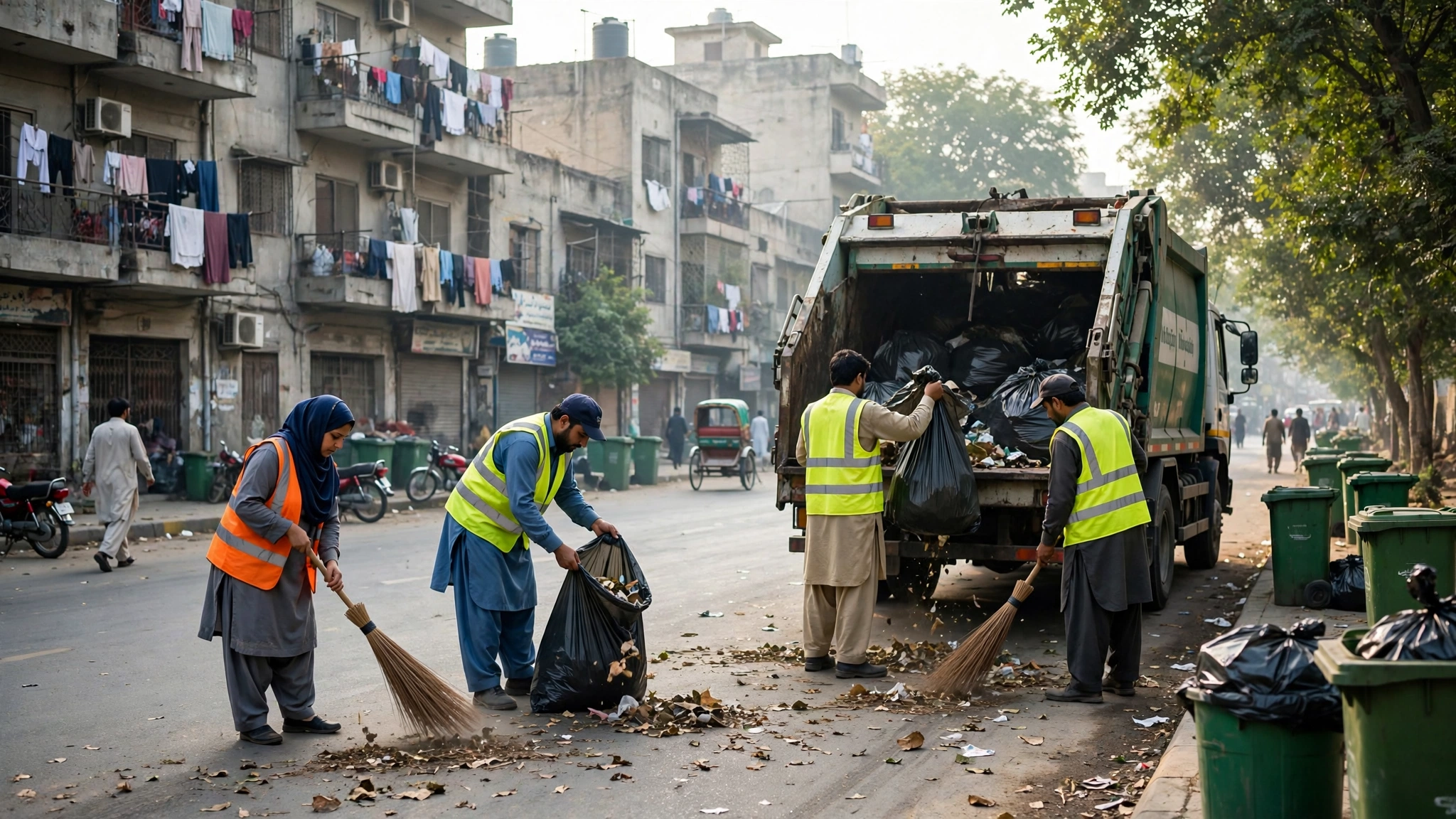
The Punjab government has decided to cancel sanitation contracts in 26 tehsils across the province, citing poor cleaning services, administrative negligence and delays in paying workers’ salaries. In the first phase, contracts covering 21 tehsils — all awarded to a single company — will be terminated, and the government will temporarily take over sanitation operations for 90 days to keep services running.
Key Takeaways
- Punjab will cancel sanitation contracts in 26 tehsils, starting with 21 held by a single company, over poor cleaning, administrative negligence and delayed worker salaries.
- A 90-day temporary government takeover will keep waste collection running under the supervision of deputy commissioners.
- The move follows a wider crackdown on the Suthra Punjab programme, including the removal of three agency heads by Chief Minister Maryam Nawaz.
What exactly is being cancelled
The decision targets contracts under the province’s Suthra Punjab cleanliness programme, which outsources door-to-door waste collection and street cleaning to private contractors at the tehsil level. According to the announcement reported on October 12, the terminations are being carried out in phases rather than all at once.
| Detail | What was announced |
|---|---|
| Total tehsils affected | 26 |
| First phase | 21 tehsils, all contracted to one company |
| Reasons cited | Poor cleaning services, administrative negligence, delayed salary payments to workers |
| Interim arrangement | 90-day government takeover of operations |
| Supervision | Deputy commissioners of the respective districts |
| Status of machinery handover | Already underway; waste to be collected directly from the source |
Contracts have already been cancelled in Multan, Faisalabad, Jhang, Bhakkar and Layyah, with similar action underway in the remaining tehsils.
Why the single-company detail matters
All 21 first-phase contracts were awarded to one company, which makes this more than a routine enforcement action. When a single contractor holds waste-collection rights across 21 tehsils and fails on cleaning quality, staff attendance and wage payments simultaneously, the disruption spreads across multiple districts at once. Cancelling the whole bundle removes a concentrated point of failure — but it also means the government’s replacement system has to scale up fast in all 21 areas at the same time.
Why now: a trail of complaints
The cancellations did not come out of nowhere. Sanitation contracting under Suthra Punjab has been under pressure for months:
- April 2026: The Sargodha Waste Management Company imposed fines exceeding Rs27 million on contractors across the division for poor sanitation arrangements, staff absenteeism and other violations. A review meeting chaired by the commissioner identified 23 serious breaches of contract clauses, including garbage left unattended and delayed responses to public complaints.
- September 2026: Contractors in about 21 tehsils reportedly suspended sanitation operations over delayed payments, with the Contractors Association raising concerns about financial difficulties and unpaid cheques. The dispute affected areas including Muzaffargarh.
- Late September 2026: Chief Minister Maryam Nawaz ordered the removal of the Suthra Punjab managing directors in Kasur, Faisalabad and Okara over unsatisfactory performance, barred officers removed for poor performance from any reassignment, and gave authorities a 15-day target to roll out door-to-door waste collection province-wide.
Together, these steps show a pattern: the provincial government is shifting from warnings and fines to structural action — removing officials and now tearing up contracts entirely.
The 90-day government takeover
To avoid a service gap after the terminations, the government has ordered a 90-day temporary takeover of sanitation operations in the affected areas. Key elements:
- Deputy commissioners will supervise day-to-day cleaning operations during the interim period.
- Machinery handover is already underway, so the government will have the vehicles and equipment the contractors were using.
- Waste collection will continue directly from the source, meaning doorstep and household-level pickup rather than relying on fixed dumping points alone.
Ninety days is a short window to run an entire waste-collection system from government offices while also preparing fresh tenders. Residents in the affected tehsils should watch for changes in collection timings during the transition — handover periods are when missed rounds are most likely.
The bigger picture: Suthra Punjab under the microscope
The Suthra Punjab programme is the provincial government’s flagship cleanliness drive. According to the programme’s official platform, it now covers 41 districts and 146 tehsils, with roughly 180,000 sanitation workers and field staff and about 40,000 vehicles and fleet assets, alongside a complaint helpline at 1139.
In its latest review, the government reported 676,551 citizen complaints logged with a claimed 99 percent resolution rate, 77,137 anti-littering inspections, 9,353 warnings and 19 challans, plus 37,852 bins installed. Officials have also tightened monitoring: field monitoring officers are being equipped with body cameras, deputy commissioners must supervise them daily, and a dedicated monitoring section is being set up.
Yet the programme keeps drawing criticism. Media reports have questioned service quality despite the scale of spending — Samaa TV cited a programme budget of around Rs170 billion — and residents in several cities have complained of overflowing bins, missed pickups and sanitation bills arriving even where services faltered. In October, the Excise Department began billing urban property owners for the Suthra Punjab sanitation fee, a move expected to raise about Rs40 billion a year, which has made the quality question even more sensitive.
What this means for residents
If you live in one of the affected tehsils, here is what the announcement changes for you:
- No gap in collection is promised — the government, not the contractors, is now responsible for 90 days.
- Complaints go up the chain differently — with deputy commissioners in charge, the local DC office becomes the authority to contact during the interim period, alongside the 1139 helpline.
- New tenders will follow — after the takeover period, fresh contracts are expected to be awarded, and past performance will likely be a filter for new bidders.
For Punjab’s contractors, the signal is equally clear: payment terms tied to results are being enforced, and repeated extensions for non-performers have been discontinued. Whether the government machinery can run tehsil-level waste collection itself — even temporarily — will be the real test of this reset.