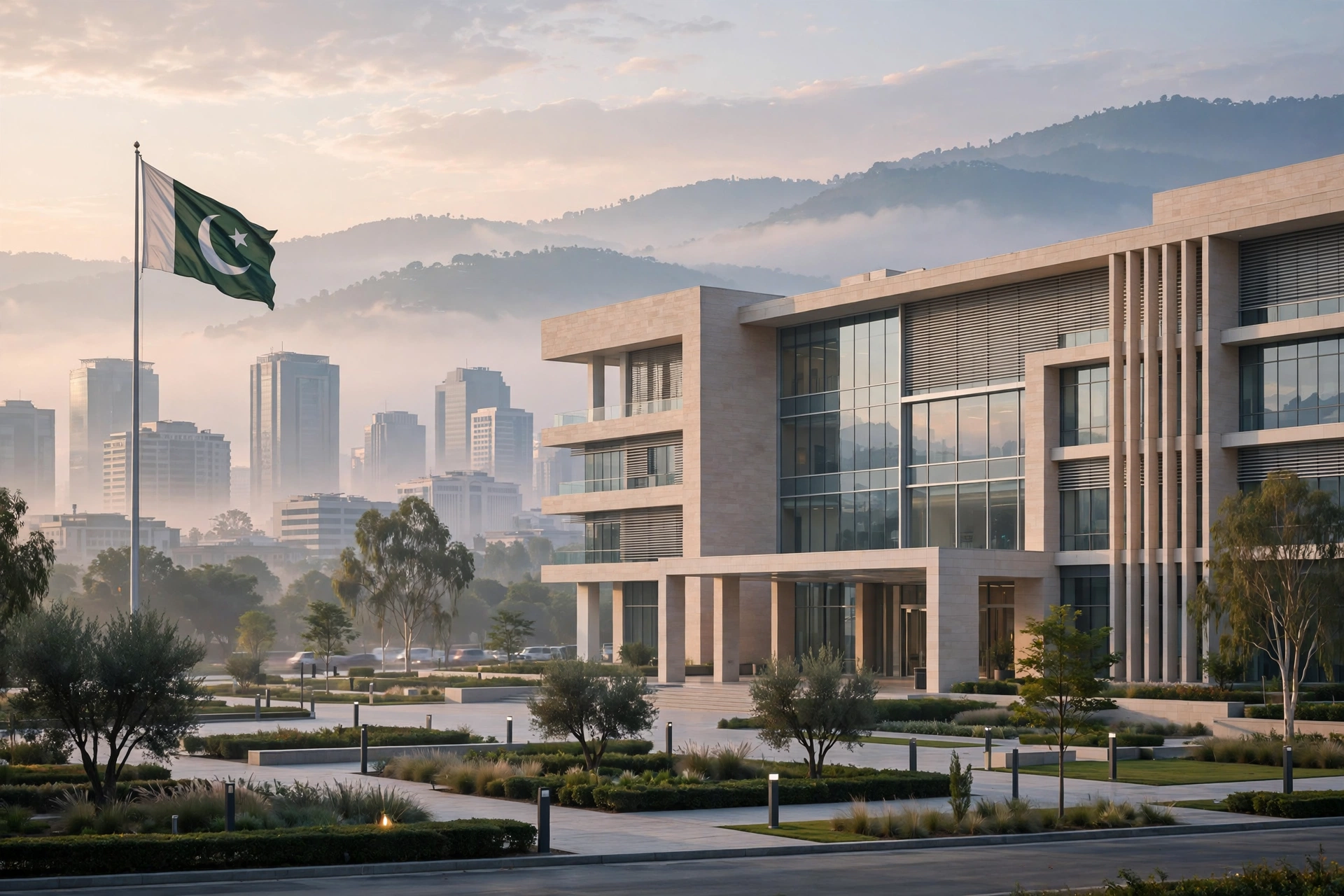
Federal Minister for Planning, Development and Special Initiatives Ahsan Iqbal has laid out the government’s long-term blueprint for Pakistan’s economy — and the numbers are ambitious. Under the flagship “URAAN Pakistan” plan, the country aims to grow its economy from around $375 billion today to $1 trillion by 2035, and onward to $3 trillion by 2047, when Pakistan celebrates 100 years of independence.
The plan is built around a homegrown model called the 5Es Framework. Here is what it contains, what it would take to get there, and the obstacles standing in the way.
Key Takeaways
- URAAN Pakistan aims to grow the economy from $375 billion to $1 trillion by 2035 and $3 trillion by 2047, guided by the 5Es framework.
- The plan centres on exports, with a goal of $100 billion in annual exports over the next decade.
- A 15-member National Task Force on AI is developing a separate 10-year roadmap for AI adoption across business, governance, education and healthcare.
The 5Es Framework: five pillars, one plan
At the heart of URAAN Pakistan are five strategic pillars the government says will drive the transformation:
- Exports — making export-led growth the centre of economic policy.
- E-Pakistan — digitising governance, expanding broadband, and nurturing the digital economy.
- Equity and Empowerment — investing in education, health, and skills, with a focus on underdeveloped regions.
- Environment and Climate Resilience — green infrastructure and clean energy for a climate-vulnerable country.
- Energy — reforming the energy sector for affordability, reliability, and diversification.
The framework is deliberately homegrown branding for an old diagnosis: Pakistan’s growth keeps crashing into balance-of-payments crises because it imports more than it earns. The minister himself has argued that debt-driven stabilisation offers false security and that expanding exports is the country’s only sustainable path forward.
The export mountain
Exports are the plan’s centrepiece, and also its steepest climb. The government has set a target of $100 billion in annual exports over the next decade — roughly triple today’s levels.
The strategy calls for diversifying beyond traditional textiles into IT, pharmaceuticals, food processing, creative industries, and the blue economy, while deepening integration with global markets through regional connectivity and Special Economic Zones under CPEC.
There are early bright spots. Pakistan’s IT and ICT exports hit a record $4.6 billion in the last fiscal year, and the government wants to shift from exporting basic IT services to developing proprietary tech products and tech-driven manufacturing. Female mobile internet usage has risen from 33 to 45 per cent, and the digital gender gap has narrowed sharply — gains the government credits to its inclusive tech policies.
But the scale of the challenge is sobering. The minister has noted that Pakistan earns only about $3 billion from the Chinese market, whose imports run to $2.5 trillion — a failure he attributes partly to weak corporate governance among Pakistani exporters. And he has openly admitted that Pakistan “failed to achieve export-led growth in the last 75 years” while successful economies built their prosperity on exports. Tripling exports in a decade means succeeding at something the country has never done.
A 10-year AI roadmap alongside it
Running parallel to URAAN Pakistan is a second long-horizon initiative: a 15-member National Task Force on Artificial Intelligence, formed to develop a 10-year roadmap for accelerated AI adoption across business, development, governance, education, and healthcare.
The task force reflects the government’s bet that the digital economy is not just a sector but “the engine of comprehensive economic transformation.” Pakistan’s digital user base has surged past 150 million, data consumption has jumped 25 per cent in two years, and fibre-optic connections are being scaled from 3 million toward 5 million, with a target of high-speed broadband for 10 million households.
Education emergency and climate reality
The plan’s people-centred elements confront some of Pakistan’s hardest statistics:
- 23 million-plus out-of-school children prompted the declaration of a national education emergency. As the minister put it, no country can compete in the 21st century with that many children left uneducated.
- Climate vulnerability is treated as a core economic risk, not an afterthought. With increasingly severe and unseasonal rainfall events, the government has sought ADB support for localised water management infrastructure and green development.
The honest obstacles
Every long-term plan in Pakistan faces the same two questions: will the money show up, and will the politics hold? On both, the record is cautionary.
Development spending has collapsed. The Annual Plan Coordination Committee was told that the Public Sector Development Programme (PSDP) fell from 19.6 per cent of the national budget (2.5 per cent of GDP) in 2017-18 to just 4.0 per cent of the budget (0.6 per cent of GDP) in 2025-26. The 2025-26 PSDP was fixed at Rs 1,000 billion against total demand of Rs 3,200 billion, then cut further to Rs 837 billion. A plan that promises transformation while development spending sits at historic lows needs either a financing miracle or a major fiscal pivot.
Continuity is the perennial risk. The minister has repeatedly argued that political instability is what stopped Pakistan from achieving the development targets its neighbours reached through stable 10-year policy runs. Plans in Pakistan have a habit of being renamed, shelved, or reversed with each government. URAAN Pakistan’s 2035 and 2047 targets deliberately outlive any single government — which is either its genius or its fatal flaw.
The bottom line
URAAN Pakistan is the most fully articulated long-term economic vision the government has produced in years: clear targets ($1 trillion by 2035, $3 trillion by 2047), a named framework (the 5Es), and parallel tracks for AI, digital exports, education, and climate resilience. The logic — exports first, everything else in support — is the right diagnosis.
But a plan is not a result. Tripling exports, rescuing development spending from historic lows, and holding policy steady across multiple governments are challenges that have defeated every previous blueprint, from Vision 2010 to Vision 2025. URAAN Pakistan will be judged the same way they were: not on the ambition of its targets, but on whether the export numbers move.


