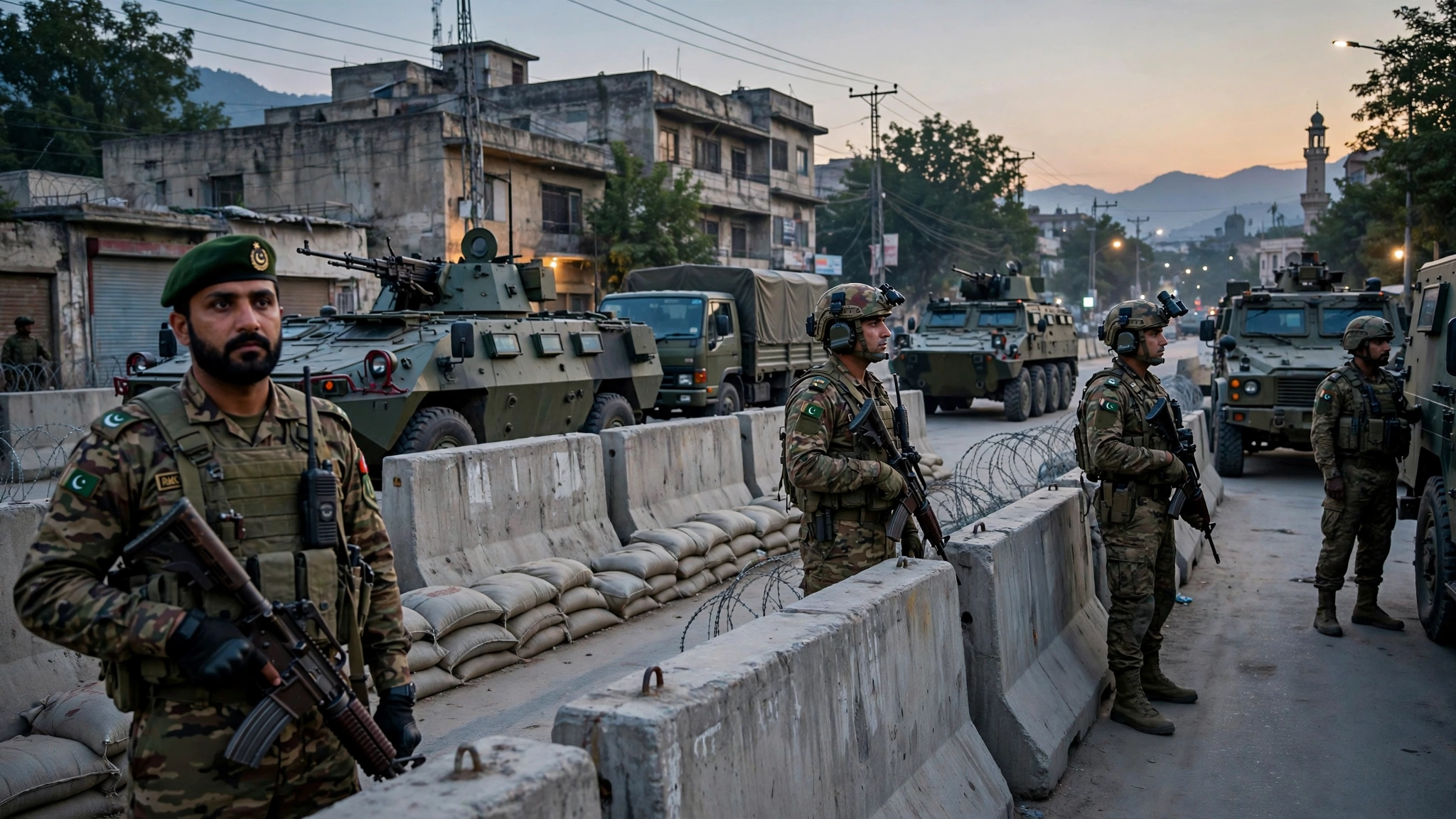
Pakistan’s federal government has imposed emergency and governor’s rule in Khyber Pakhtunkhwa and authorised the Pakistan Army to deploy in aid of civil power — its most sweeping provincial intervention in years.
On Sunday, 11 October 2026, President Asif Ali Zardari approved the federal cabinet’s recommendation on Prime Minister Shehbaz Sharif’s advice. Within hours, the PTI-led provincial administration ceased to exist, Governor Faisal Karim Kundi took charge, and troops began securing lives, property and government installations across the province.
Key Takeaways
- Emergency (Article 232) and governor’s rule (Article 234) were imposed in KP on 11 October 2026, suspending the PTI-led provincial government.
- The Pakistan Army has been deployed under Article 245 in aid of civil power to protect lives, property and government installations during the emergency.
- An 11-member advisory council now assists Governor Faisal Karim Kundi in running the province; PTI plans to challenge the move in courts and assemblies.
What exactly happened
- Federal cabinet meeting: PM Shehbaz Sharif chaired an emergency session recommending Articles 232 and 234 of the Constitution for KP.
- Presidential approval: President Zardari signed the proclamation, bringing both into force immediately.
- Provincial government dissolved: Under the Gazette notification, CM Sohail Afridi, his ministers, advisers, special assistants and the advocate general immediately ceased to hold office. The KP Assembly’s powers will now be exercised by or under Parliament’s authority.
- Army authorised: The Interior Ministry issued a Statutory Regulatory Order under Article 245, authorising Army troops and assets to assist civil authorities for the duration of the proclamation.
Why the Army was called in
The federal government’s stated reasons centre on security and counterterrorism: the cabinet cited the provincial government’s “deliberate disengagement from the fight against terrorism” and a worsening law-and-order situation. The Prime Minister added that Islamabad could not allow the provincial leadership to derail economic stability or undermine security operations — a signal that KP is being treated as both a security and an economic threat.
The deployment itself is limited. Under the Interior Ministry’s notification:
- The Army assists civil authorities in protecting human life, citizens’ property and government installations.
- The deployment lasts for the duration of the proclamation issued on 11 October 2026.
- The Governor, in consultation with GHQ’s Military Operations Directorate, will set troop numbers and assets.
- The role is explicitly “in aid of civil power” — supporting, not replacing, the civil administration.
Who runs KP now
With the provincial government suspended, a federal-oversight structure has taken its place:
- Governor Faisal Karim Kundi now exercises the provincial government’s functions on behalf of the federation. At the first meeting of the new arrangement on Sunday, he said restoring peace, public security and the writ of the state would be his top priorities.
- An 11-member technocratic KP Advisory Council assists the governor, covering home and tribal affairs, finance, information, law, health, education, energy, local government and works, industries, and mines and minerals.
- Dr Muhammad Fakhr Alam Irfan has been appointed chief secretary, while senior administrative officer Muhammad Yahya Akhunzada has been transferred into the provincial administration.
The situation on the ground in Peshawar
The announcement was accompanied by a visible tightening of security. Shipping containers were placed on roads in Peshawar, large police contingents were deployed around sensitive installations, and access to parts of the provincial capital was restricted.
Targeted mobile and internet disruptions were also reported in parts of the province — a familiar pattern during major security operations or crackdowns, affecting everyday communication for millions.
How this happened: the build-up
The move did not come entirely out of the blue. On 29 September 2026, Law Minister Azam Nazeer Tarar publicly signalled the centre could act if constitutional circumstances existed for governor’s rule or an emergency, as reported by The Express Tribune. Political tension between Islamabad and the PTI-led provincial government had been running high for months, especially over security policy; negotiations collapsed earlier in October, and PTI supporters continued street protests demanding the release of former prime minister Imran Khan, in prison since August 2023.
KP borders Afghanistan and has been the frontline of Pakistan’s fight against militancy for two decades. That geography is a large part of why this intervention was deemed possible — and why it carries such weight.
The political fallout
PTI chairman Barrister Gohar Khan and the party’s parliamentary committee rejected the move as an unconstitutional assault on provincial autonomy and the public mandate, announcing challenges in courts, assemblies and public forums.
PTI leaders also alleged that Chief Minister Sohail Afridi and MNA Junaid Akbar had been detained or abducted. Minister of State for Interior Tallal Chaudhry confirmed detentions linked to law and order, but not who was detained.
The opposition alliance Tehreek-e-Tahafuz-e-Ayin-e-Pakistan (TTAP) also condemned the move — questioning why similar measures had not been taken in Balochistan despite its severe security challenges. The Human Rights Commission of Pakistan warned the emergency risks deepening political tensions and undermining democratic processes, urging both sides to resume dialogue and ensure citizens’ fundamental rights are not suspended under any pretext.
What this means for ordinary Pakistanis
- For KP residents: Road closures, heavy security deployments and intermittent mobile and internet disruptions are already affecting daily life. Expect an increased military presence in cities and around key installations for as long as the emergency lasts.
- For the province’s politics: KP was the one province where PTI still held full governmental power. Its suspension reshapes Pakistan’s political map, concentrating authority in Islamabad and the governor’s office.
- For national security policy: The government frames this as a counterterrorism measure first. The coming weeks will be judged by whether security operations actually improve — and by how residents experience the military presence.
- For the courts: PTI’s promised legal challenge means the emergency is likely headed for judicial scrutiny, and any court intervention could reshape how long the arrangement lasts.
What to watch next
- PTI’s legal challenge: Whether courts admit petitions against the emergency and how quickly they move.
- Troop levels and duration: Finalised by the governor with GHQ; how long the proclamation lasts and whether it is extended.
- Security outcomes: Whether the promised counterterrorism coordination materialises on the ground.
Conclusion
The emergency and governor’s rule in KP, coupled with the Army’s deployment under Article 245, mark a decisive — and deeply contested — turn in Pakistan’s political and security landscape. The federal government says the province’s security situation left it no choice; the opposition calls it an assault on the people’s mandate.
What is certain is that KP now sits at the intersection of Pakistan’s biggest questions: how the state fights terrorism, how the federation treats a province governed by the opposition, and where the line between security necessity and democratic process lies.