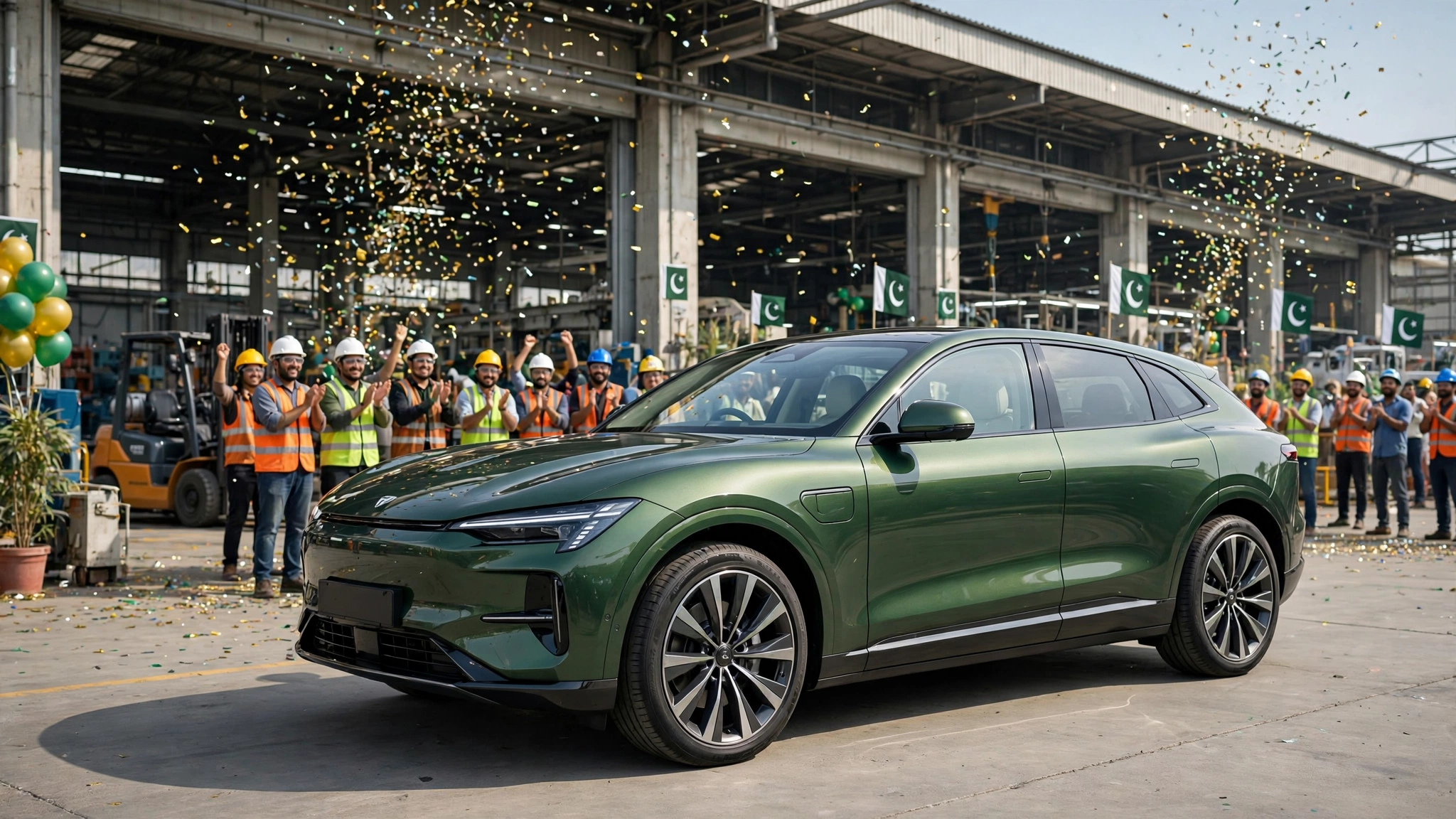
For decades, Pakistan’s carmakers have built vehicles for one market: Pakistan. That era may be ending. Under the proposed Automotive and Auto Parts Manufacturing Policy 2026–31, the government wants to set legally enforceable export targets for car manufacturers — and penalise companies that fail to meet them.
Key Takeaways
- Carmakers would face legally enforceable export targets, rising to 12% of factory-gate production value by 2029-30.
- Missing the targets could trigger higher tariffs or cancellation of manufacturing licences.
- The draft is not final yet — it still needs IMF review, ECC and cabinet approval.
The headline proposal: mandatory exports
The biggest change under discussion comes from an inter-ministerial committee headed by Federal Minister for Power Sardar Awais Ahmad Khan Leghari, which has proposed seven broad principles to guide the auto sector over the next five years.
At the centre is a simple idea: export performance should come with targets and teeth. Under the proposal, car, jeep and SUV manufacturers would gradually raise exports from zero in 2026–27 to 12% of their factory-gate production value by 2029–30 — with the 12% target continuing into 2030–31.
The dollar figures show how ambitious the plan is. Carmakers could face export targets of roughly $160.89 million in 2027–28, climbing to $347 million in 2028–29, jumping to about $558.2 million in 2029–30 and reaching approximately $596.1 million in 2030–31.
Not just cars
The proposal extends well beyond passenger vehicles. Tractor manufacturers could see their export requirement rise from 5% in 2026–27 to 15% by 2030–31. Motorcycles and rickshaws — segments where Pakistan already has manufacturing scale — could move from zero to a 15% export target over the policy period.
Auto parts manufacturers are also in the frame, with earlier drafts suggesting export targets rising from 5% to 15%. The overall ambition, as reported, is a cumulative $4.586 billion in vehicle and auto-parts exports over five years.
What happens to companies that miss the targets?
This is where the policy gets serious. The framework would link export performance with legally enforceable obligations — meaning companies that fall short could face penalties.
According to the Pakistan Automotive Manufacturers Association (PAMA), the draft may set steep export targets with penalties including higher tariffs or even cancellation of manufacturing licences for companies that miss them. That is PAMA’s account of reports it has heard; the draft itself is not yet public.
The logic from the government’s side is straightforward: manufacturers that have enjoyed decades of tariff protection should now earn their place by competing abroad. PM’s Adviser on Industries Haroon Akhtar Khan has said the industry had not met earlier export targets, signalling frustration in Islamabad.
The bigger bargain: tariffs down, localisation up
The export targets are one half of a larger bargain. The other half is a dramatic opening of the market:
- Tariff cuts: Customs duties on conventional vehicles could fall by up to 80% over five years, with the weighted-average auto tariff dropping from around 10.6% toward about 6% by 2030–31 under a simplified four-slab structure (0, 5, 10 and 15%).
- Localisation: Automakers would be required to raise local content from 10% to 40% over five years, pushing deeper local production of engines, transmissions, sensors and battery systems.
- EV push: Proposed incentives include exemptions from federal excise duty, capital value tax and withholding tax for electric vehicles, a 1% customs duty on charging-station equipment, and EV financing extended to five years with a limit of Rs10 million.
- Consumer protection: Manufacturers would be responsible for price increases after a vehicle has been booked, with clear delivery dates required at the time of booking.
Industry pushback
The plan has not landed quietly. Parts manufacturers, represented by the Pakistan Association of Automotive Parts and Accessories Manufacturers (PAAPAM), warn that tariff changes — particularly around new energy vehicles — could make imported components cheaper than parts already produced in Pakistan, weakening the local vendor base the policy is meant to build.
Industry leaders also stress that hitting ambitious export targets will require sustained government support: lower production costs (especially electricity and financing), stronger trade access, and policies that protect rather than undermine local suppliers. High electricity, financing and taxation costs make Pakistani manufacturers less competitive than regional rivals, while limited trade agreements restrict access to overseas markets.
PAMA has asked to see the draft policy before it reaches the Prime Minister, and reports say the IMF has sought more data on it.
How close is this to becoming law?
Not close enough to change any prices yet. Prime Minister Shehbaz Sharif gave the draft in-principle approval in September, but by the government’s own account the policy must still go to the IMF in October, then the Economic Coordination Committee and the federal cabinet, before tariff changes become binding. The Senate Standing Committee on Industries and Production was recently informed that cabinet approval was expected within two weeks.
Haroon Akhtar Khan has also cautioned that several drafts circulating in the market are not final, and that the final version was prepared after considering the interests of consumers, manufacturers and exporters.
What it means for car buyers in Pakistan
If the policy survives in anything like its current form, buyers could see cheaper cars as tariffs fall over five years, more EV options with easier financing, and stronger protection against the price hikes and delivery delays that have plagued the market. The trade-off the government is making is clear: less protection for the industry, more competition, and manufacturers that must earn their profits by selling to the world — not just to Pakistani showrooms.
Conclusion
Pakistan’s proposed auto policy is the most ambitious attempt yet to turn a protected assembly industry into a genuine exporter. The export targets are aggressive, the penalties are real, and the industry is nervous. But nothing is final — the IMF, the ECC and the cabinet all still have to sign off. Until then, the penalties remain a proposal, not a law.