Islamabad commuters have a new date to circle. Prime Minister Shehbaz Sharif laid the foundation stone of the Kashmir Chowk Underpass on October 7, 2026, and the Capital Development Authority (CDA) says the Rs 1.4 billion project will be completed within one month — putting the expected opening around the first week of November 2026.
It is an unusually aggressive timeline for an underpass at one of the capital’s busiest junctions. Whether CDA hits it will be one of the most watched infrastructure tests of the year.
Key Takeaways
- PM Shehbaz Sharif laid the foundation stone of the Kashmir Chowk Underpass on October 7, 2026, with a one-month completion target.
- The project costs Rs 1.4 billion after cost optimisation, and the junction currently handles about 107,000 vehicles daily.
- Once open, Serena-side traffic to Rawalpindi will use the underpass while Murree-bound traffic moves over the structure.
The Announcement
The groundbreaking ceremony was attended by Interior Minister Mohsin Raza Naqvi, Information Minister Atta Tarar, and other senior officials. CDA Chairman Sohail Ashraf briefed the Prime Minister on the project, informing him that it had been finalised at Rs 1.4 billion — reduced from an initial estimate of Rs 1.6 billion through cost optimisation.
The Prime Minister appreciated the interior minister and his team for launching the project, noting that road schemes reduce travel time for the general public, including students.
Why This Junction Needs an Underpass
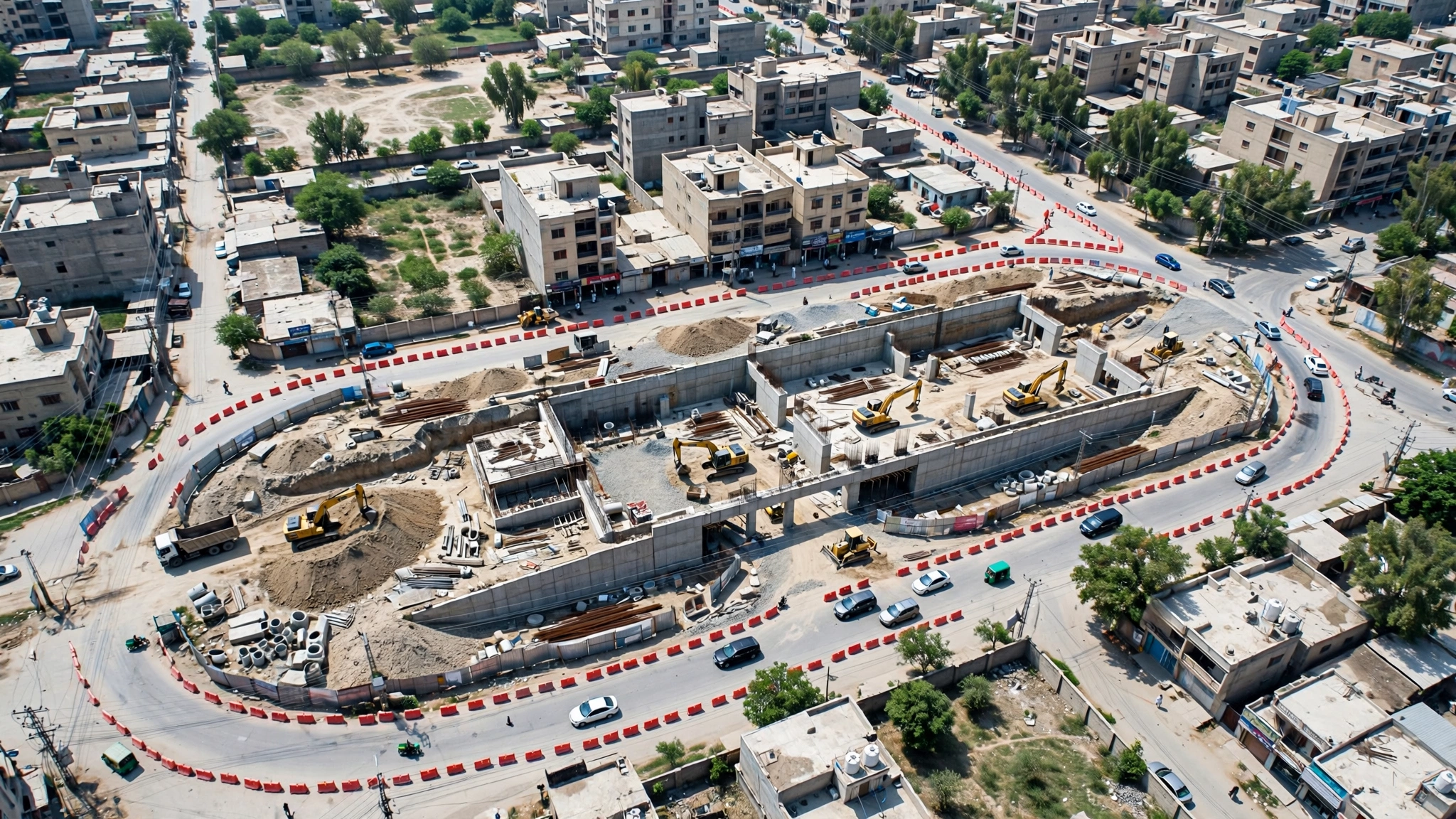
Kashmir Chowk — also known as Dhokri Chowk — sits on Murree Road near Islamabad Club, connecting traffic from the Serena side, Murree Road and the Rawalpindi direction. CDA says the junction currently handles approximately 107,000 vehicles, producing frequent congestion, delays and traffic conflicts, particularly during VIP movements and peak hours.
The traffic plan is simple in concept:
- Serena side → Rawalpindi: vehicles will use the underpass
- → Murree: traffic will continue at surface level over the structure
Separating the two movements removes the signal-controlled conflict that causes today’s jams.
The Numbers
| Detail | Figure |
|---|---|
| Final cost | Rs 1.4 billion |
| Original estimate | Rs 1.6 billion |
| Contractor’s bid | Rs 1.45 billion (Habib Construction Services) |
| Tender estimate | Rs 1.486 billion |
| Contractual completion period | 90 days |
| CDA fast-track target | ~1 month |
| Daily vehicles at junction | ~107,000 |
| Foundation stone | October 7, 2026 |
Can It Really Be Done in a Month?
The honest answer: it is a target, not a guarantee. Procurement documents specify a 90-day contractual completion period, though CDA officials have said they are aiming to finish far sooner on a fast-track basis.
There is some precedent for speed. The same contractor, Habib Construction Services, previously delivered CDA projects on accelerated schedules — including the Serena Interchange, Murree Road Underpass, T-Chowk Flyover and Shaheen Chowk Underpass. The Shaheen Chowk project, originally given 150 days, was finished in roughly two months.
The design was prepared by NESPAK’s Lahore team, and officials say they want to avoid design changes that could push costs up. Preparatory work — including a diversion road and utility shifting — was already underway before the foundation ceremony.
What the Project Includes
Beyond the underpass barrel itself, the scheme includes four new slip roads and about five acres of additional land acquisition to handle traffic distribution around the intersection. The slip roads are meant to smooth the merges and exits at the junction’s four arms, so vehicles joining or leaving Murree Road do not recreate the bottlenecks the underpass is supposed to eliminate.
The design also had to reckon with the junction’s sensitive surroundings. Kashmir Chowk sits close to Islamabad Club and the Serena side corridor, where VIP movements regularly disrupt normal traffic. That is one reason the junction suffers disproportionately at peak hours — and one reason CDA chose a grade-separated solution rather than another signal retiming exercise.
A Record of Fast Builds — and Recent Openings
The fast-track promise does not come out of nowhere. The Shaheen Chowk Underpass on Khyaban-i-Iqbal, completed in roughly two months against a 150-day original deadline, opened to traffic and now allows nonstop movement on Margalla Road. The Park Road (Margalla Enclave) Underpass — part of a Rs 10 billion Zone-IV infrastructure package — opened to traffic in September 2026 after months of delays that frustrated commuters with 20 to 30-minute peak-hour waits.
Those two projects are instructive in opposite ways. Shaheen Chowk shows CDA can deliver on an accelerated schedule; Park Road shows what happens to commuters when it cannot. Kashmir Chowk, with its 107,000 daily vehicles, will be the harder test of the two precedents.
What Commuters Should Expect
Construction at a live junction means short-term pain for long-term gain. Drivers should expect congestion, temporary route changes and possible lane restrictions around Kashmir Chowk while work proceeds. CDA has not yet published a detailed diversion map, so commuters are advised to follow official CDA notices and Islamabad Traffic Police advisories rather than unverified social media route claims.
Part of a Bigger Push
The underpass is one piece of a wider infrastructure programme. Interior Minister Naqvi said Islamabad is being developed on modern lines ahead of next year’s Shanghai Cooperation Organisation (SCO) conference. According to CDA’s development briefing, the capital completed 18 development projects during 2025 at a combined cost of around Rs 15 billion.
Several other schemes remain in progress, including the Margalla Avenue extension, the Islamabad Expressway Service Road project and the upgrading of Atatürk Avenue.
The Bottom Line
A one-month underpass build would be remarkable by Pakistani construction standards. The foundation stone is laid, the contractor is mobilised, and the political will is on display. The target opening — around early November 2026 — now stands as CDA’s commitment to test. Commuters will know soon enough whether the fast-track promise holds.