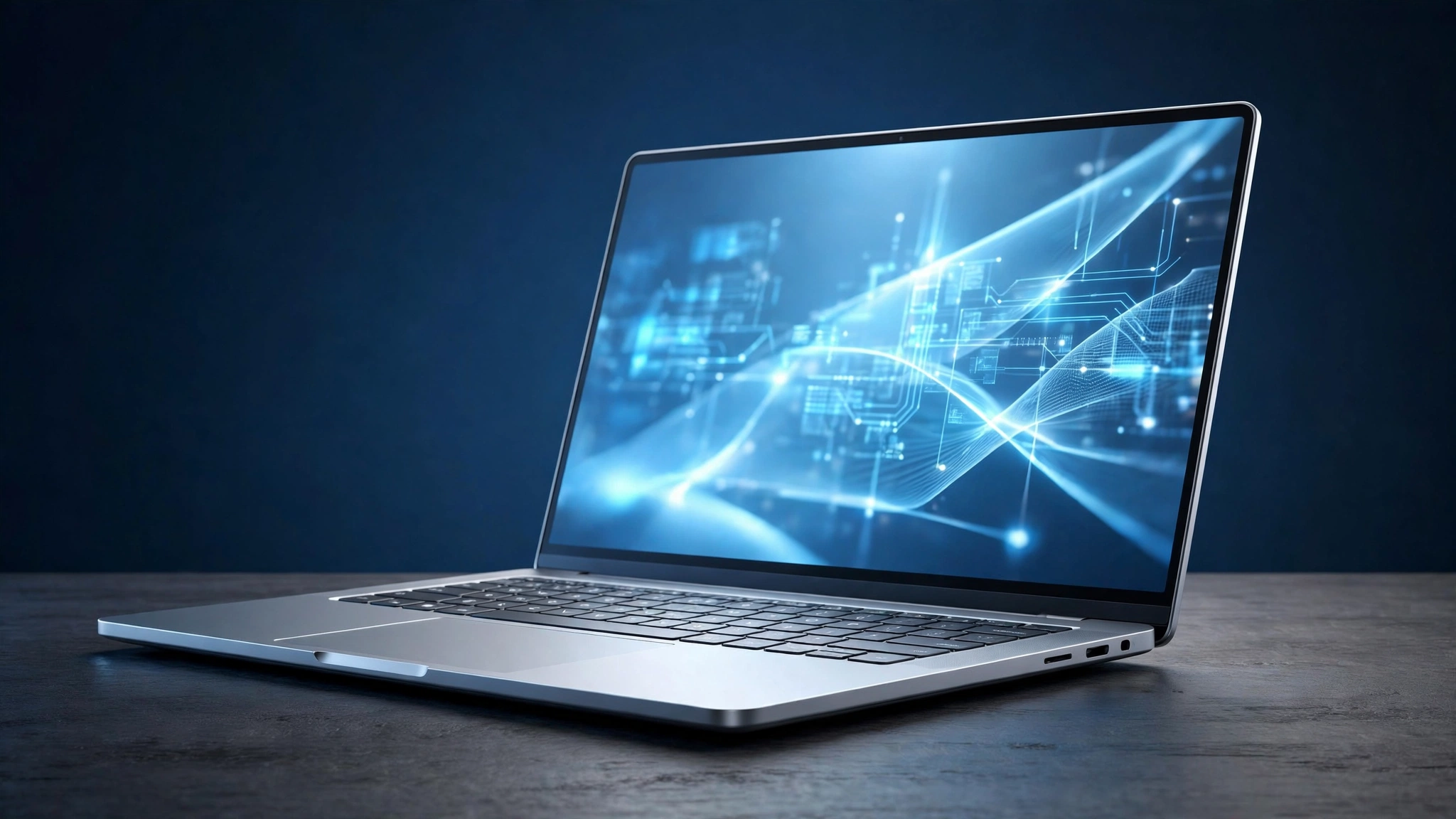
Microsoft has fired its biggest shot yet in the AI PC wars. At a Windows and Surface keynote in San Francisco on October 7, 2026, the company announced the Surface Laptop Ultra — the first laptop ever to ship with NVIDIA’s RTX Spark chip, and what Microsoft calls its most powerful notebook to date.
With preorders open and shipping set for October 16, the 15-inch flagship starts at $2,599, positioning it squarely against Apple’s 16-inch MacBook Pro — and undercutting it by $400.
Key Takeaways
- Microsoft announced the Surface Laptop Ultra on October 7, 2026 — its first laptop with NVIDIA’s Arm-based RTX Spark chip, starting at $2,599.
- With up to 20 CPU cores, 6,144 GPU cores and 128GB of unified memory, it is built to run large AI models locally.
- Preorders are open now; the laptop ships October 16, alongside a $5,999 Surface RTX Spark Dev Box mini PC.
The RTX Spark Chip: NVIDIA Enters the Laptop CPU Game
The headline story is the silicon. The Surface Laptop Ultra runs on NVIDIA’s RTX Spark N1X superchip — an Arm-based design that marks NVIDIA’s entry into Windows laptop processors, after its GB10 chip spent a year inside NVIDIA’s DGX Spark mini-PCs.
The chip combines:
- An NVIDIA Grace CPU with up to 20 Arm-based cores
- A Blackwell RTX GPU with up to 6,144 cores
- Up to 128GB of unified memory, shared in one LPDDR5X pool between CPU and GPU
- Up to 1 petaflop of AI performance
The unified memory architecture is the key to the whole pitch. A conventional laptop GPU tops out at around 24GB of VRAM, which limits the size of AI models that can run locally. With up to 128GB shared across CPU and GPU, the Surface Laptop Ultra can load and run models that would simply not fit on a normal notebook — Microsoft demoed models as large as 60GB running locally during its presentation, and the chip supports AI models up to 120 billion parameters.
One note of caution for the spec-sheet readers: some technical analysts point out that the headline petaflop figure relies on FP4 precision with 2:4 sparsity, which almost no real-world inference workload uses — with a fairer figure closer to 500 teraflops. Even so, that is an enormous amount of AI compute for a laptop.
Built for Creators, Developers and AI
Microsoft says the Surface Laptop Ultra is designed for “demanding creative, software development, AI, engineering, and 3D workloads.” That target audience explains the memory story: developers working with local AI models, coding agents and large datasets are precisely the users who need tens of gigabytes of unified memory — the same audience Apple has been courting with high-memory MacBook Pro configurations.
For comparison, the fully loaded Surface Laptop Ultra with 128GB of memory costs $5,899 — roughly $800 less than a 14-inch MacBook Pro configured with the same memory.
The base $2,599 model ships with 24GB of unified memory and 512GB of storage, running Windows 11 Home. Storage ranges up to 2TB, and — in a welcome nod to repairability — the storage is upgradeable.
Display and Design: Taking on the MacBook Pro
Microsoft is not subtle about the comparison it wants you to make. The company claims the Surface Laptop Ultra has the “brightest, sharpest, and most vivid display” it has ever used in a Surface device, with peak HDR brightness 25% higher than the M5 MacBook Pro’s.
The 15-inch mini-LED touchscreen offers:
- Resolution: 3270 × 2180 (3:2 aspect ratio)
- Refresh rate: up to 120Hz
- Peak HDR brightness: 2,000 nits
- Colour: 100% DCI-P3 with Dolby Vision IQ
The touchscreen supports gestures and navigation, though not pen input. The laptop weighs 4.41 lb (2.0 kg) — lighter than the 16-inch MacBook Pro — and measures just under 18mm thick. It features a large haptic trackpad and, in a first for any laptop, built-in magnetic USB-C charging that Microsoft calls Magnetic Connect — essentially its own answer to Apple’s MagSafe.
Port selection is generous by modern flagship standards: three USB-C ports, a USB-A port, an HDMI port, a full-size SD card reader and a 3.5mm headphone jack.
Windows on Arm — and Gaming Too
Because RTX Spark is Arm-based, the laptop runs Windows on Arm, with x86 applications handled through Microsoft’s Prism emulation layer. That is a familiar trade-off from the Snapdragon Copilot+ era: excellent efficiency, with emulation overhead for older apps.
Microsoft is also pitching the device to gamers. The company says graphics performance is on par with a GeForce RTX 5070, and it demoed Gears of War: E-Day running on the laptop during the keynote. Call of Duty: Modern Warfare 4 is confirmed for later this year with support for ray tracing, DLSS Super Resolution, DLSS Frame Generation and NVIDIA Reflex. Notably, the chip is designed to draw no more than 80W — impressive for this class of hardware.
The Dev Box Sibling
Alongside the laptop, Microsoft announced the Surface RTX Spark Dev Box — a compact desktop mini PC aimed at AI developers, priced at $5,999. It puts the same RTX Spark platform on a desk for local model development and AI agent experimentation, shipping in November 2026. It is Microsoft’s answer to devices like the Mac Studio and Mac mini.
Why It Matters for Pakistan
For Pakistani developers, researchers and software houses, the Surface Laptop Ultra’s significance is the local-AI story. Cloud GPU rentals are costly and connectivity can be a bottleneck; a machine that runs 60GB-class models on-device could be genuinely useful for AI startups and university labs. The caveat, as always, is pricing and availability — there is no word yet on when, or at what price, the device will reach Pakistan, and the $2,599 base price will climb steeply once import duties apply.
Still, the direction is unmistakable. Between Asus’ ProArt RTX Spark laptops and now Microsoft’s own flagship, the era of the AI workstation laptop has arrived — and the cloud is no longer the only place serious AI happens.