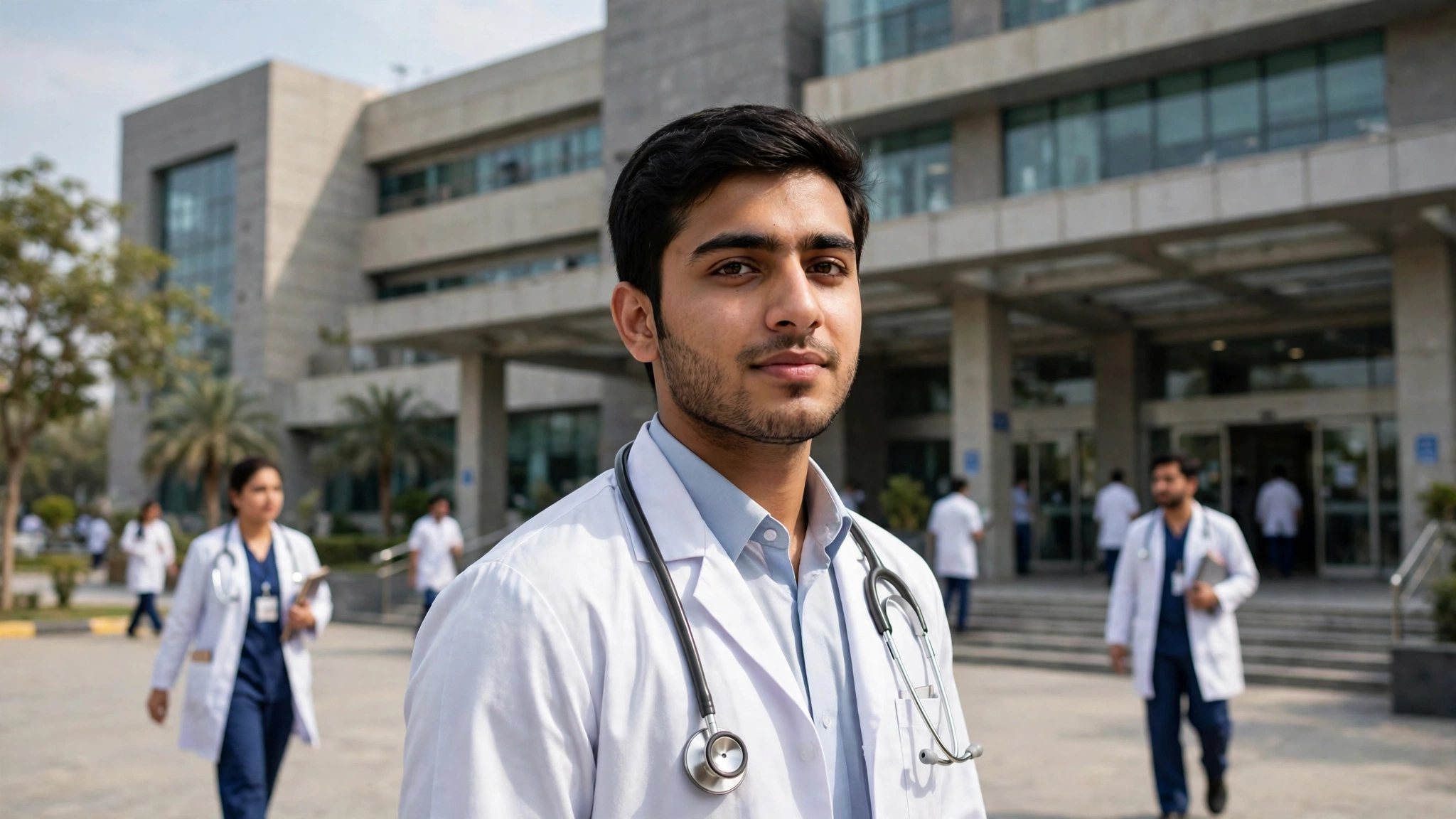
The Punjab government has moved to reform how foreign medical graduates (FMGs) get house jobs and postgraduate training in the province’s public hospitals. A nine-member committee of top medical educators has been asked to propose a centralised, merit-based induction system — and it has just 10 days to deliver its recommendations.
If you are a Pakistani who studied medicine abroad and are waiting for a house job in Punjab, this development directly affects your future. Here is what has actually happened, what it could change, and what to watch out for.
Key Takeaways
- Punjab’s health department has set up a nine-member committee to propose a centralised, merit-based house job and training system for foreign medical graduates.
- The committee, made up of vice-chancellors and college principals, has been given 10 days to submit its recommendations.
- No new policy has been introduced yet — the review will examine eligibility, degree verification and gaps in the current induction process before any change is announced.
What Punjab Has Actually Decided
On October 8, 2026, the Specialized Healthcare and Medical Education Department issued a notification constituting a nine-member committee, following decisions taken at a meeting of the Postgraduate Admission Committee (PGAC).
To be clear about what this means: Punjab has not introduced a new house job policy yet. It has launched a formal review process that could lead to one. The Lahore Tribune, which reported the notification in detail, notes that the move “does not immediately introduce a new centralized induction policy” — it sets up the machinery to design one.
The committee’s core mandate is to examine the existing induction procedures for FMGs seeking house jobs and postgraduate training in hospitals run by the provincial health department, and to consider whether a uniform, transparent, merit-based system should replace them.
Who Is on the Committee
The panel draws on the senior leadership of Punjab’s medical education system. Its members include the vice-chancellors of:
- University of Health Sciences (UHS), Lahore
- King Edward Medical University (KEMU), Lahore
- University of Child Health Sciences, Lahore
- Fatima Jinnah Medical University (FJMU), Lahore
- Faisalabad Medical University, Faisalabad
- Rawalpindi Medical University, Rawalpindi
- Nishtar Medical University, Multan
Alongside them sit the principals of Allama Iqbal Medical College, Lahore, and Quaid-e-Azam Medical College, Bahawalpur.
The composition matters. These are the people who run the universities and colleges that actually host house officers, so any system they propose will be built with the institutions that must implement it — rather than imposed on them from above.
What the Committee Is Supposed to Examine
Under its terms of reference, the committee will review several areas that have long been pain points for foreign graduates:
- Eligibility and legal requirements — including the rules prescribed by the Pakistan Medical and Dental Council (PM&DC) for FMGs.
- Verification of credentials — how degrees, professional registration, licences and eligibility are checked, and where the current process has gaps.
- Merit, transparency and uniformity — whether selection into house jobs is fair and consistent across different hospitals.
- A possible centralised system — covering application submission, document scrutiny, merit determination and placement in eligible healthcare institutions.
The panel has also been told to identify administrative, regulatory and procedural gaps in how FMGs are currently inducted — an acknowledgement that the existing process has not been working smoothly.
Why This Is Happening Now: The Background FMGs Already Know
Foreign medical graduates in Pakistan have had a difficult couple of years, and Punjab’s move lands against that backdrop.
In December 2025, the PM&DC issued a public notice making provisional registration mandatory for all foreign medical and dental students and graduates before they could start a house job, internship, clinical training or observership anywhere in Pakistan. Hospitals were directed to verify provisional registration and discontinue any training by non-compliant graduates — with regulatory action threatened against institutions and individuals who did not comply.
Separately, PMDC policy changes around which foreign universities are recognised left many returning graduates in limbo, with registration portals reportedly blocked mid-process for graduates of institutions in countries such as China, Russia, Kyrgyzstan, Kazakhstan and Azerbaijan — countries where thousands of Pakistani students study medicine. Many graduates lost house-job slots while their applications were stuck.
On top of that, FMGs must clear the National Registration Examination (NRE) before full registration, adding another hurdle between graduation and a house job.
Against this history, a centralised merit-based system in Punjab could — if designed well — replace the current patchwork of hospital-by-hospital induction with a single, predictable process: one application channel, one verification standard, one merit list.
What a Centralised System Could Fix
| Current problem | What the proposed system aims to do |
|---|---|
| Different hospitals follow different induction procedures | One uniform process across Punjab’s public hospitals |
| Unclear verification of foreign degrees and licences | Standardised document scrutiny and eligibility checks |
| Complaints about opaque or inconsistent selection | Merit-based selection with published criteria |
| Administrative and legal gaps nobody owns | Identified gaps addressed in the committee’s recommendations |
What FMGs Should Do Right Now
Since the policy itself does not exist yet, the practical advice is to prepare rather than wait:
- Secure PMDC provisional registration. It remains a hard requirement — no house job without it. Check the status of your application on the PMDC portal.
- Keep your documents ready. Degrees, transcripts, equivalence certificates, registration and licensing paperwork should be complete and verifiable, because verification is explicitly on the committee’s agenda.
- Track the NRE schedule. The National Registration Examination remains the gateway to full registration for FMGs.
- Watch for the committee’s recommendations. The 10-day deadline means proposals should land with the Punjab Health Department by around mid-October 2026 — but recommendations are not a policy. Any new induction system would still need formal approval and a rollout plan.
- Verify hospital approvals. Only train at hospitals approved by the PMDC for house jobs; PMDC publishes its lists of approved institutions.
The Honest Caveat
Headlines calling this a “new house job policy” run ahead of the facts. What Punjab has done is appoint a credible committee with a tight deadline and a clear question: should FMG induction be centralised and merit-based, and if so, how?
That is a meaningful step — but graduates should treat it as the start of a process, not the finish. The committee’s recommendations, the health department’s response, and the actual notification of any new system are all still to come. Until then, the existing rules — PMDC provisional registration, recognised universities, the NRE — remain fully in force.
For thousands of Pakistani doctors who trained abroad and want to serve at home, a fair, transparent, single-window house job system in Punjab would be genuinely good news. Whether this committee delivers it will become clear in the weeks ahead.