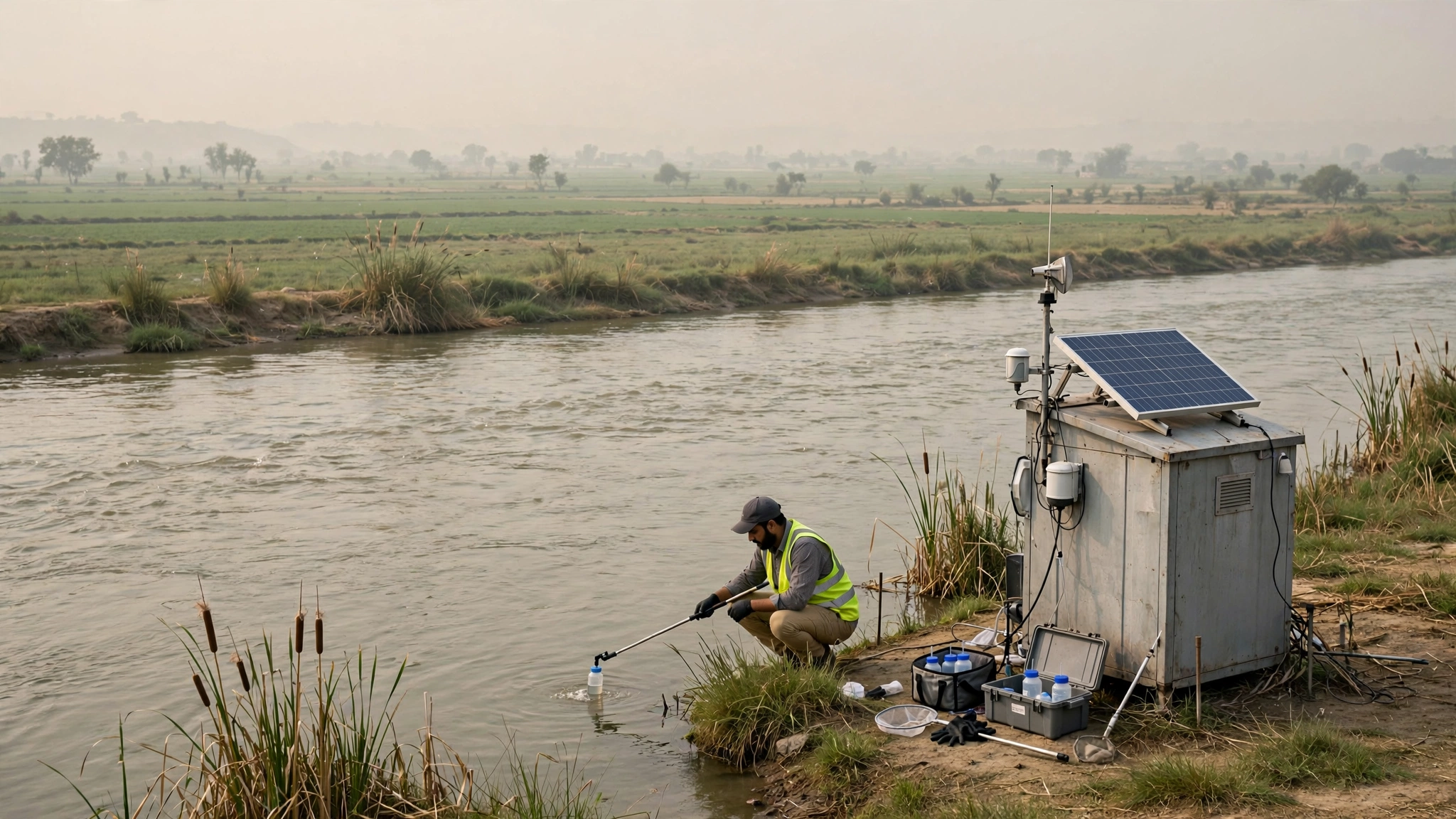
Punjab has established 15 modern water quality monitoring stations at strategic points across the province, giving the government its first real-time window into what is flowing through its rivers and drains. The stations form a key part of a Rs3 billion environmental monitoring programme run by the Punjab Environment Protection and Climate Change Department.
For a province whose rivers carry untreated industrial effluent, municipal sewage, and agricultural runoff, the move is a meaningful step from periodic manual sampling toward continuous, automated surveillance of water bodies.
Key Takeaways
- Punjab has set up 15 modern water quality monitoring stations at key locations, including river entry/exit points and major drains.
- The stations are part of a Rs3 billion environmental monitoring push by the Punjab Environment Protection and Climate Change Department.
- Real-time river and drain data could tighten enforcement against industrial pollution and improve public-health response.
What the New Stations Do
According to official announcements around the programme, the monitoring systems are being placed at key locations including the entry and exit points of rivers and major drains. The positioning is deliberate: by measuring water quality as it enters Punjab and again as it leaves, authorities can build a clearer picture of where pollution is being added — and by whom.
Continuous water quality monitoring typically tracks parameters such as dissolved oxygen, pH, turbidity, conductivity, temperature, and in more advanced setups, chemical oxygen demand and heavy metals. Real-time data lets the Environmental Protection Agency move faster than the old model of scheduled manual sampling, under which polluters could discharge at night or between inspections and escape detection.
Why Punjab Needed This
The urgency is not hard to see. Punjab’s rivers — the Ravi, Chenab, Jhelum, Sutlej, and Beas tributaries that feed its irrigation and drinking systems — have been under stress from rapid industrialisation and urban sprawl for decades. Lahore alone generates a huge volume of untreated wastewater that drains into the Ravi, and industrial clusters around Faisalabad, Sialkot, and Multan have long been flagged for effluent discharge.
What made the situation worse was the data vacuum. Before this programme, EPA Punjab operated only a handful of air quality monitoring stations and had no dedicated water quality monitoring network of its own. Without baseline data, it was difficult to prove pollution trends, target enforcement, or measure whether cleanup efforts were working.
The monitoring stations were originally envisaged under the Punjab Green Development Programme, a World Bank-assisted initiative designed to strengthen the Environment Protection Department’s institutional capacity. The idea of 15 water quality stations alongside 30 air quality stations dates back to planning documents from that programme — and the rollout marks its transition from blueprint to infrastructure.
Part of a Broader Rs15 Billion Environmental Push
The water monitoring network is not a standalone project. It sits inside a wider Rs15 billion environmental strategy announced by the provincial government, which includes:
- New divisional environmental offices in Lahore, Bahawalpur, DG Khan, Rawalpindi, and Sahiwal, equipped with laboratories and monitoring control centres
- A Plastic Management Cell to tackle plastic waste
- An expanded Environment Protection Force, with 250 new recruits selected from over 20,000 applicants
- A Strategic Communication Cell for public outreach on environmental issues
- Research investment through an Environmental Policy and Technology Centre
Four fuel testing laboratories have also been established to monitor petrol quality, and thousands of industrial units across the province have been directed to install emission control systems.
What It Means for Ordinary Citizens
Cleaner rivers, clearer accountability
For residents living near rivers and drains, the most tangible benefit should be accountability. When water quality data is collected continuously and tied to specific locations, it becomes far harder for polluting industries to operate unnoticed — and easier for the EPA to issue fines, seal units, or escalate cases.
Early warning for public health
Contaminated water is a direct public-health threat in Punjab, where much of the rural population relies on groundwater and surface water that is hydrologically connected to polluted rivers. Continuous monitoring creates the basis for early-warning systems — flagging sudden contamination events before they reach downstream users.
Better policy, not just punishment
Perhaps the biggest long-term gain is informational. Regular, reliable data on river health allows the government to design targeted interventions: where to build treatment plants, which drains need interception, and whether existing regulations are actually changing outcomes. Evidence-based policy replaces guesswork.
Challenges That Remain
Monitoring, on its own, does not clean a river. Pakistan’s environmental enforcement record is mixed — fines are issued, but repeat violations persist, and political pressure has historically protected well-connected polluters. The stations will only matter if the data they produce is published, acted on, and protected from interference.
Transparency will be the real test. If the live water quality readings are made public — the way air quality data has increasingly been shared in Lahore — journalists, researchers, and citizens can hold both polluters and regulators to account. If the data stays locked inside departmental dashboards, the investment risks becoming another monitoring system that watches without acting.
Maintenance is another concern. Automated monitoring stations need calibrated sensors, reliable power, and regular servicing. Sensor drift, vandalism, and funding gaps have degraded similar installations elsewhere; keeping 15 stations operational over years requires a dedicated maintenance budget, not just a one-time installation contract.
The Bigger Picture
Punjab’s move comes as water quality becomes a national concern. Groundwater levels in major cities continue to fall, glaciers feeding the river system are retreating, and climate-driven monsoon variability is making pollution pulses harder to predict. A province that finally knows what is in its water — in real time, at 15 strategic points — is better equipped for all of it.
The stations alone won’t deliver clean rivers. But for the first time, Punjab’s environmental regulators will be able to see the problem as it happens rather than discovering it after the damage is done. That visibility is the foundation everything else — enforcement, cleanup, and public trust — has to be built on.