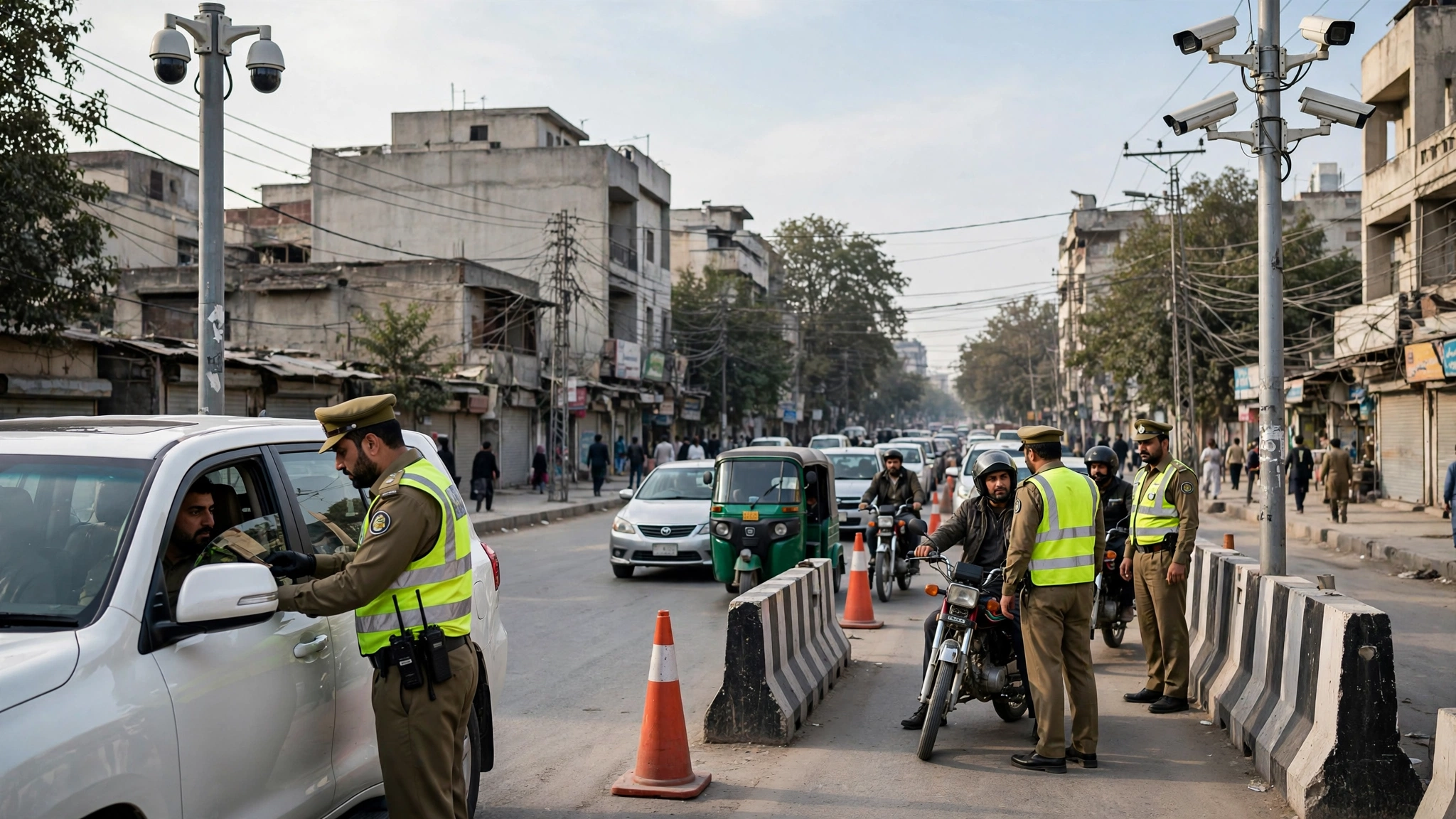
Punjab is taking its vehicle tax enforcement digital. Punjab Police, the Excise and Taxation Department, and the Punjab Safe Cities Authority (PSCA) have agreed to set up joint digital checkpoints that use camera surveillance to catch vehicles with unpaid token taxes, unregistered vehicles, and fake number plates.
Under the plan, the Safe Cities Authority will issue automated alerts when its camera network detects a vehicle with outstanding tax dues or registration problems. Enforcement teams stationed 200 to 500 metres from the cameras will then intercept the flagged vehicle for checking and further legal action. Only vehicles flagged in the system will be stopped — ordinary motorists should not face random roadside stops.
Key Takeaways
- Punjab Police, the Excise Department, and the Punjab Safe Cities Authority are setting up joint digital checkpoints to target vehicles with unpaid token tax, unregistered vehicles, and fake number plates.
- Safe Cities cameras will flag suspected defaulters from 200–500 metres away; only flagged vehicles will be stopped for legal action.
- The drive follows a province-wide crackdown that began October 1, with defaulters facing double payment (100% penalty) and registration suspension.
How the digital checkpoints will work
The system relies on linking three data streams: the Excise Department’s tax records, vehicle registration data, and the Safe Cities Authority’s camera network with automatic number plate recognition.
When a camera captures a plate tied to unpaid token tax, missing registration, or a blacklisted number, an alert goes to the joint enforcement teams positioned nearby. The Excise Department will also equip its officers with special digital devices to coordinate directly with the Safe Cities Authority during the operation.
Officials say billions of rupees in outstanding token tax and e-challan payments remain unpaid across Punjab, and the relevant departments are now coordinating to make the joint checkpoint system operational, with enforcement expected to begin soon.
The bigger enforcement drive
The digital checkpoints are part of a much larger push to recover Punjab’s vehicle tax. The Excise Department launched a province-wide crackdown on token tax and property tax defaulters on October 1, 2026, after a September 30 payment deadline expired.
The terms are steep for latecomers: vehicle owners who missed the deadline must now pay their outstanding token tax plus an equal amount as a penalty — effectively doubling the bill. Property taxpayers who missed their deadline lost a 5% early-payment concession, and long-term commercial property defaulters face sealing action.
The stakes are high for the department, which is chasing a Rs. 125 billion annual revenue target. Earlier this year, the department suspended the registration status of more than 850,000 defaulting vehicles in its digital records — registrations that remain frozen until the dues are cleared. Officials have also warned that unregistered vehicles and those with fake plates can be seized during road checks.
What vehicle owners should do
If your token tax is overdue, the message from the authorities is unambiguous: pay now, before the checks tighten.
- Check your dues through the Excise Department’s online services or an e-pay channel before the digital checkpoints go live.
- Clear outstanding e-challans too — traffic police have separately been impounding vehicles with large numbers of unpaid digital fines.
- Fix your plates — fake, obscured, or tampered number plates are a specific target of the joint operation, and recent weeks have seen cases registered over fake plates.
Token tax is an annual charge every registered vehicle in Punjab must pay, and the Excise Department maintains a digital record of which vehicles are current and which are not. Citizens can check their vehicle’s tax status and pay outstanding amounts through the department’s online services, official e-pay channels, or by visiting an Excise office. Paying through an official channel generates a digital receipt — keep it, since it is the simplest way to prove compliance if you are stopped at one of the new checkpoints.
Paying through official e-pay channels or an Excise office also creates a digital receipt, which is the simplest way to prove compliance if you are stopped.
This is not the first time the department has turned the screws. Ahead of the fiscal year-end earlier in 2026, the Excise Department suspended the registration status of more than 850,000 defaulting vehicles in its digital records, keeping them frozen until dues were cleared. Daily enforcement checkpoints ran from 8 a.m. to 5 p.m. across districts. The new digital checkpoints represent an escalation — and a permanent shift in method.
Why Punjab is going after tax defaulters now
Token tax is one of Punjab’s most reliable provincial revenue sources, with over 1.7 million vehicle owners liable for annual payments. When hundreds of thousands skip payment, the shortfall runs into billions of rupees — money that funds roads, hospitals, and schools.
By connecting excise records directly to road cameras, the province is betting that targeted, data-driven enforcement will recover more revenue than scattered physical checkpoints ever could. Whether the new system deters evasion or simply moves it elsewhere remains to be seen — but for Lahore’s motorists, the days of the unpaid token tax going unnoticed are clearly ending.
The bottom line
The joint digital checkpoints are the sharp end of Punjab’s most aggressive vehicle-tax enforcement drive in years: camera alerts, targeted stops, doubled fines for late payment, and suspended registrations. If you drive in Punjab and your token tax is outstanding, clearing it through an official e-pay channel before the checkpoints go live is the cheapest and simplest option available.