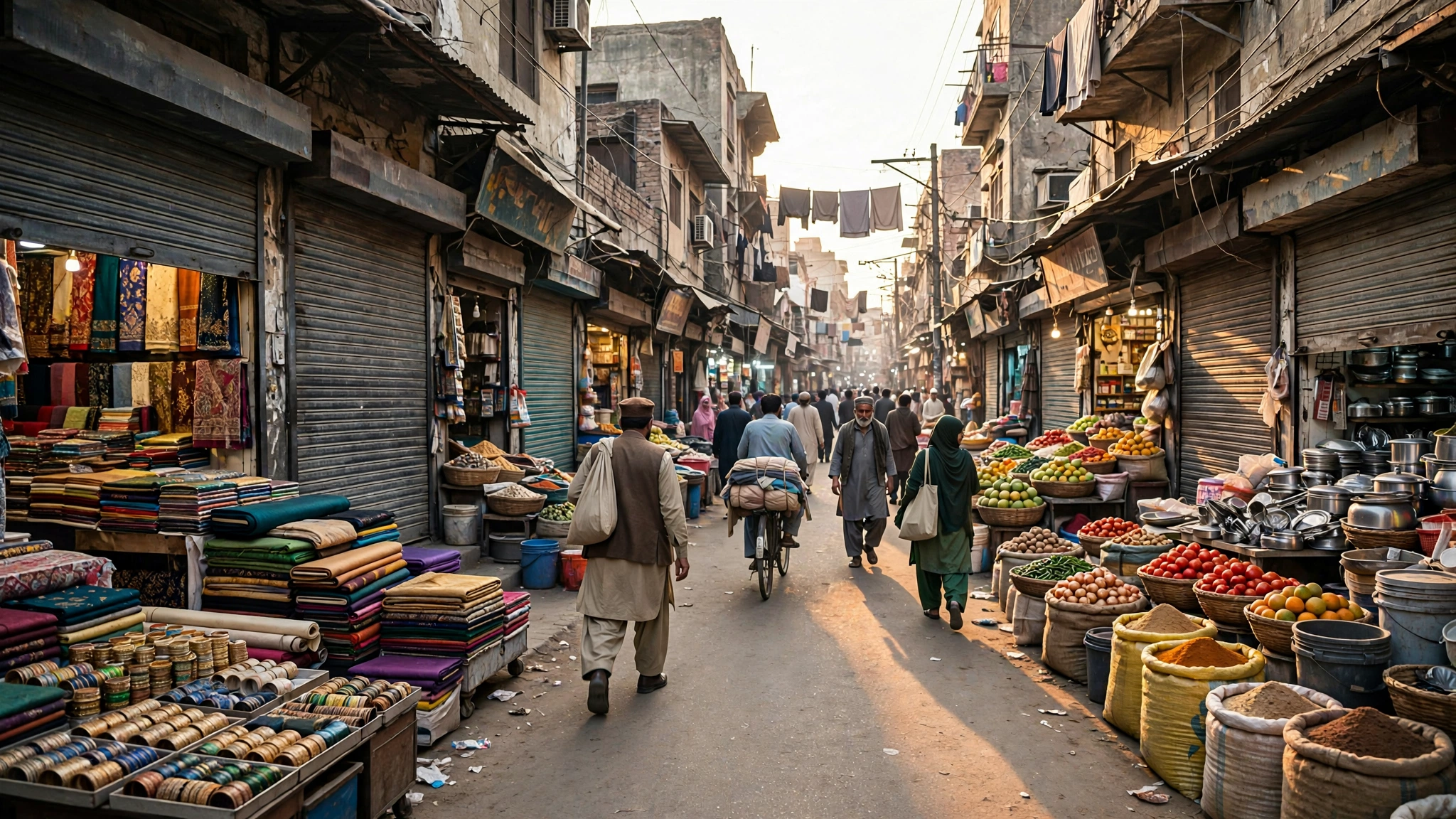
Walk through any neighbourhood in Lahore, Karachi or Peshawar and the rooftops tell the story: Pakistan is in the middle of one of the world’s fastest solar revolutions. A new study, published in the peer-reviewed journal Energy Research & Social Science, puts numbers to what everyone can already see — and delivers a warning. The boom is enormous, much of it is happening off the books, and a wave of policy changes is squeezing the next wave of adopters.
The research, by Wajid Islam of the Pakistan Institute of Development Economics, Jan Rosenow of the universities of Oxford and Cambridge, and Asha Amirali of the University of Bath, combined Ember generation data with NEPRA regulator reports and solar-panel import figures.
Key Takeaways
- Registered net-metering capacity hit 6.1 GW by June 2025, but imported panels suggest far more solar is installed unregistered.
- NEPRA replaced net metering with net billing for new connections, cutting the export rate from about Rs27 to roughly Rs11-13 per unit.
- Researchers say higher taxes on modules and lower buyback rates will slow registered adoption and push users off the grid.
The boom in numbers
The headline figures are staggering. Registered rooftop solar under the net-metering scheme reached 6.1 gigawatts across 378,339 consumers by June 30, 2025 — a nineteen-fold increase from 321 megawatts in 2021. Then there is the shadow boom: roughly 40 gigawatts of solar modules have been imported since fiscal year 2020, a gap the researchers treat as a lower bound on unregistered capacity. Renewables First later put cumulative imports at about 54 gigawatts by end-March 2026, with roughly 51 gigawatts operational.
Solar generation tells the same story. It rose from 2.6 terawatt-hours in 2019 to 36.6 terawatt-hours in 2025 — 22.5 percent of output. In the first quarter of 2026, solar supplied 32.3 percent of electricity (12.1 of 37.5 TWh), putting it ahead of coal, gas, nuclear and hydropower for the first time.
But the boom runs through two separate channels. Registered net metering is concentrated among higher-income customers in the best-served utility areas — about 85 percent sits in six distribution companies, with Lahore’s LESCO at 1.3 GW, Islamabad’s IESCO and Karachi’s K-Electric at 0.9 GW each, Multan’s MEPCO at 0.8 GW, Faisalabad’s FESCO at 0.7 GW and Gujranwala’s GEPCO at 0.6 GW. Five of those six report near-zero load shedding.
The second channel is invisible: unregistered, off-grid and behind-the-meter systems dominate where the grid is worst. The four worst-served utilities — PESCO, HESCO, SEPCO and QESCO — hold only about 14 percent of registered capacity, yet face 8 to 10 hours of daily load shedding, with line losses nearing 39 percent. There, people did not wait for policy — they just bought panels.
Why Pakistan went solar
The researchers found adoption is driven primarily by electricity prices rather than outages in the metered segment. The national average base tariff rose from PKR 16.91 per unit in fiscal year 2022 to PKR 35.50 in fiscal year 2025 — an increase of about 110 percent — while the top residential slab reached PKR 48.84 per unit. A rooftop system displacing the most expensive units can pay for itself in two to four years, after which the electricity is essentially free.
Meanwhile, the global price of solar panels fell roughly 90 percent between 2010 and 2024, putting systems within reach of the middle class.
The pressure points
That economics is now under deliberate pressure from three directions.
1. Net metering is over. NEPRA replaced net metering with net billing for new connections in February, ending the old one-unit-for-one-unit exchange that let households export daytime solar and consume free at night. Under five-year contracts, exports are now credited at roughly Rs 11–13 per unit, down from about Rs 27 — effectively halving the value of exported power. Existing contracts stay valid until they expire, but new adopters face much thinner returns.
2. The burden argument. The government argues the old system transferred costs to non-solar consumers. The Finance Division estimated the original framework had shifted a Rs 159 billion burden to grid consumers by December 2024 — projected to reach Rs 4,240 billion by 2034 if left alone. Capacity payments to power producers, which must be paid whether or not electricity is consumed, rose 46 percent to Rs 1.9 trillion in fiscal year 2024, and utilities recover those through per-unit tariffs. Every unit leaving the grid raises the per-unit cost for whoever remains — increasingly, those who cannot afford solar.
3. Higher costs coming. The June budget proposed higher sales tax on solar modules and higher duties on batteries and inverters, raising the upfront cost of going solar just as the financial returns shrink.
The researchers say the policy changes govern only the visible boom. The likely effect: slower registered adoption, more battery storage and self-consumption, and more marginal adopters pushed into the unregistered segment — exactly where the grid loses all visibility of them.
Batteries: the new frontier
One clear winner in the squeeze is storage. If exporting to the grid pays little, storing daytime power for the evening makes more sense. Battery imports jumped from 1.4 GWh in 2024 to 4.6 GWh in 2025, according to Renewables First. CNTE, backed by battery giant CATL, entered Pakistan’s battery market in June through an agreement with Treet Battery. And in September, NEPRA required solar and wind projects in the country’s first renewable wheeling auction to include co-located storage equal to at least 10 percent of firm capacity.
The Pakistan Solar Association reported that midday demand on LESCO’s network collapsed from 2.2 GW in 2024 to 765 MW in 2026 — the visible face of the self-consumption shift.
What needs fixing
The researchers’ conclusion is blunt: “Pakistan’s solar boom is best understood not as an energy-policy success or a crisis but as a verdict on the incumbent model.” They call for a standing programme to measure behind-the-meter capacity by region, time-of-use pricing, a transparent fixed network charge, and a time-differentiated export credit that rewards evening exports. For the worst-served areas, they suggest solar-plus-storage mini-grids and daytime solar feeders rather than more central-grid spending.
As one analysis in The News put it, the debate is wrongly framed as a choice between protecting the distribution companies or protecting solar consumers. The real problem is structural: a 20th-century grid built around one-way flow from giant plants, colliding with millions of homes that are now small power plants themselves.
For Pakistani households weighing a solar investment today, the message is mixed. The sun is as generous as ever, and panels remain cheap. But the easy math of the net-metering era is gone. New adopters need to plan for self-consumption — ideally with storage — rather than counting on generous export credits. The boom is not ending. It is going underground.