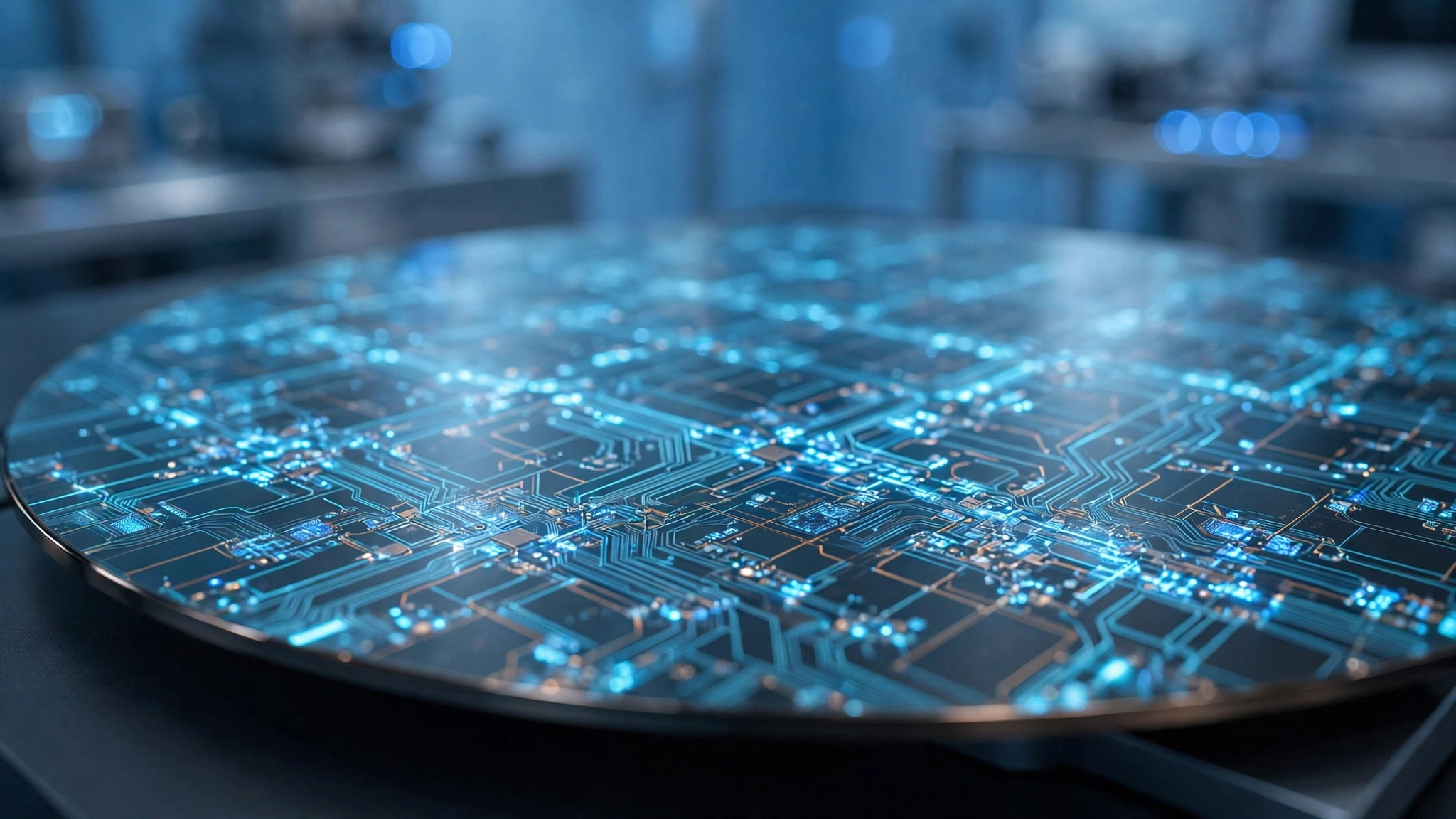
If you asked most people who makes the world’s most powerful processor, they’d say Qualcomm or Apple — the giants whose chips power the phones and laptops in our pockets. The real answer is neither. The most powerful processor on Earth is built by a company called Cerebras, and it is literally the size of a dinner plate.
Key Takeaways
- The world’s most powerful processor is Cerebras’s WSE-3, a wafer-scale AI chip with 4 trillion transistors and 900,000 cores.
- Qualcomm’s Snapdragon X2 Elite (80 TOPS) and Apple’s M-series chips are consumer chips — they compete in a completely different league.
- NVIDIA’s Vera Rubin, unveiled at CES 2026, is the strongest challenger, but ‘strongest’ claims from chipmakers always need context.
The Straight Answer: Cerebras Wafer-Scale Engine 3
The crown, by the only metric that matters at the top end — raw AI computing power — belongs to the Cerebras Wafer-Scale Engine 3 (WSE-3). According to the company’s official specifications, the chip packs:
- 4 trillion transistors — roughly 50 times more than NVIDIA’s H100, the workhorse of AI data centers
- 900,000 AI-optimized compute cores on a single piece of silicon
- 125 petaflops of peak AI performance — theoretically equal to about 62 NVIDIA H100 GPUs
- 44 GB of on-chip SRAM, with memory placed directly beside the computing cores
Cerebras says the CS-3 supercomputer built around it can train AI models with up to 24 trillion parameters — about ten times the scale of GPT-4 and Gemini-class models. Note: this is the company’s own claim, not an independent benchmark, though the physical specs — transistor count, wafer-scale design — are confirmed by multiple independent technical publications.
How Is a Chip This Big Even Possible?
Normal chips are cut like cookies from a round silicon wafer: manufacturers produce many small dies per wafer and throw away any with defects. Cerebras did the opposite. It kept the entire wafer — all 46,225 square millimetres of it — and connected the computing cores across it to form one giant processor. This technique is called wafer-scale integration.
The idea works for one reason: speed. In AI workloads, the biggest bottleneck is not raw computing power but moving data between memory and the processor. Cerebras places memory right beside its cores on the wafer itself, claiming 2,625 times the memory bandwidth of NVIDIA’s B200 and inference up to 15 times faster than leading GPU systems on open-source models. Again, those are company figures — independent benchmarks are rare because so few of these systems exist.
There are trade-offs. A wafer this large is hard to manufacture: Cerebras has said that when it started, nobody knew how to package a chip this big without cracking it, and every wafer has defects, so the company builds in spare cores (970,000 physical, with 900,000 switched on) and routes around the bad ones. It also depends entirely on TSMC for manufacturing — one supplier, no long-term capacity guarantees.
The Challenger: NVIDIA’s Vera Rubin
NVIDIA isn’t sitting still. At CES 2026, the company unveiled Vera Rubin, its next-generation AI platform. The Rubin GPU carries 336 billion transistors — 1.6 times more than the previous Blackwell generation — and delivers 50 petaflops of inference performance, a five-fold jump over Blackwell. It’s paired with the Vera CPU — an Arm chip with 88 custom “Olympus” cores — and 288 GB of next-generation HBM4 memory.
NVIDIA previously marketed its Blackwell GB200 superchip (208 billion transistors, up to 20 petaflops) as the world’s most powerful chip. So the “strongest processor” title in the data-center world really comes down to which company’s claim you trust. What’s not in dispute is that both are in a different universe from anything Qualcomm or Apple ships.
How the Giants Compare
| Chip | Company | Transistors | AI Compute | Designed For |
|---|---|---|---|---|
| WSE-3 | Cerebras | 4 trillion | 125 petaflops | AI training/inference in data centers |
| Vera Rubin GPU | NVIDIA | 336 billion | 50 petaflops (NVFP4) | AI training/inference in data centers |
| B200 (Blackwell) | NVIDIA | 208 billion | 20 petaflops (FP4) | AI training/inference in data centers |
| Snapdragon X2 Elite | Qualcomm | ~31 billion | 80 TOPS (NPU) | Laptops, on-device AI |
| M-series | Apple | Not disclosed | Tens of TOPS | Macs, iPads, iPhones |
Where Qualcomm and Apple Actually Stand
To be clear, their chips are excellent at what they’re designed to do. Qualcomm’s flagship Snapdragon X2 Elite, launched in September 2025 with 18 third-generation Oryon cores and an 80-TOPS neural processor on TSMC’s 3nm process, is one of the best laptop chips available. Apple’s M-series chips power the fastest ultrabooks and phones in the world.
But they are consumer chips, built to sip single-digit watts inside a phone or thin laptop. A WSE-3 sits in a rack and does the work of dozens of data-center GPUs. Comparing them is like comparing a racing engine with an airliner engine — the “strongest” one depends entirely on the race.
Why “Strongest” Needs Context
Three cautions for readers of tech headlines:
- Vendor claims aren’t benchmarks. Cerebras’s “fastest AI chip” and NVIDIA’s “most powerful chip” are marketing statements from the companies themselves. Independent, apples-to-apples testing of these systems is rare.
- Peak numbers aren’t sustained numbers. A “125 petaflops” figure describes theoretical maximum throughput in one specific precision, not what the chip delivers on every workload.
- Efficiency matters. Raw power means little if the chip costs a fortune to run. In the end, performance-per-watt is the real battleground.
What This Means for Pakistan
Why should a Pakistani reader care about a chip that will never sit inside a phone? Because the entire AI economy runs on it. Every time someone in Lahore asks ChatGPT a question or a developer in Karachi builds an AI feature, the request lands on chips like these. Pakistani AI startups rent GPU capacity from cloud providers, and chips that generate answers faster and cheaper directly reduce the cost of building AI products here.
Closer to home, Cerebras recently went public and signed a multiyear $20-billion-plus deal with OpenAI to deploy 750 megawatts of computing power. NVIDIA has announced RTX Spark — an Arm-based chip derived from its data-center Grace Blackwell technology — with machines from Dell, HP, ASUS, Lenovo, MSI, Acer and Microsoft expected this autumn. If those AI-capable PCs reach Pakistan at reasonable prices, local developers could run larger AI models on their own laptops instead of paying for cloud.
The bottom line: the phone in your hand has a fine processor. But the strongest processor in the world looks nothing like it — it’s a silicon dinner plate made by neither Qualcomm nor Apple, and it’s powering the AI revolution from inside a data center.