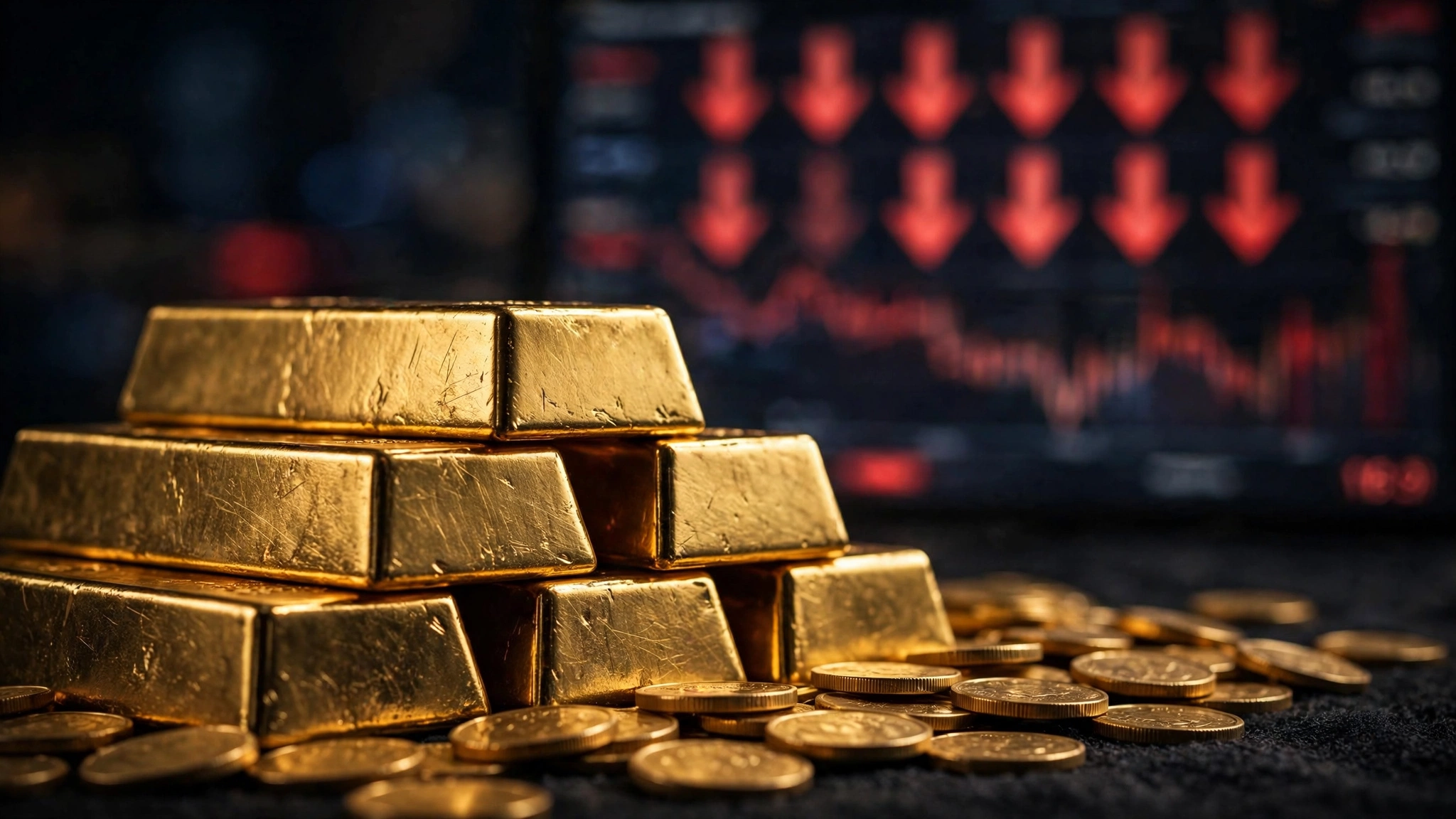
Gold’s brief recovery didn’t last. The precious metal fell again on Tuesday, October 13, giving up the gains from its one-week high just a day earlier as a rock-hard US dollar and hawkish Federal Reserve expectations squeezed buyers out of the market.
Spot gold dropped 0.2% to around $4,164.45 an ounce in early Tuesday trade, while US gold futures for December delivery slipped 0.1% to about $4,187.90, according to Reuters. The decline ended a short-lived rally that had pushed gold to its highest level in a week on Monday — a rally that now looks, in hindsight, like a mere pause in a broader downward trend.
Key Takeaways
- Spot gold fell 0.2% to around $4,164 an ounce on Tuesday, October 13, after touching a one-week high a day earlier, as the US dollar held near an 18-month high.
- Markets are braced for US CPI data on Wednesday, with traders pricing an 88% chance of a Fed rate hike in December — a hawkish backdrop that keeps pressure on the yellow metal.
- In Pakistan, the All Pakistan Sarafa Gems & Jewellers Association set 24K gold at Rs 440,636 per tola; gold remains roughly 25% below its January record high of $5,589 an ounce.
A Dollar at Its Strongest in 18 Months
The main villain behind gold’s latest fall is no mystery: the US dollar. The greenback lingered near an 18-month high on Tuesday, making dollar-denominated gold more expensive for buyers holding other currencies and draining demand across Asia and Europe. A strong dollar raises the cost of bullion for international buyers, while also reflecting expectations that US interest rates will stay high — a double blow for a metal that pays no interest and competes with yield-bearing assets.
All Eyes on Wednesday’s CPI Report
The bigger test is yet to come. The US Consumer Price Index (CPI) for September is due on Wednesday, October 14, followed by the Producer Price Index (PPI) on Thursday. Both reports will give fresh signals on the Federal Reserve’s interest-rate trajectory — the single biggest driver of gold prices right now.
Traders are pricing only a 21% chance of a Fed rate hike at the October 27–28 meeting, but an overwhelming 88% chance of a hike in December, according to the CME’s FedWatch tool — a hawkish tilt that gold bulls fear, since rising rates push investors toward assets that pay real returns.
Kyle Rodda, senior financial market analyst at Capital.com, told Reuters that US CPI data “will be critical for gold in the short-term,” warning that hotter-than-expected inflation could trigger another dip if it nudges up expectations of an October rate hike.
The hawkish chorus from Fed officials isn’t helping. Cleveland Fed President Beth Hammack has said the central bank should move “relatively quickly” to a more restrictive monetary policy stance to control inflation, which she believes has become broader-based and is beginning to influence how firms set prices.
A Metal That Has Lost a Quarter of Its Value
Zoom out, and Tuesday’s dip is just the latest chapter in gold’s remarkable reversal of fortune. The metal set an all-time record of $5,589.38 an ounce on January 28, 2026. At current prices, gold is trading roughly 25% below that peak — a drawdown of more than $1,400 per ounce.
Consider the timeline of the sell-off:
- Late January 2026: Gold touches its all-time high above $5,580.
- July 16, 2026: Gold finds a 2026 settlement low near $3,985.
- October 7, 2026: Spot gold closes around $4,110, its lowest since August 5, after a 1.28% one-day drop.
- October 9, 2026: Gold rebounds more than 1% and December futures jump 1.43% to $4,216.30.
- October 12, 2026: The bounce fails — spot gold falls 0.69% to $4,164.96; Comex gold settles at $4,165.80, down 0.60%.
- October 13, 2026: Gold slides further as the dollar holds firm.
Monday’s session had briefly looked like the start of a genuine recovery, with gold climbing more than 1% to a one-week high. But the rebound had the fingerprints of short-covering — traders buying back borrowed positions — rather than fresh buying conviction, and Tuesday’s reversal confirmed that suspicion.
Where the technical picture stands
| Indicator | Level | What it means |
|---|---|---|
| Spot gold (Oct 13) | ~$4,164 | Down ~0.2% on the day |
| December futures | ~$4,188 | Down ~0.1% on the day |
| October 7 low | ~$4,110 | Support level traders are watching |
| January record high | $5,589.38 | Roughly 25% above current price |
| December Fed hike odds | ~88% | Key headwind for gold |
What It Means for Pakistan
For Pakistani readers, the global slide is a mixed blessing. On the one hand, cheaper international gold means lower import costs for jewellery and investment gold. On the other, a strong dollar — the very thing crushing gold — also weakens the rupee, which can offset some of the benefit.
According to the All Pakistan Sarafa Gems & Jewellers Association, 24-karat gold was priced at Rs 440,636 per tola on Tuesday, October 13, with 10 grams of 24K gold at Rs 377,774. Silver stood at Rs 6,752 per tola. These rates are set by the association and apply across major cities including Karachi, Lahore, Islamabad, Multan, and Peshawar.
The combination of falling global prices and a volatile rupee means local rates can swing either way. If the rupee stabilises while global gold keeps sliding, Pakistani buyers — including families planning wedding purchases — could see a genuine buying opportunity. But dollar strength may keep pressuring the rupee, limiting how much local prices fall.
Why the Outlook Stays Gloomy for Now
Three forces are keeping a lid on gold:
- A relentless dollar. Near an 18-month high, the dollar shows no sign of loosening its grip while Fed hike bets remain firm.
- Rising real yields. Surging US Treasury yields — recently around 5.24% on the 10-year note — make bonds far more attractive than gold.
- Hot CPI risk. If Wednesday’s inflation print surprises to the upside, even the modest 21% chance of an October hike could climb, hitting gold with another wave of selling.
That said, the long-term case hasn’t entirely vanished. Central banks continue buying gold for their reserves — a steady source of structural demand. And if inflation comes in cooler than expected, December hike odds could soften, giving gold room to breathe.
Conclusion
Gold’s latest plunge is a reminder that in 2026, the metal answers to the dollar and the Fed — not to its reputation as a safe haven. Tuesday’s slide leaves gold deep in its downtrend, a full quarter below January’s record.
The next move hinges on Wednesday’s CPI report. A hot reading could send gold retesting the October 7 lows near $4,110; a cool one might revive the recovery Monday hinted at. Either way, for Pakistani buyers, the weeks ahead bear watching: global weakness plus currency risk make this a moment to track rates closely, not to rush in blind.