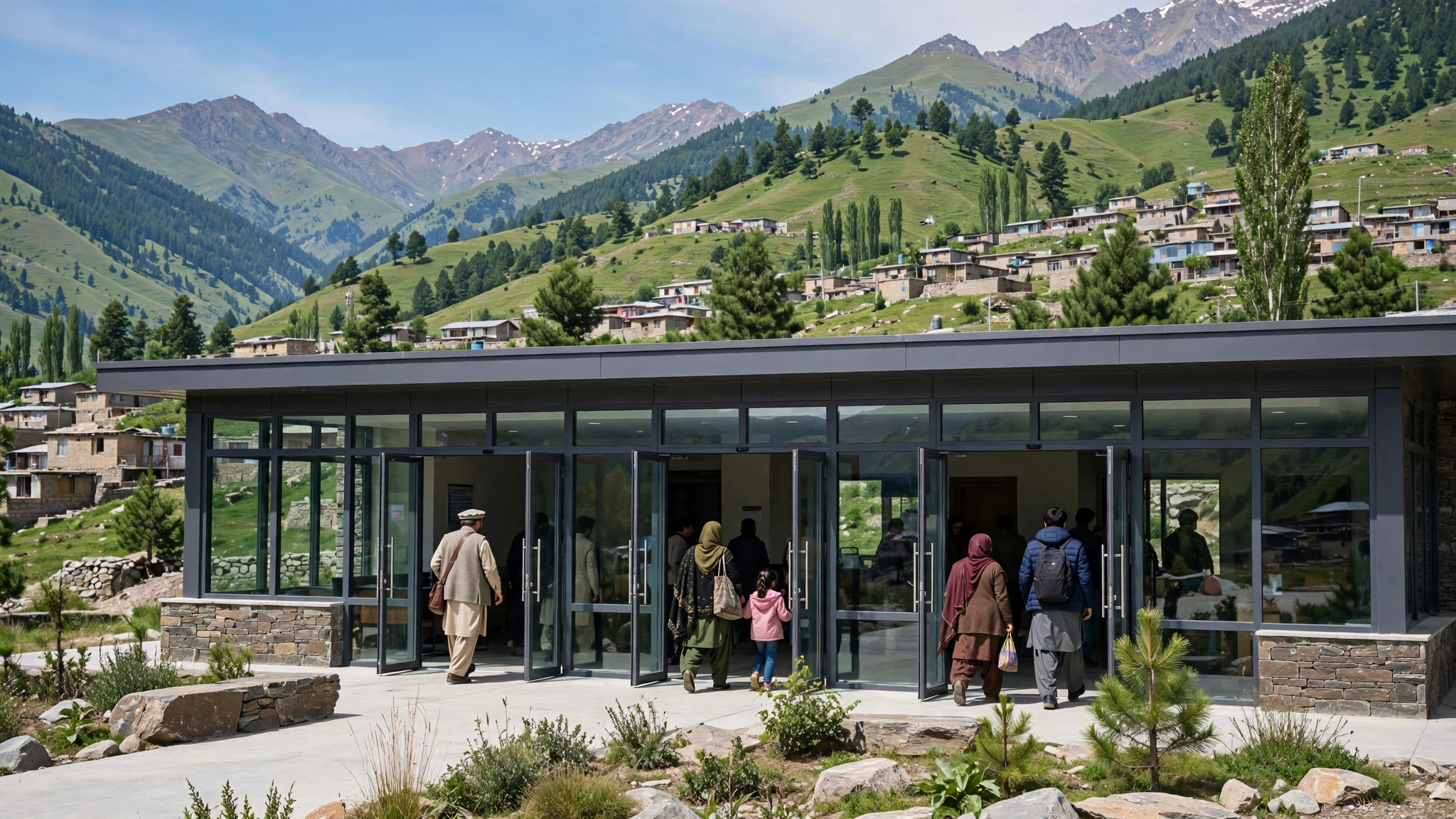
The federal government has formally moved to bring its flagship one-stop public service model to Azad Jammu and Kashmir (AJK) and Gilgit-Baltistan (GB). In a meeting held in Islamabad on October 6, 2026, Federal Minister for Economic Affairs and the Establishment Division Senator Ahad Cheema directed the Chief Secretaries of both regions to initiate the tendering process for Asaan Khidmat Centres, with the federal government footing the bill.
The Chief Secretaries attended the meeting virtually and agreed to proceed. The directive was issued in line with directions from Prime Minister Shehbaz Sharif, who has been pushing the expansion of the citizen-service hubs beyond the capital.
Key Takeaways
- Federal Minister Ahad Cheema directed AJK and Gilgit-Baltistan to start tendering for Asaan Khidmat Centers in a meeting on October 6, 2026.
- The federal government will fund the centers, which bring NADRA, passports and other public services under one roof.
- Three operating models — hybrid, fully private, and government-run — were reviewed, with a feasibility study ordered before a final decision.
What Exactly Is an Asaan Khidmat Centre?
An Asaan Khidmat Centre is a one-stop facility that places counters of multiple government departments under a single roof. Instead of a citizen running between separate offices for a CNIC, a passport renewal, an attestation, or an excise receipt, the services are delivered from one building through a paperless, technology-driven process.
The model is inspired by Azerbaijan’s ASAN Service, which is widely regarded as one of the world’s most successful citizen-service reforms. Pakistan’s first pilot facility opened in Sector G-9, Islamabad, consolidating over 60 government services in one location. After what the government described as strong citizen feedback on the pilot, the Prime Minister directed authorities to take the model to AJK, Gilgit-Baltistan, and eventually major provincial cities.
Why It Matters Most in AJK and GB
For residents of Pakistan’s two northern regions, the promise of a one-stop centre carries more weight than it might in Islamabad or Lahore. In AJK and GB, routine paperwork can mean long journeys over difficult mountain roads to reach a district headquarters — and days spent moving between scattered government offices.
A centre closer to home that houses NADRA, the Immigration and Passports Department, and other service providers in one place would cut both travel and waiting time. In a region where a single passport application can currently consume a working week of travel and queuing, the efficiency gains are immediate and tangible.
The initiative also aligns with the government’s broader Digital Nation Vision, which aims to shrink the divide between urban and rural citizens in access to state services.
What the October 6 Meeting Decided
According to the Press Information Department’s account of the meeting, several concrete steps were decided:
- Tendering begins now. The Chief Secretaries of AJK and GB were directed to start the tendering process for the centres in their respective regions. Tendering is the first administrative step — a public call for bids — before contracts can be awarded and facilities built out.
- Federal funding. The Minister stated that the federal government would provide the required funds, removing a key financial hurdle for the two regions.
- Speed emphasised. The Minister stressed that work should be expedited in accordance with the Prime Minister’s directions.
It is worth noting what was not decided: no opening dates, no cities, and no number of centres were announced. The centres are in the pipeline, not yet open.
Three Models for Wider Expansion
The meeting also reviewed how the Asaan Khidmat model could be rolled out to other cities beyond AJK and GB. Three operating models were discussed:
| Model | Who provides the premises | Who runs the centre |
|---|---|---|
| Hybrid | Government | Private company |
| Fully private | Private company (under a government licence) | Private company |
| Government-operated | Government | Government |
The Minister ordered a feasibility study on these models, after which proposals will be submitted to the Prime Minister for a final decision. No model has been selected yet, and no cities outside AJK and GB were named.
Who Pays for Operations — and the No-Extra-Charges Pledge
One of the more significant discussions concerned how the centres would be funded once running. The meeting examined a revenue-sharing arrangement with departments providing services at the centres — specifically NADRA and the Immigration and Passports Department — with the idea that departments benefiting from the shared premises and utilities would contribute toward operating costs.
Crucially, the Minister insisted on safeguards against extra charges: any private-sector involvement must include revenue-sharing mechanisms that prevent private operators from imposing additional fees on citizens. The initiative, he said, is intended to facilitate the public — and its costs should not be passed on to them.
The Road Ahead
The Prime Minister had already signalled this expansion months earlier. In January 2026, he told an Azerbaijani delegation that more Asaan Khidmat Markaz centres would be established across the country, with AJK and Gilgit-Baltistan in the next phase — and he has since directed that the centres be integrated into Pakistani embassies abroad to serve overseas Pakistanis as well. He has also called for quarterly third-party audits of the centres against clear performance targets.
For now, the next milestone is the tendering process itself. Only after bids are invited, evaluated, and contracts awarded can construction and staffing begin — so residents of AJK and GB should treat the October 6 decision as the starting gun of a multi-stage process, not the ribbon-cutting.
Still, the direction of travel is clear: Pakistan’s experiment with one-stop citizen service, born from the G-9 Islamabad pilot, is heading for the mountains. For citizens in Muzaffarabad, Gilgit, and the valleys in between, a single building that handles passports, identity cards, and attestations without a day of travel would be one of the most practical governance reforms in years.