Karachi’s most beloved heritage landmark has a new lease on life. The Empress Market — the 137-year-old colonial-era bazaar at the heart of Saddar — has been comprehensively restored and beautified in a multi-phase project by the Karachi Metropolitan Corporation (KMC), with Sindh Chief Minister Syed Murad Ali Shah formally inaugurating the restored complex on June 12, 2026.
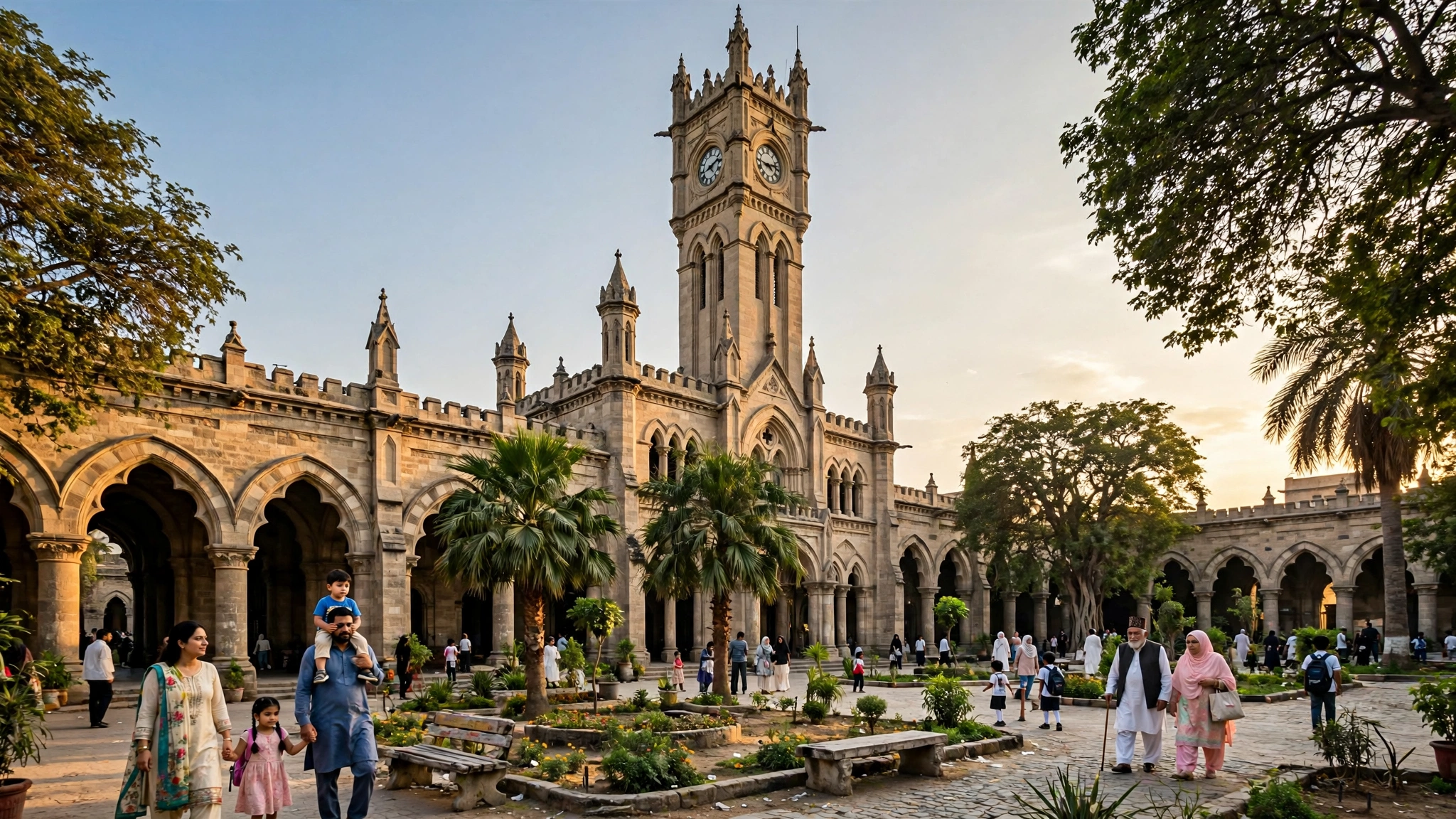
The transformation is hard to overstate. For decades, the Indo-Gothic building was buried under illegal encroachments, traffic chaos, and grime. Today, the 140-foot clock tower chimes again, the stone facades have been cleaned and repaired, and a landscaped public park fronts the building. Visitors who remember the old Saddar barely recognise the place.
Key Takeaways
- The 137-year-old Empress Market in Saddar has been fully restored and formally inaugurated by Sindh CM Murad Ali Shah in June 2026.
- The project repaired the iconic 140-foot clock tower, restored the building’s stone facade, and created a 5,000-square-foot public park.
- The restoration is part of a wider KMC heritage drive covering Old City markets and Soldier Bazaar.
A Monument to 137 Years of Karachi
Few buildings capture Karachi’s story like the Empress Market. Constructed between 1884 and 1889 to commemorate the Golden Jubilee of Queen Victoria — who held the title Empress of India — the market was designed by municipal architect James Strachan in the Domestic Indo-Gothic style. Its pointed arches, yellow-stone facades, and soaring clock tower made it an instant landmark.
For more than a century it has anchored Karachi’s commercial life: hundreds of stalls selling fresh fruit and vegetables, spices, meat, seafood, dry fruits, textiles, and everyday essentials, arranged in galleries around a central courtyard. Through partition, the port city’s boom years, and every political turn since, the market has remained at the centre of daily trade — and a symbol of the city’s multicultural merchant traditions.
What the Restoration Changed
The KMC-led rehabilitation was extensive. According to the details shared at the inauguration, the project covered the nearly five-acre Empress Market complex and included:
- Clock tower reactivation — the 140-foot tower’s historic clock was repaired and now chimes every hour. (When the Chief Minister began his inauguration speech, the clock struck ten — prompting a joke from Shah about the “12 hours” on some faces.)
- Podium and courtyard renovation — the central courtyard was rebuilt with a running fountain and wooden benches, turning a cramped passage into a family-friendly public space.
- Landscaping and lighting — a 5,000-square-foot public park, decorative garden lighting, and landscaped grounds replaced the encroached, garbage-strewn surroundings.
- Modern trading facilities — 36 double-decker grocery shops, 29 modern meat stalls, and six fruit-and-vegetable stalls, all shifted into hygienic, organised layouts.
- Civic amenities — parking for 250 vehicles and 500 motorcycles, separate public washrooms for men and women, and dedicated facilities for persons with disabilities.
The documentary screened at the inauguration ceremony — showing the market’s condition before restoration alongside the rehabilitation work — drew applause from the attending crowd of traders, officials, and citizens.
The Inauguration: “A Responsibility to Future Generations”
At the June 12 ceremony, attended by Mayor Murtaza Wahab, Deputy Mayor Salman Murad, and project director Tariq Mughal, the Chief Minister described the project as a significant step toward preserving the city’s cultural heritage while providing modern public amenities for citizens, traders, and visitors.
Shah said the Empress Market was a symbol of Karachi’s history and culture, and that its restoration had been a priority because preserving heritage was “a responsibility we owe to future generations.” He noted that the nearly five-acre complex had been transformed into a modern, organised civic space while retaining its historical character — and suggested it would boost the commercial and tourism appeal of Saddar and surrounding areas.
He also announced that the Sindh government would consider establishing a memorial near the Empress Market to commemorate those who lost their lives during the colonial era.
Citizens Are Noticing
The reaction from Karachiites has been warmly positive. Associated Press footage from September 2026 shows families taking photographs at the restored site, with visitors contrasting the present calm with the old congestion.
The mayor has said the restoration drive responds to decades of neglect: Karachi is “blessed to have a very rich cultural heritage,” and the idea was to highlight the city’s history even while building modern infrastructure. He has also framed maintenance as the real challenge — vested interests that let heritage buildings decay so they could be demolished and redeveloped must be resisted, he argued.
Part of a Bigger Heritage Drive
The Empress Market is the crown jewel, but not the only restoration underway. KMC has mounted a broader campaign across Karachi’s historic commercial districts:
- Old City markets (Rs 700 million): Launched in January 2026, this program targets Jodia Bazaar, Bolton Market, Mithadar, and Kharadar with Rs 595.6 million — covering 400,000 square feet of paver blocks, 850,000 square feet of road construction, and over 14,000 feet of new sewerage lines. A separate Rs 100 million is earmarked for restoring the historic Lea Market building.
- Soldier Bazaar: On October 6, 2026, Mayor Wahab announced that KMC is actively restoring and beautifying the historic Soldier Bazaar, long damaged by neglect and encroachments, alongside road rehabilitation across the district.
- Century-old KMC buildings: Restoration work continues on heritage-declared colonial buildings, with AP footage confirming conservation underway.
Why It Matters for Pakistan
Heritage restoration is not just aesthetics — it is economic policy. Revived landmarks draw footfall: domestic tourists, school groups, and the diaspora all visit restored sites, and each visit supports the surrounding shops, food vendors, and transport workers. For Saddar, one of Karachi’s busiest commercial zones, a restored Empress Market can anchor a tourism circuit that includes the nearby heritage streets.
There is also a civic pride argument that Karachi has needed for years. A city often defined in the news by its problems — congestion, encroachments, infrastructure strain — now has a counter-image: a 137-year-old bazaar, cleaned, lit, and chiming on the hour, surrounded by families on a Sunday evening.
The clock, silent for so long, is ticking again. For Karachi, that sound is worth more than the stone it chimes from.