A university campus in Lahore is fast becoming one of Pakistan’s most important laboratories for green living. Beaconhouse National University’s (BNU) Green Experience Center (GEC) — an interdisciplinary hub devoted to green architecture, sustainable technology and environmental education — has drawn the attention of one of Pakistan’s largest corporate houses. When a senior delegation from Oil and Gas Development Company Limited (OGDCL) toured the Center and met the university’s OGDC scholars, it marked a notable convergence of academia and industry around a shared climate agenda.
The visit underscored a simple but powerful idea: that Pakistan’s energy future and its sustainability future are no longer separate conversations.
Key Takeaways
- BNU’s Green Experience Center (GEC) is an interdisciplinary hub for green architecture, sustainable technology and environmental education, targeting full operationalization in 2026.
- A senior OGDCL delegation toured the Center and met OGDC scholars at BNU, signalling a rare corporate–academia alignment on climate action.
- The Center builds on BNU’s status as Pakistan’s first WWF-certified EcoSmart campus and its bamboo afforestation and zero-waste drives.
What the Green Experience Center Actually Is
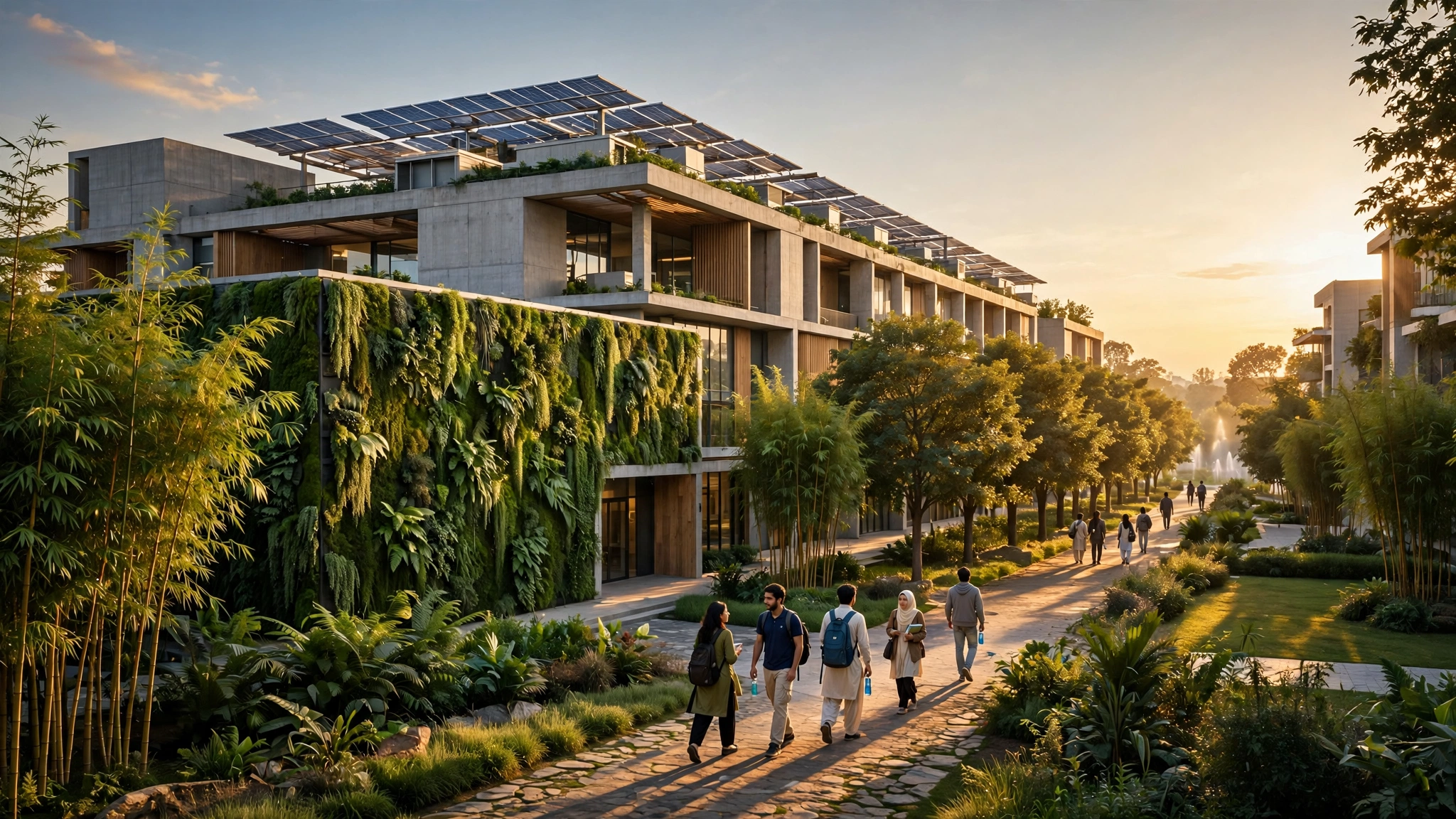
The GEC is not a single building so much as a living, working model of climate-conscious design. Conceptualized under BNU’s Climate Change and Environmental Sustainability (CCES) initiative, the Center is described by the university as an interdisciplinary lab driving green architectural innovation, with full operationalization targeted by 2026.
It is being developed in four interlocking parts:
- Sustainable Architectural Pavilion — an eco-friendly structure designed by BNU’s Mariam Dawood School of Visual Arts & Design and the Razia Hassan School of Architecture, built from renewable and recyclable materials. It will host sustainability exhibitions, workshops and academic collaborations.
- Green Art & Design Installations — a rotating showcase of student, alumni and faculty-led installations aimed at giving indigenous green design ideas global visibility.
- Interactive Sustainability Labs — immersive spaces for hands-on learning in green science, environmental policy and climate-resilience strategies.
- Community Engagement Hub — a transdisciplinary platform for workshops, knowledge-sharing sessions and applied sustainability experiments open to the wider community.
The Center sits inside a campus that is already practising what it preaches. BNU is the first university in Pakistan to receive WWF-Pakistan’s EcoSmart Campus Certification, awarded after a rigorous evaluation of resource efficiency, waste reduction, renewable-energy adoption, biodiversity conservation and environmental awareness.
The OGDCL Connection: Why an Oil and Gas Giant Cares
The spotlight moment came when an OGDCL delegation — led by Deputy Chief Corporate Social Responsibility Ms. Sumbal Wahab, alongside Senior CSR Officer Mr. Usman Ahmed and CSR Officer Mr. Saddam Hussain — visited BNU, toured the Green Experience Center and expressed strong appreciation for the university’s pioneering sustainability and green-campus initiatives.
That a company whose core business is hydrocarbon exploration is investing its CSR attention in a green campus center is significant. OGDCL has been public about its ESG Strategy 2025, under which it reports large-scale tree plantations, solar-powered water pumping systems in water-stressed areas, and emission-control initiatives. Among its documented community projects: solarizing 30 homes in Gazboba Bettani in Lakki Marwat, installing solar water-pumping systems at communal locations in Kharan and Noshki, and operationalizing the Pather Nala water project in Pirkoh with a 130 KVA solar system.
The delegation’s visit also included an engagement session with OGDC scholars at BNU — students supported under the company’s education and scholarship commitments — tying together corporate social responsibility, academic excellence and environmental stewardship in one visit.
Corporate–academia partnerships, explained
Pakistan has a long tradition of corporate CSR, but most of it has flowed toward disaster relief, school buildings and health camps. What makes this engagement different is its focus on innovation infrastructure — a space where design students, architects and engineers can prototype the climate-resilient buildings Pakistan’s cities will need in the coming decades.
For OGDCL, aligning with a certified green campus offers a credible channel to demonstrate its ESG commitments beyond its field operations. For BNU, corporate engagement brings visibility — and potentially future funding — to an initiative that is meant to outgrow the campus and influence the region’s construction and planning industries.
What BNU Has Already Built Around It
The Green Experience Center does not stand alone. It is the flagship of a campus-wide sustainability program that has been accumulating visible wins:
- Afforestation and biodiversity: a dedicated Biodiversity Hub, large-scale plantation drives with partners including Parco and Synergy, and a bamboo afforestation strategy that doubles as both carbon sequestration and a renewable material resource for architecture students.
- Low-carbon mobility: two electric shuttle buses serving students and staff — including those with mobility challenges — plus on-campus e-carts, cycling support and carpooling policies.
- Air quality monitoring: five real-time AQI sensors tracking PM2.5, PM10, NOx and CO₂ hotspots across campus, with a live dashboard.
- Zero waste: waste segregation, on-site organic composting, recycling partnerships and paperless administration.
- Curriculum integration: sustainability woven into teaching across schools — from climate science and green finance to environmental journalism and eco-design.
That layered approach is precisely what impressed the visiting OGDCL team: sustainability at BNU is not one project but an operating system.
Why It Matters for Pakistan
Pakistan is routinely ranked among the countries most vulnerable to climate change. The catastrophic 2022 floods, which inundated a third of the country, remain fresh in national memory, and Lahore itself chokes each winter under severe smog driven by traffic, industry and crop burning. Against that backdrop, the kind of work the GEC is designed for — climate-resilient architecture, low-carbon building materials, and public environmental literacy — is not decorative. It is practical.
There is a regional dimension too. Experience centers of this kind are rare in South Asia. If BNU’s model — pairing design education with a functioning green pavilion, real emissions data and community programming — proves replicable, it offers a template for universities across Punjab and beyond.
The Center’s community-engagement mandate matters as well. Climate adaptation in Pakistan will succeed or fail at the community level: in how homes are built, how waste is handled and how water is managed. A university center that opens its doors to workshops and applied experiments gives those conversations a physical home.
What Comes Next
With full operationalization targeted by 2026, the coming months will show whether the Green Experience Center moves from concept to a working showcase. The indicators to watch are concrete: the completion of the Sustainable Architectural Pavilion, the launch of the interactive labs, and whether corporate partners — OGDCL among them — deepen their involvement from visits to sustained collaboration.
For now, the signal is clear. Pakistan’s green transition needs institutions that teach it, companies that fund it and communities that live it. On a tree-lined campus off Raiwind Road, all three are starting to meet in one place — and that, quietly, is what makes this a landmark.