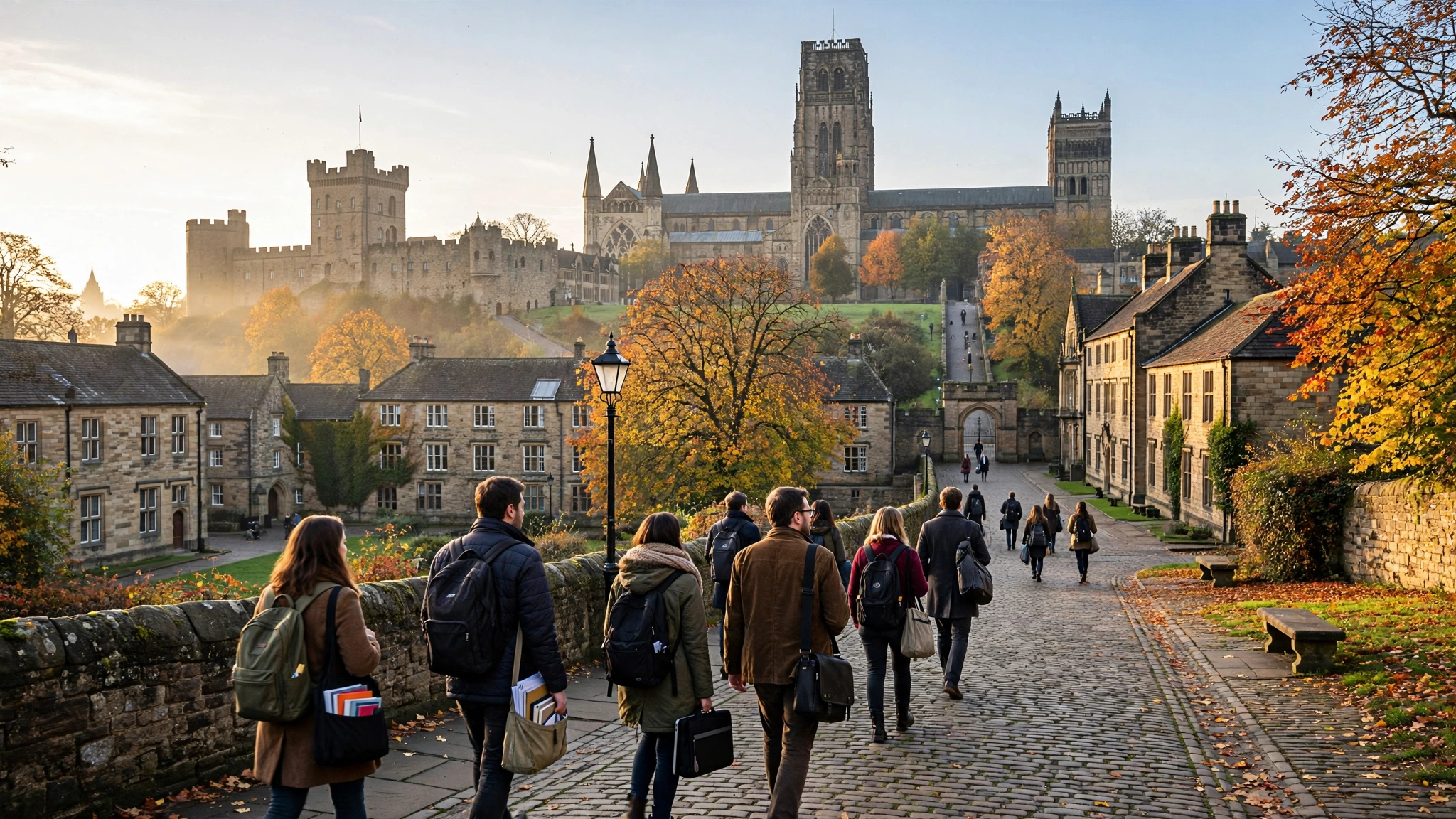
Durham University — one of the UK’s leading research-intensive universities, ranked 11th in the world for Geography by subject (QS) — runs several doctoral funding schemes explicitly open to overseas students, covering full tuition fees and a living stipend. This article breaks down the funded PhD routes that matter for Pakistani applicants right now: which calls are still open, what each award covers, and what you need to do. Confirm all details on Durham’s official pages before applying.
Key Takeaways
- Durham runs multiple fully funded PhD schemes open to overseas applicants, covering tuition, a living stipend, and in some cases visa and fieldwork costs.
- Two calls are still open as of October 2026: the NINE DTP ESRC studentships (deadline 27 October 2026) and the Transformative Humanities studentships for October 2027 (deadline 15 January 2027).
- Every route is highly competitive: contact a proposed supervisor first, prepare a strong research proposal, and check deadlines against Durham’s official pages.
What “Fully Funded” Actually Covers
A fully funded Durham PhD award generally includes:
- Full tuition fees — at the overseas (international) rate, the figure that matters most for Pakistani applicants
- A tax-free annual maintenance stipend — set at UK Research and Innovation (UKRI) rates, roughly £20,000 per year, to cover living costs
- Research training and fieldwork support — some schemes add several thousand pounds per year for conferences, data collection, and training
- Visa costs — covered by some flagship awards
- College membership — Durham is collegiate, so funded students join a college and its postgraduate community
With tuition fully covered and a ~£20,000 yearly living stipend, a student can realistically complete a PhD without family savings.
Route 1: NINE DTP ESRC Studentships — Deadline 27 October 2026
This is the most urgent live opportunity. Durham’s School of Government and International Affairs offers studentships through the NINE Doctoral Training Partnership (DTP), funded by the Economic and Social Research Council (ESRC) — a collaboration of seven universities across the social sciences.
Key facts:
- Open to UK and international applicants, including Pakistanis
- Covers tuition fees (at the UK rate) plus a tax-free living stipend, research training, and fieldwork support
- Requires a social science methodology with an element of empirical research
- You must first be accepted for doctoral study; the department then nominates candidates on a ranked basis
- Stage 1 nomination deadline: 27 October 2026 — and Durham advises submitting your university application by 23 October to get an application ID in time
Documents include a research proposal (max 2,000 words), two-page CV, personal statement, two references, transcripts, and a consent form. Note Durham’s firm rule: you must have been in touch with a proposed supervisor before being considered for funding.
Route 2: Transformative Humanities Studentships — Deadline 15 January 2027
Durham is running a competition for up to eleven PhD studentships in Transformative Humanities, supported by its AHRC Doctoral Landscape Award, for October 2027 entry. This is the most generous multi-disciplinary call relevant to Pakistani applicants:
- Each award offers a tuition fee waiver plus a stipend for 3.5 years (full time) at UKRI level, plus training and placement resources
- Open to both home and overseas students: up to nine awards cover home fees, and up to two awards cover tuition at the overseas rate — the category Pakistani applicants need
- Supervision must be cross-departmental (at least two departments)
- Application deadline: noon (UK time) on 15 January 2027; online information session on 10 November 2026
- The proposal is capped at just 1,000 words, plus a two-page CV and two referees
- Online information session: 10 November 2026
Only two overseas-rate awards makes this brutally competitive, but it is one of the few schemes that explicitly funds international tuition for humanities PhDs at this scale.
Route 3: Business School Doctoral Studentships
Durham University Business School — triple-accredited and in the top 1% of global business schools — runs doctoral excellence studentships for its 60th anniversary, supporting full-time PhD and Integrated PhD studies in Accounting, Economics, Finance, and Management & Marketing. Scholarship listings for the 2026 cycle describe full tuition fees regardless of UK or international status, plus an annual stipend at UKRI rates. Check the school’s own call page for the current round rather than relying on listings.
Route 4: Commonwealth PhD Scholarships
Pakistani students should also know Durham supervisors participate in the Commonwealth PhD Scholarship scheme, which fully funds UK doctoral study for candidates from eligible Commonwealth countries — a category that has historically included Pakistan. The 2026 deadline is around 20 October 2026, but applications need nomination through an approved body (in Pakistan, the Higher Education Commission), and nominators set earlier internal deadlines. Durham academics publicly invited expressions of interest from Commonwealth candidates this cycle. If this appeals to you, contact the Commonwealth Scholarship Commission site and HEC Pakistan immediately — the 2026 window is nearly closed.
A Cautionary Note: the CMMF Studentship Is Already Closed
Durham’s Christopher Moyes Memorial Foundation PhD Studentship — full overseas-rate tuition for 3.5 years, a UKRI-aligned stipend, visa costs, £5,000 per year in fieldwork funding, and college membership — closed on 6 February 2026. It funded research on building resilience to hazards and risks for populations in the Global South — highly relevant to Pakistan (floods, climate adaptation, disaster resilience). Worth tracking for future entry years, especially for candidates in climate and disaster topics.
Eligibility Essentials for Pakistani Applicants
Across Durham’s schemes, the bar is consistent:
- Academics: a First or Upper Second-Class (2:1) undergraduate degree or international equivalent . Most successful applicants hold a Master’s.
- English language: Durham requires Direct Entry Band A proficiency (an IELTS-type requirement).
- Research proposal: 1,000–2,000 words depending on the scheme, tightly framed around research questions, methods, and fit with Durham’s expertise.
- Supervisor contact: contacting a proposed supervisor is effectively mandatory for the major schemes.
- References and transcripts: two academic references and full degree transcripts are standard.
The Pakistan Angle: Cost and Strategy
Durham is in North East England, where living costs are substantially lower than in London or the South East — the UKRI-rate stipend stretches much further there, which matters when budgeting for three to four years. Apply to multiple schemes simultaneously: NINE DTP, Transformative Humanities, the Business School, Commonwealth, and departmental studentships run on different timetables, and the HEC nominator route runs parallel to direct applications.
Bottom Line
Fully funded PhDs at Durham University are real, generous, and genuinely open to Pakistani applicants — but not easy to win. As of October 2026, your live windows are the NINE DTP ESRC studentships (deadline 27 October 2026) and the Transformative Humanities scheme (deadline 15 January 2027), alongside Commonwealth and Business School routes. The winning formula: strong academics, a sharp research proposal, a supervisor who wants you, and documents in well before the deadline. Start with Durham’s official postgraduate funding pages, and treat third-party listings as pointers, not promises.