Senior Hyderabad journalist Abdul Ghafoor Sarohi was arrested by police in a pre-dawn raid at his home, accused of attempting to rape a woman — and released the very same night after the FIR against him was downgraded to C-class, a category that effectively admits police got the initial investigation wrong.
The dramatic turnaround has ignited a fierce debate in Sindh’s media circles: was this a legitimate criminal case, or was a journalist punished for criticising the police? Here is what is known so far, strictly as alleged and reported.
Key Takeaways
- Senior Hyderabad journalist Abdul Ghafoor Sarohi was arrested in a pre-dawn raid and produced before a court the same morning, but released before midnight the same day.
- The FIR against him was reduced to C-class, meaning police acknowledged an error in the initial investigation.
- Journalist unions, lawyers and civil society say the case reeks of retaliation for his criticism of police inaction on drug trafficking, and demand an FIA inquiry.
What happened, step by step
- October 5, ~1am (alleged): According to the FIR, the complainant — a woman residing in a rented house in Silawat Para — alleged that Sarohi and an unidentified companion attempted to rape her at her home. She claimed he dragged her in the street and tore her clothes, then fled with the other suspect on a motorbike when she screamed. She further alleged he had been threatening her and repeatedly demanding meetings.
- October 8: The FIR was registered at Market police station in Hyderabad.
- Pre-dawn raid (~3am): Roughly 20 policemen broke into Sarohi’s apartment in Qasimabad, damaging the metal gate, and took him away. His family says they were kept in the dark about the reason until he appeared in court that morning.
- Friday morning: Market police produced Sarohi before a court and obtained two-day physical remand. He complained to the judge that he had been tortured in custody; the court ordered a medical checkup.
- Before midnight: Despite the two-day remand, Sarohi was released the same night, and the FIR was reduced to C-class — the police’s own admission of a mistake in the initial investigation.
The timeline at a glance
| Date | Event |
|---|---|
| Oct 5, ~1am | Alleged incident reported in the FIR |
| Oct 8 | FIR registered at Market police station |
| Pre-dawn (raid day) | ~20 officers raid Sarohi’s Qasimabad home around 3am |
| Friday morning | Produced in court; two-day physical remand granted; medical checkup ordered |
| Friday night | Released before midnight; FIR reduced to C-class |
Why journalists say this was retaliation
Sarohi was not just any reporter. He was known for persistently criticising Hyderabad police for what he described as their lax response to drug trafficking in the city — a beat that routinely puts journalists on a collision course with law enforcement in Sindh.
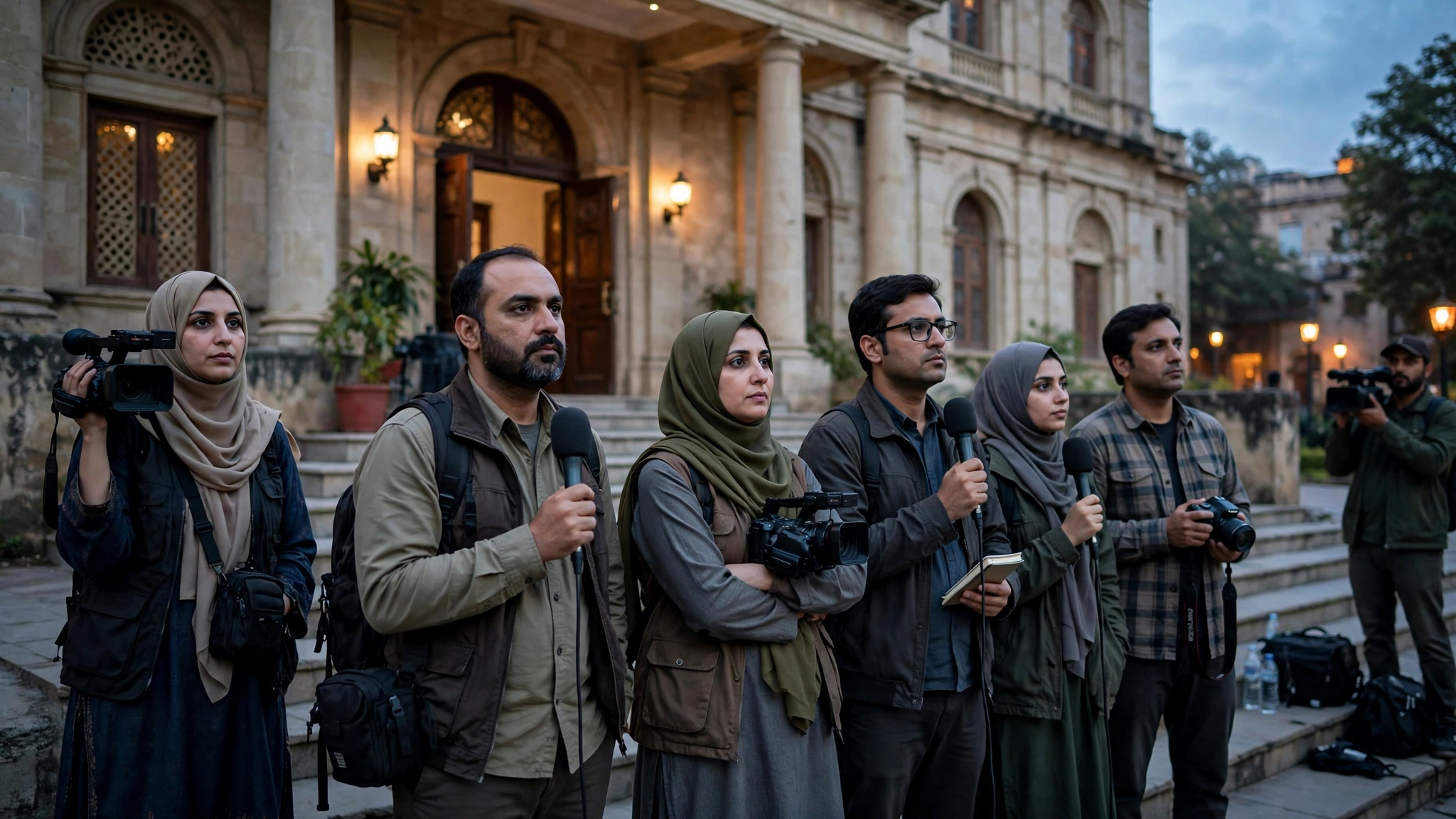
His family, fellow reporters, lawyers and civil society activists staged a protest outside the SSP office, calling the FIR fabricated. Two lawyers have gone on record backing that view:
- Advocate Sajjad Ahmed Chandio told *The Express Tribune* that “mere registration of an FIR or allegation [thereof] isn’t the only ground to arrest anyone.”
- Advocate Aslam Laghari, who accompanied Sarohi in court, demanded a transparent inquiry conducted by the Federal Investigation Agency (FIA), describing Hyderabad police as partisan and accusing them of managing a fake FIR.
The Pakistan Federal Union of Journalists (PFUJ), the Islamabad Union of Journalists, Sindh Sahafi Ittehad and other bodies condemned the arrest, flagging what they called a troubling pattern of criminal cases being used to pressure journalists. Journalists also questioned why Sarohi was held at the CIA centre rather than the Market police station where the case was registered.
What does “C-class FIR” actually mean?
For readers unfamiliar with police procedure in Pakistan, FIRs can be closed or reclassified by police. A C-class report means the police acknowledge the case was false or admittedly mistaken at the investigation stage — essentially, an official admission that the initial complaint did not hold up. For Sarohi’s supporters, that rapid downgrade within hours of the arrest is the strongest evidence yet that the case was never solid.
That said, the matter is still under investigation and has not been fully adjudicated in court. No final legal finding has cleared or convicted anyone. The police’s own version of the raid, the detention, and the reasons for the release have not been independently verified by all outlets covering the story.
Pakistan context: journalists and criminal cases
This episode fits into a larger, uncomfortable pattern in Pakistan — and especially in Sindh — where reporters who take on powerful interests find themselves facing criminal complaints:
- The Pakistan Press Foundation has documented multiple cases of journalists booked on questionable charges shortly after critical reporting.
- Media unions routinely argue that FIRs are being weaponised to silence scrutiny of police, local government and organised crime.
- At the same time, police argue they act on complaints regardless of the accused’s profession, and that media status should not grant immunity.
The truth in such cases usually emerges only through a genuinely independent investigation — which is exactly why journalists and lawyers in this case are demanding an FIA-led inquiry rather than one conducted by the very police force being criticised.
What happens next
Three things matter from here:
- An independent inquiry: Media bodies want the FIA, not Hyderabad police, to investigate how the FIR was registered, why the raid happened at 3am, and why the case collapsed within hours.
- Accountability for the raid: The manner of the arrest — breaking into a home at night, handcuffing the accused “like a terrorist,” as one lawyer put it — has raised questions about due process regardless of the underlying allegation.
- The complainant’s case: The woman who lodged the FIR retains her right to be heard. A fair investigation must test her allegations properly — which is precisely what the C-class reclassification suggests did not happen the first time.
The bottom line
Within 24 hours, Abdul Ghafoor Sarohi went from a 3am raid to a court remand to freedom — with the police themselves downgrading the FIR to C-class. That extraordinary sequence, combined with his record of criticising the police on drug trafficking, is why Pakistan’s journalist community is treating this not as an ordinary criminal case, but as a test of whether the law can be used as a weapon against the press. An independent, transparent investigation — and only that — can answer the question properly.