Pakistan’s leading mobile operators could soon be sharing networks instead of endlessly duplicating them. The Pakistan Telecommunication Authority (PTA) has developed and approved a nationwide spectrum sharing framework that would let telecom companies use each other’s assigned frequencies — a change the regulator says will cut costs, reduce infrastructure duplication, and speed up the expansion of 4G and 5G services across the country.
The framework, prepared under Clause 8.16 of the Telecom Policy 2015, was forwarded to the Ministry of Information Technology and Telecommunication (MoIT&T) in April 2026 for policy-level approval. Once the federal government signs off, it could reshape how Pakistan’s telecom market builds and runs its networks.
Key Takeaways
- PTA has prepared and approved a nationwide spectrum sharing framework, forwarded to the Ministry of IT and Telecom in April 2026 for final policy approval.
- The framework would let same-category operators share spectrum across bands from 700 MHz to 3500 MHz while meeting existing quality and rollout obligations.
- Sharing aims to cut infrastructure duplication, lower costs, and extend 4G/5G coverage to rural and underserved areas.
What the sharing framework allows
Sharing across eight frequency bands
Under the proposed rules, eligible operators would be able to share assigned spectrum across multiple frequency bands: 700, 850, 900, 1800, 2100, 2300, 2600, and 3500 MHz. These bands span both the lower frequencies prized for wide-area coverage and the higher frequencies needed for fast data speeds — in other words, the full toolkit for 4G expansion and 5G deployment.
Same-category operators only
Sharing would be permitted only between license holders in the same category — mobile operators with mobile operators, in essence. Operators would remain fully bound by their existing rollout obligations, quality-of-service benchmarks, and regulatory requirements. Sharing a network resource is not a licence to share excuses: PTA’s position is that service quality cannot be compromised in the process.
Why it matters now
5G changed the spectrum picture
Pakistan’s recent 5G spectrum auction dramatically increased the country’s available spectrum, from about 274 MHz to 750 MHz. That sudden abundance created a new question: how do you make sure all that spectrum is actually used efficiently, rather than sitting idle while operators build expensive parallel infrastructure in the same areas?
Spectrum sharing is the regulator’s answer. Instead of two companies each running half-empty networks over the same district, they can cooperate — sharing spectrum and, in effect, serving customers from shared infrastructure, which brings down the cost per gigabyte for everyone.
Rural coverage is the real prize
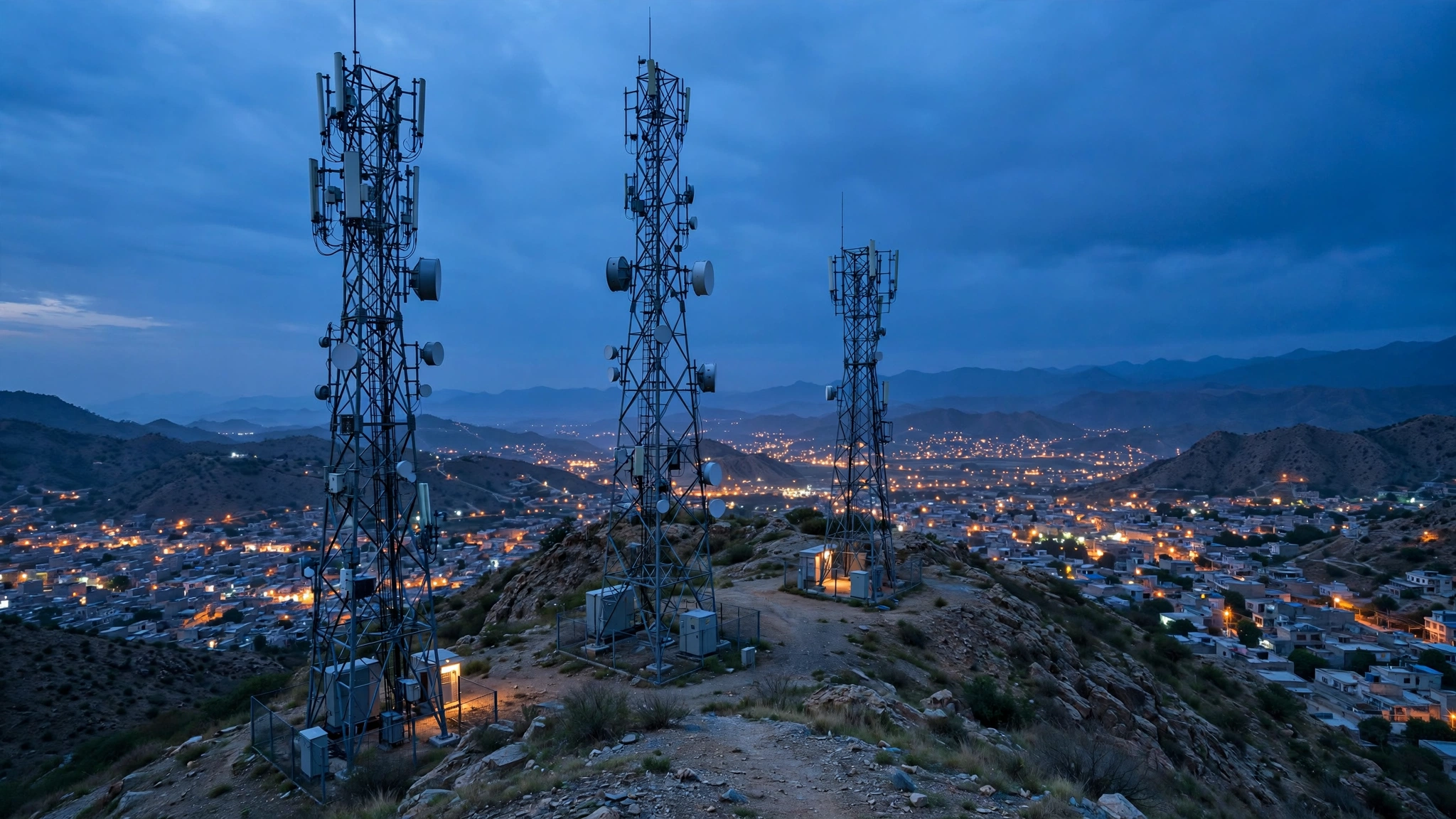
The clearest winners would be people in rural and underserved regions. Building a tower in a remote district with a small subscriber base rarely pays for itself, which is why coverage gaps persist. If operators can share spectrum and serve users from a single tower, the economics of rural coverage improve sharply.
The potential knock-on effects are significant: students in remote villages able to attend online classes reliably, small businesses reaching customers beyond their district, and families in far-flung areas staying connected. In a country where digital services are increasingly tied to education, commerce, and even government payments, coverage is no longer a luxury.
What it means for the big operators
Pakistan’s mobile market is in the middle of a major reshaping. PTCL’s acquisition of Telenor Pakistan was finalized at the end of 2025, and the merged entity — sometimes called MergeCo — operates roughly 26,000 telecom towers before rationalisation, compared with Jazz’s 16,000-plus active cell sites and 25,000-plus kilometres of fibre.
PTA imposed strict conditions on the merger: no network merging, spectrum sharing, or site decommissioning without prior approval, with towers barred from dismantling for at least four months after any approval. A spectrum sharing framework sitting on top of this consolidation gives the regulator another lever to ensure the market stays competitive rather than cozier.
For consumers, the honest version is this: sharing does not automatically mean cheaper packages. What it can mean is better coverage, fewer dead zones, and operators freed from duplicative spending who can redirect investment into network upgrades and 5G equipment instead of parallel towers.
The safeguards
Regulators know that cooperation between competitors can slide into collusion, so the framework is wrapped in conditions:
- Quality benchmarks stay in force. Operators must continue meeting PTA’s service standards; sharing does not dilute accountability.
- Rollout obligations remain. Companies cannot use sharing as a way to quietly retreat from coverage commitments.
- Regulatory approval required. Sharing arrangements would be subject to PTA oversight, not private handshake deals.
A separate 2026 draft of telecommunication competition rules — still under comment, not law — would go further, letting PTA order network access and national roaming from dominant operators. For now, that is a draft; the spectrum sharing framework is the concrete step in front of the ministry.
What’s next
The ball is now in the Ministry of IT and Telecom’s court. Once policy approval lands, PTA can move to implementation — at which point Jazz, Zong, Ufone, and the merged Telenor entity can begin negotiating actual sharing arrangements.
For subscribers, the advice is simple: don’t expect a bill change tomorrow. But watch your coverage map over the coming years. If spectrum sharing works as designed, the most noticeable difference won’t be in your city — where networks are already dense — but on the highways, in the villages, and in the northern areas where a single shared tower can finally make a signal economically viable.