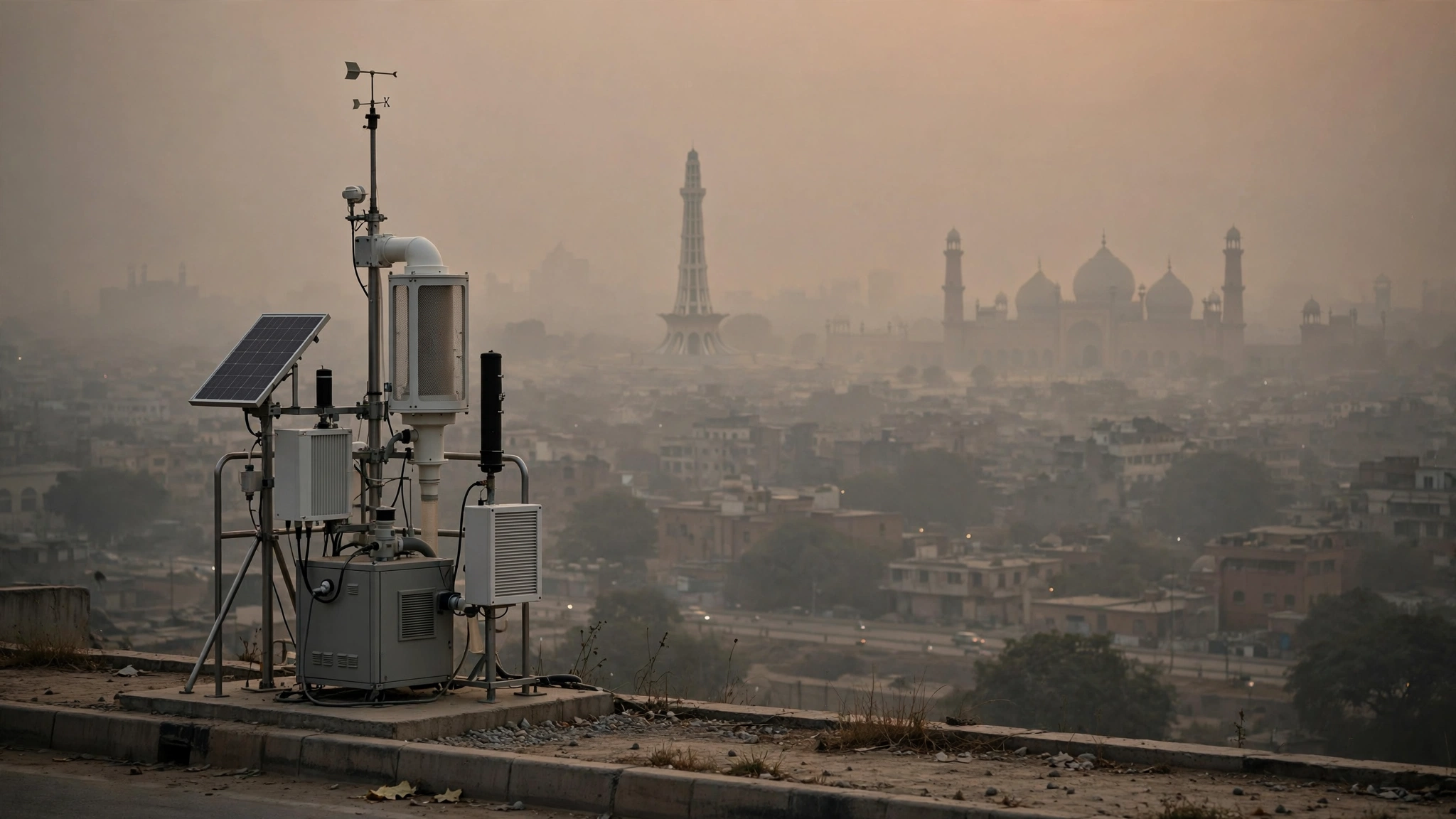
The Lahore University of Management Sciences (LUMS) has launched the Centre for Air Pollution and Environment (CAPE), a new research centre dedicated to identifying the sources of air pollution in Punjab — the province that bears the heaviest burden of Pakistan’s annual smog crisis.
CAPE has been established with a major grant from Coefficient Giving, which will fund a multi-year, multi-site study to identify and quantify the major contributors to particulate air pollution across the province. The project also includes a state-of-the-art laboratory for the chemical analysis of air pollutants, giving Pakistani researchers the capacity to analyse pollution samples locally rather than relying on facilities abroad.
Key Takeaways
- LUMS has launched the Centre for Air Pollution and Environment (CAPE), funded by Coefficient Giving, to identify and quantify the sources of particulate pollution across Punjab.
- The centre will set up a state-of-the-art chemical analysis lab, run a multi-year source-apportionment study, and assess indoor air quality in schools.
- The launch brought together Punjab government departments, air-quality organisations and researchers to align science with smog policy.
Why Lahore Needs This Research
Lahore is one of the most polluted cities in the world, and the problem peaks every winter. The IQAir newsroom reported on 24 September 2026 that Lahore was again among the top 10 most polluted cities globally, with pollution driven by dust loading, vehicle emissions, brick kilns, construction dust and industrial activity. Research cited by IQAir shows PM2.5 concentrations in Lahore rising from around 60.52 µg/m³ in the pre-smog period to 180.34 µg/m³ during peak smog season.
The health stakes are enormous. Estimates cited at the CAPE launch suggest that bringing outdoor air pollution down to international health guidelines could increase average life expectancy by about 5.3 years in Lahore — alongside 2.6 years in Karachi and 4.6 years in Islamabad.
For years, public debate in Punjab has focused on who is to blame for the smog: farmers burning crop residue, factories, vehicles, or brick kilns. CAPE’s premise is that without hard data, these arguments go nowhere. The centre’s core scientific mission is source apportionment — analysing the chemical composition of particulate matter collected from sites across Punjab to determine exactly which sources contribute to pollution, and by how much.
Who Is Leading CAPE
Dr Qasim Imtiaz, a faculty member in LUMS’s Department of Chemistry and Chemical Engineering, has been appointed the centre’s founding director. The core research team also includes Dr Farah Said, Dr Shahana Khurshid and Dr Walther Schwarzacher.
Presenting the centre’s mission, Dr Imtiaz said that systematic measurements were essential: CAPE will build the evidence and work with government, researchers and communities to translate it into targeted interventions that protect public health.
Speaking at the launch ceremony, LUMS Provost Dr Tariq Mahmood Jadoon stressed why the university was establishing CAPE and why stronger scientific evidence is needed to address air pollution. Dr Schwarzacher, Dean of the Syed Babar Ali School of Science and Engineering, spoke about the centre’s establishment within the school, and LUMS Rector Shahid Hussain closed the event with thanks to the participants and partners.
What CAPE Will Actually Do
The centre’s work is organised around several concrete research streams:
- Source apportionment study. Collecting particulate-matter samples from multiple locations across Punjab and analysing their chemical makeup in the new laboratory to quantify how much each pollution source contributes.
- Health and environmental impacts. Assessing how pollution exposure affects people and the environment, providing the evidence base for intervention priorities.
- Indoor air quality in schools. Examining the air children breathe inside school buildings — a focus that matters enormously in Punjab, where smog season regularly disrupts the school calendar.
- Science-to-policy links. Strengthening the connection between research findings, local communities and policymakers, so that results feed directly into action rather than sitting in journals.
The research effort is already staffed up: LUMS has advertised a fully funded postdoctoral researcher position at CAPE covering ambient air-quality monitoring, particulate-matter chemical analysis, source apportionment and receptor modelling, with techniques such as ion chromatography, GC–MS and XRF.
Government and Researchers at the Same Table
The launch ceremony brought together LUMS leadership, members of CAPE’s Policy Advisory Board, provincial government departments, air-quality organisations, researchers and development partners.
In a session moderated by Dr Shahana Khurshid, representatives of the Environment Protection and Climate Change Department, the Urban Unit and the Pakistan Air Quality Initiative presented their ongoing work on Punjab’s smog mitigation framework, air-quality monitoring, sectoral emissions inventories, air-quality action plans and citizen monitoring.
A second panel, moderated by Dr Farah Said, brought together senior officials including the Secretary of the Provincial Transport Authority, the Managing Director of the Punjab Safe Cities Authority, and officials from the Higher Education Department, alongside academic researchers. The discussion highlighted Punjab’s efforts to strengthen vehicle-emissions testing and use Safe City camera systems to monitor environmental violations — and reinforced the consensus that reliable data is needed to assess whether pollution-control measures are actually working.
Why This Matters for Policy
Punjab’s response to smog has historically leaned on broad, blunt instruments: temporary brick-kiln shutdowns, restrictions on certain vehicles, and appeals against crop burning. The problem with blunt instruments is that nobody knows precisely which of them work, because nobody has measured the pollution’s ingredients properly.
That is the gap CAPE is designed to fill. If the chemical fingerprint of Lahore’s winter particulate matter turns out to be dominated by one or two sources, policy can be targeted rather than scattershot. Evidence-based targeting also makes it easier for the government to defend tough measures — and for citizens to accept them — because the case rests on measurements, not assumptions.
The centre’s emphasis on community engagement also signals a shift: air pollution research in Pakistan has often been an expert-only conversation. By linking researchers, government departments and local communities, CAPE aims to make the evidence usable by everyone from provincial planners to neighbourhood advocacy groups like the Pakistan Air Quality Initiative.
The Bottom Line
Lahore’s smog problem has been studied before, but rarely with the sustained, multi-site, chemically rigorous approach that CAPE promises. Funded by Coefficient Giving and backed by Punjab’s own environment and transport departments, the centre gives Pakistan a domestic scientific engine for answering the most basic — and most contested — question about its air: what exactly is in it, and where does it come from?
If CAPE delivers on its source-apportionment mission, the next few smog seasons could be the first where Punjab fights pollution with a full map of the enemy. For a city where residents stand to gain years of life from clean air, that is a research project worth watching.