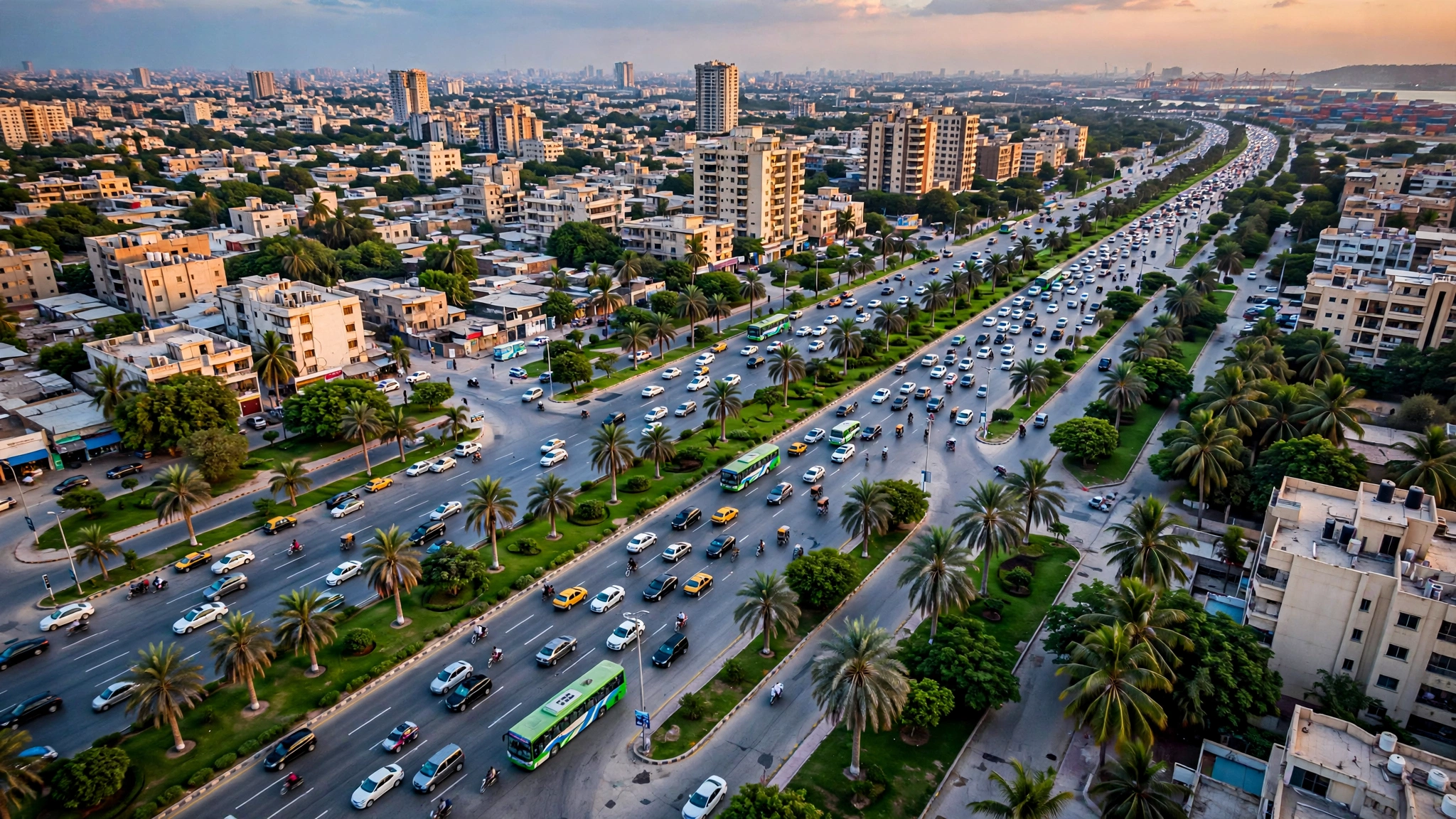
Karachi’s busiest roads are getting more than just pothole repairs. The Karachi Metropolitan Corporation (KMC) has approved a comprehensive Rs4.2 billion uplift and beautification plan aimed at giving four major traffic corridors a modern, green and “international” look — alongside proper rehabilitation of the roads themselves.
The plan was finalised by Karachi Mayor Murtaza Wahab, and it covers some of the city’s most congested routes: Rashid Minhas Road, S.M. Taufique Road, Sir Shah Suleman Road, and Pehalwan Goth Road. Work on at least one of them is already underway, and tenders for the rest have been ordered.
Key Takeaways
- KMC approved a Rs4.2 billion uplift and beautification plan for four major Karachi traffic corridors.
- The project includes green belts, lane markings, traffic-friendly designs and long-pending sewerage fixes.
- Rashid Minhas Road gets the largest share at Rs1.12 billion, followed by Pehalwan Goth Road at Rs1.9 billion.
What’s Included in the Beautification Plan
This is not just a resurfacing job. According to KMC officials, the initiative focuses on sustainable infrastructure, improved traffic management and a greener urban environment. Each corridor will get:
- Complete road rehabilitation — resurfacing and structural repairs.
- Resolution of long-standing sewerage issues — a chronic complaint on several of these routes.
- Lush green belts along medians and edges to soften the concrete sprawl.
- Improved lane markings and traffic-friendly road designs.
- Better connectivity to the city’s inner arteries, easing pressure on surrounding streets.
The goal, in the KMC’s own words, is to give Karachi a “truly modern and international vibe.”
The Four Corridors and Their Budgets
| Corridor | Route | Budget |
|---|---|---|
| Rashid Minhas Road | Sharea Faisal to Shahrah-i-Usman via 4-K Chowrangi and Nagan Chowrangi | Rs1.12 billion |
| Pehalwan Goth Road | Habib University, Gulistan-i-Jauhar to Race Course, Safoora | Rs1.9 billion |
| Sir Shah Suleman Road | Karsaz to Nazimabad Habib Bank Chowrangi | Rs574 million |
| S.M. Taufique Road | Liaquatabad flyover to Teen Hatti Bridge | Rs429 million |
The biggest single share — Rs1.9 billion — goes to Pehalwan Goth Road in District East, a route used by thousands of commuters travelling between Gulistan-e-Jauhar, Safoora and surrounding areas. The roughly 5-kilometre project includes road reconstruction plus new utility lines to improve sewerage and rainwater disposal before the dualised road is completed. Mayor Wahab announced the start of work back in March 2026, and progress reports indicate the project is moving ahead.
Rashid Minhas Road, at Rs1.12 billion, is the second-largest component. It is one of the most critical east-west arteries in the city, carrying heavy traffic between Sharea Faisal and the northern districts through 4-K Chowrangi and Nagan Chowrangi.
Part of a Bigger Infrastructure Push
The four-corridor plan does not stand alone. It sits within a much larger infrastructure drive for Karachi:
- Rs5.54 billion for rehabilitating 26 internal roads spanning 68 kilometres, announced in January 2026, covering areas from North Nazimabad to Khokhrapar.
- Rs21.53 billion approved by Sindh Chief Minister Murad Ali Shah, with Rs13 billion earmarked for Town Municipal Corporation roads, Rs8.53 billion for KMC-led reconstruction, and Rs1 billion each for water/sewerage repairs, storm drains and streetlights.
- A 400-road rehabilitation programme covering 409 roads across all seven municipal districts, plus a 139-road solar corridor package.
In other words, the beautification of these four corridors is the showcase layer on top of a city-wide repair programme that is among the most ambitious in Karachi’s recent history.
Why Beautification Matters — Not Just Potholes
Sceptics will rightly ask whether green belts and lane markings matter when Karachi’s roads still flood every monsoon. The honest answer: the cosmetic layer only works if the engineering underneath is fixed. To its credit, the KMC plan explicitly includes sewerage resolution and drainage fixes alongside the aesthetics.
Still, there is real value in the “beautification” part:
- Road safety. Fresh lane markings and clearer layouts reduce accidents on high-speed corridors.
- Public morale. A well-kept road signals that the city is being managed, which matters in a metropolis battered by years of neglect.
- Property values. Commercial rental yields along upgraded corridors have been rising, and better-looking, better-lit roads attract businesses.
- Night visibility. Upgraded streetlights — part of the broader Rs21.53 billion package — make night driving safer, especially for motorcyclists and rickshaw drivers.
What Commuters Should Expect
With tenders ordered and work ongoing, commuters should brace for short-term pain: construction zones, lane closures and slower traffic on all four corridors. The Pehalwan Goth Road work is already visible to drivers in District East.
At the same time, Karachiites should temper expectations about timelines. Large municipal projects in the city have a history of delays, and the KMC’s own commitment to “float tenders without delay” is a promise to watch, not a guarantee. Residents can track progress by watching for completed stretches on Pehalwan Goth Road, which is the furthest along.
The Bottom Line
The Rs4.2 billion beautification plan is a welcome signal that Karachi’s authorities are thinking beyond emergency repairs — about how the city’s roads look, feel and function. Four major corridors, thousands of daily commuters, green belts and proper drainage: the ingredients are right. Now it comes down to execution, and whether the city can finish what it has started without the usual delays.
For a city that has waited decades for roads it can be proud of, that is the real test.