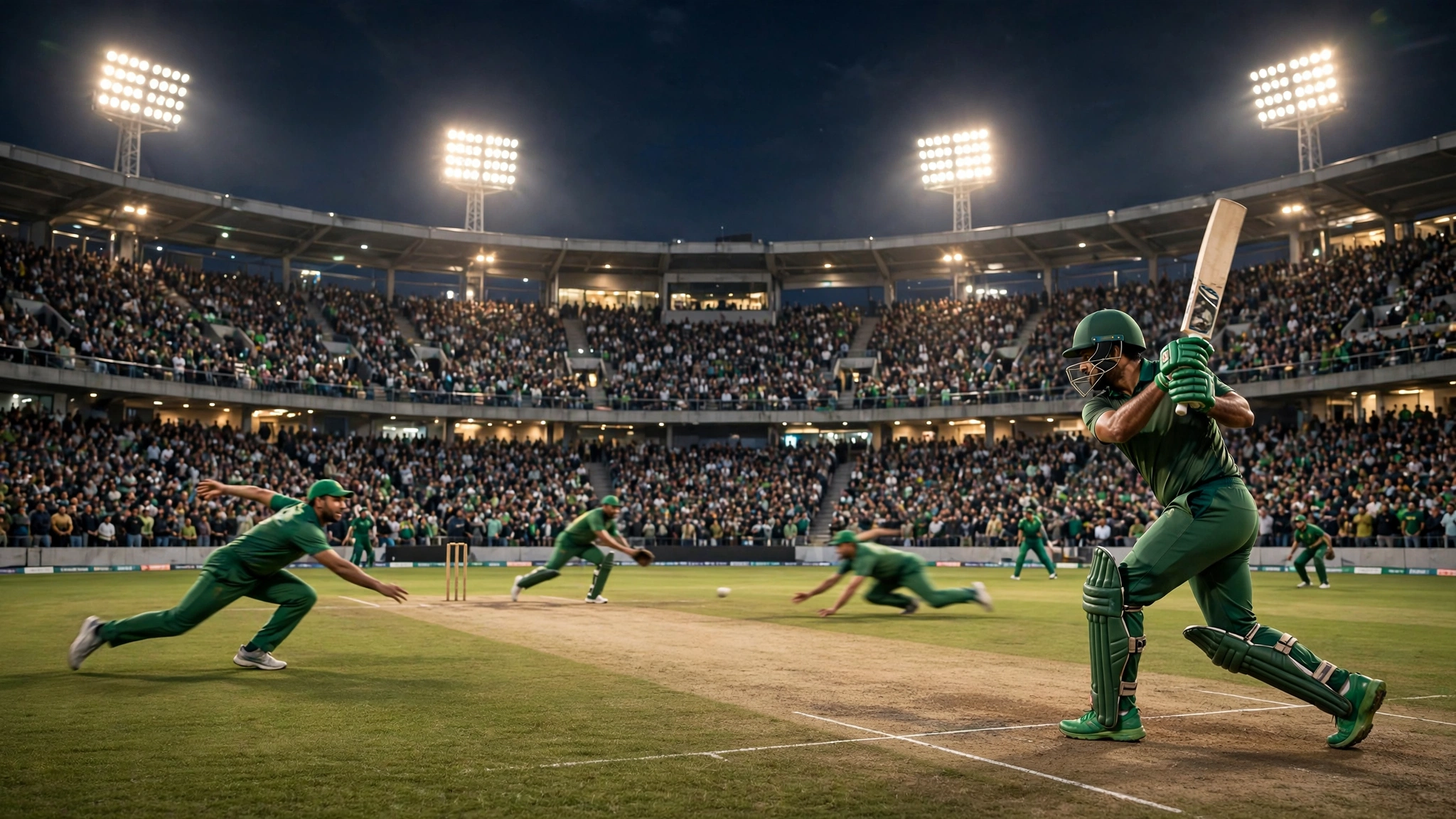
Pakistan produced one of the most dominant batting displays in their T20I history on Sunday, posting a record 215-3 against Sri Lanka in the second T20I at the Rawalpindi Cricket Stadium before cruising to an 82-run victory that sealed the three-match series 2-0.
One evening rewrote several pages of Pakistan’s record book: it was the highest T20I total ever posted by Pakistan on home soil, the second-highest in the country’s T20I history, the highest by any side at Rawalpindi, and the biggest T20I total against Sri Lanka. The 82-run margin was also Pakistan’s largest T20I win over the visitors.
Key Takeaways
- Pakistan posted 215-3 in the 2nd T20I at Rawalpindi — their highest-ever T20I total on home soil and their best against Sri Lanka.
- Maaz Sadaqat’s 96 and captain Sahibzada Farhan’s 73 drove the record total; Sadaqat’s seven sixes equaled Pakistan’s T20I single-innings record.
- The 82-run win is Pakistan’s biggest-ever T20I victory over Sri Lanka, sealing an unassailable 2-0 series lead.
A Home Record a Decade in the Making
The 215-3 swept past the previous home mark of 208-3 against the West Indies in Karachi in 2021, a record that had stood for five years. It remained 17 runs shy of the all-time best — the 232-6 against England in Nottingham in 2021 — and it edged past the previous best against Sri Lanka, the 212-8 scored at Pallekele during the 2026 T20 World Cup.
Pakistan’s highest T20I totals at home
| Total | Opposition | Venue | Year |
|---|---|---|---|
| 215-3 | Sri Lanka | Rawalpindi | 2026 |
| 208-3 | West Indies | Karachi | 2021 |
| 207-6 | Australia | Lahore | 2026 |
| 205-3 | West Indies | Karachi | 2018 |
| 203-0 | England | Karachi | 2022 |
For supporters who have long lamented Pakistan’s conservative approach in the shortest format, the evening was a statement. Seventy runs arrived in the final five overs alone, and 156 came in the last 12 — an acceleration that reflected the side’s new emphasis on aggressive, format-specialist batting.
Sadaqat and Farhan Run the Show
The wreckage was engineered by two men in career-best form. Maaz Sadaqat, the breakout story of the series, smashed 96 off 51 balls with six fours and seven sixes before falling off the final delivery of the innings. His seven maximums equaled the record for the most sixes by a Pakistani batter in a single T20I innings.
Captain Sahibzada Farhan continued his outstanding series with 73 off 44 balls — four fours and five sixes — for his second successive half-century. The pair added 88 runs for the second wicket in only 49 balls, after an opening stand of 55 between Farhan and Fakhar Zaman (22 off 17) had laid the platform. Sadaqat and Hasan Nawaz (19 not out off 9) then compiled 72 in 31 balls for the third wicket.
Pakistan struck 13 sixes in total, matching the team’s joint-second-highest six tally in T20Is. Sri Lanka’s fielding told its own story: three catches were dropped, with Sadaqat reprieved on 44 and Farhan surviving on two and 11. As captain Kusal Mendis admitted afterwards, the catching “has not been up to the mark” across the series.
Individual records from the Rawalpindi run-fest
- Maaz Sadaqat, 96 (51 balls): his highest T20I score; seven sixes equal the Pakistan single-innings T20I record.
- Sahibzada Farhan, 73 (44 balls): back-to-back fifties in the series, extending his rich vein of form.
- 13 sixes: joint-second-most by Pakistan in a T20I innings.
- Team total 215-3: highest T20I total by any team at Rawalpindi, improving the previous mark of 195 against Zimbabwe.
Sri Lanka Dismantled for 133
Any hope of a competitive chase dissolved inside the powerplay. Sri Lanka slumped to 35-2 in the first six overs and then 64-5 by the 11th, with not a single member of the top seven reaching 30. Young pacer Mohammad Imran was the destroyer-in-chief with 3-11 from four overs, while Salman Mirza struck early to remove the dangerous Lahiru Udara.
Only Maheesh Theekshana’s unbeaten 32 offered resistance as Sri Lanka limped to 133-7 — 82 runs short. That eclipsed Pakistan’s previous biggest T20I win over Sri Lanka, the 52-run victory at Colombo in 2009.
“If we continue this way we will end up scoring more than 200 every time,” Farhan said afterwards — music to fans who have waited years for Pakistan to adopt a fearless batting identity.
Records Keep Falling: The Series Story So Far
The second T20I’s record haul continued a trend set in the series opener on October 9, when Pakistan chased down Sri Lanka’s 182 for a four-wicket win — the highest successful T20I chase ever against Sri Lanka, bettering the 173 at Colombo in 2015.
That game also produced a record 92-run second-wicket stand between Farhan and Sadaqat — beating the 76 set by Babar Azam and Haris Sohail at Lahore in 2019 — with Farhan scoring 89 off 53 balls. Sri Lanka’s Lahiru Udara hit 91, the highest individual score by a Sri Lankan against Pakistan in T20Is, eclipsing Kusal Perera’s 84 from Dubai in 2013.
Across the two matches, the records tumble as follows:
- 2nd T20I: highest home T20I total (215-3); highest vs Sri Lanka (215-3); largest T20I win over Sri Lanka (82 runs); joint-most sixes in an innings by a Pakistani (Sadaqat’s 7).
- 1st T20I: highest chase vs Sri Lanka (183); record second-wicket partnership vs Sri Lanka (92); highest Sri Lankan score vs Pakistan (Udara’s 91).
What It Means for Pakistan Cricket
The significance goes beyond the scoreboard. For years this side was criticised for falling 20-30 runs short of par in modern T20 cricket. Back-to-back 200-plus scores in 2026 — 207-6 against Australia in Lahore and now 215-3 — suggest the mindset shift is real.
With the final T20I on Tuesday at Rawalpindi, Pakistan can complete a 3-0 whitewash. If Sadaqat and Farhan keep batting like this, more record-book entries may not be far away.
Conclusion
Pakistan’s 215-3 was no accident — bold batting, ruthless late acceleration and a fielding collapse from the opposition. Five years after the 208-3 against the West Indies, Pakistan have a new home record, a new benchmark against Sri Lanka, and a captain promising 200-plus totals as the new normal. On Tuesday, Rawalpindi gets to see whether the encore lives up to the show.