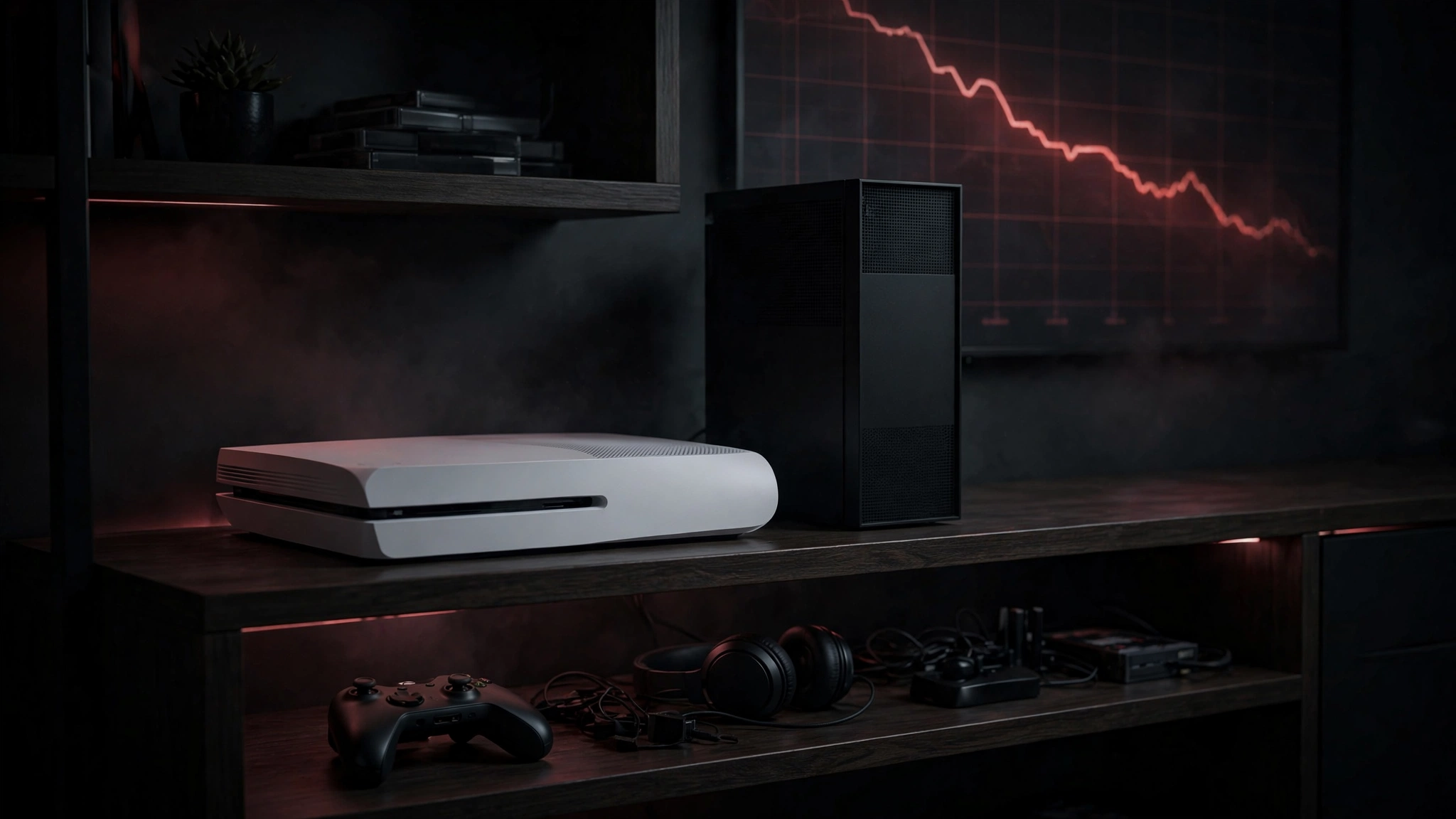
If you’ve been waiting for PlayStation 5 or Xbox console prices to drop before buying one, the opposite happened. Fresh US retail figures released on October 9, 2026, paint a grim picture: Xbox hardware sales are down 33% year over year through August, while PlayStation is down 25% — record lows for both brands.
What’s going wrong? It’s a pile-up of price hikes, a global component crisis, and both companies quietly changing their strategies. Here’s the breakdown.
Key Takeaways
- US retail data through August 2026 shows Xbox hardware units down 33% and PlayStation down 25% year over year — all-time lows for both brands.
- Repeated price hikes pushed average US console prices to record highs: $529 for Xbox (+26%) and $597 for PlayStation (+20%).
- An AI-driven RAM and component shortage, rising costs, and shifting company strategies are driving the slump.
The Numbers: How Bad Is It?
According to Circana’s US retail tracking data, published by analyst Mat Piscatella on October 9, 2026:
- Xbox hardware unit sales fell 33% in January–August 2026 compared with the same period in 2025 — an all-time low for the Xbox brand.
- PlayStation hardware unit sales fell 25% over the same stretch — the lowest level since 2013.
- In August 2026 alone, total US hardware unit sales dropped 15% to roughly 559,000 units — the weakest August in 13 years.
These are units sold, not revenue. Because consoles cost more than ever, dollar spending fell less sharply. But the message is clear: far fewer people are buying a new console.
Reason 1: Prices Have Reached Record Highs
This is the biggest factor. Every major console maker has raised prices repeatedly over the past year and a half, and buyers are pushing back. Circana analyst Mat Piscatella’s verdict: “Price sensitivity is becoming a real problem.”
Look at how the prices stack up:
| Console | Current price (US) | What changed |
|---|---|---|
| Xbox Series X (disc) | $799.99 | Up $300 from its original launch price after multiple hikes |
| Xbox Series S (1TB) | $599.99 | Raised from its original budget positioning |
| Base PS5 | ~$649.99 | $499 → $549.99 in Aug 2025, then another ~$100 in April 2026 |
| PS5 Pro | $899.99 | Sony’s premium tier, raised in April 2026 |
| Nintendo Switch 2 | ~$500 | Raised by $50 in September 2026 |
The result: the average Xbox sold in the US in 2026 cost $529 — up 26% from a year ago. The average PlayStation sold for $597 — up 20%. Both are all-time US highs. A PS5 Pro at $900 is a luxury purchase in almost any market, and in Pakistan it’s worse still (more on that below).
Reason 2: The RAM Crisis Is Squeezing Everyone
Why are companies raising prices instead of cutting them? Because their own costs are rising. A global shortage of memory chips — driven by AI data centres buying up RAM supply — has tightened component availability across the industry. This “RAM-pocalypse,” as gaming press has dubbed it, shows no signs of ending soon: Micron’s chief executive has said the shortage could last until at least 2028.
The numbers explain why this hits consoles so hard. Research from TrendForce notes that memory accounts for roughly 35% of the cost of a PS5 or Xbox console. TrendForce now expects global console shipments to fall 4.4% in 2026 compared with 2025.
Console makers have traditionally sold hardware at thin margins and made money on games and subscriptions. With component costs soaring, that model breaks — so they pass the cost to buyers, who respond by not buying.
Reason 3: Sony and Microsoft Are Shifting Their Priorities
Both companies are subtly de-emphasising the box itself:
Microsoft is going multi-platform. Xbox hardware revenue fell 29% year over year in a recent quarter, which Microsoft itself attributed to lower console volumes. The company has increasingly focused on Xbox Game Pass and bringing its games to rival platforms — reports indicate 75–80% of some launch sales revenue for single-player games now sits on Sony’s hardware. When Microsoft’s biggest games no longer require an Xbox, the box itself becomes a harder sell.
Sony is thriving on software while hardware slows. In the quarter ending June 30, 2026, Sony reported PS5 sales of 1.6 million units — down 36% year over year. Yet the PS5 has still crossed 95.3 million lifetime sales, closing in on 100 million, and Sony’s gaming division posted record operating income. With nearly the entire willing audience already owning a PS5, most remaining buyers are upgraders or late adopters — exactly the price-sensitive groups least willing to pay record prices.
The chipmaker AMD felt the slowdown too: its gaming segment revenue dropped 31% year over year, which it blamed directly on lower semi-custom chip orders from the console makers.
Reason 4: The Generation Is Simply Aging
The PS5 launched in 2020, and the Xbox Series X|S in the same year. Six years in, the pool of people who want a console but don’t have one is naturally shrinking. Normally, late-cycle price cuts would tempt holdouts in — that’s the classic playbook. Instead, this generation has seen late-cycle price increases, the first in console history. A buyer who skipped the PS5 at $499 is unlikely to be tempted at $650.
What This Means for Gamers in Pakistan
The official price hikes are painful enough in the US, but in Pakistan the damage multiplies. Neither Sony nor Microsoft sells consoles officially here — nearly every PS5 and Xbox in the country arrives through unofficial importers, mainly via Lahore’s Hall Road and Karachi markets. Importers buy at the new, higher international prices, then add shipping, customs complications, and their own margins on top. A depreciating rupee makes each successive price hike land even harder.
The practical effect: late-2026 PS5 and Xbox prices in Pakistani markets are higher than they’ve ever been, and the once-popular budget option — the Xbox Series S — no longer feels like a budget buy. For now, used and refurbished consoles from earlier price eras remain the best value for Pakistani buyers.
Will It Get Better? Maybe in November
One bright spot is approaching: a major game release in November 2026 could temporarily lift sales — new blockbusters have historically moved hardware. But as Circana’s Piscatella cautioned, this depends on product availability amid the component crisis and, inevitably, pricing. One game won’t fix a market whose core problem is that consoles cost too much for too many people.
The Bottom Line
- Record-high prices are the primary reason PS5 and Xbox sales are crashing in 2026.
- A RAM and component shortage — expected to persist into 2028 — forced the price hikes.
- Both Sony and Microsoft now prioritise games and subscriptions over hardware volume.
- Until prices fall again, unit sales will keep declining — in the US and even more in markets like Pakistan.