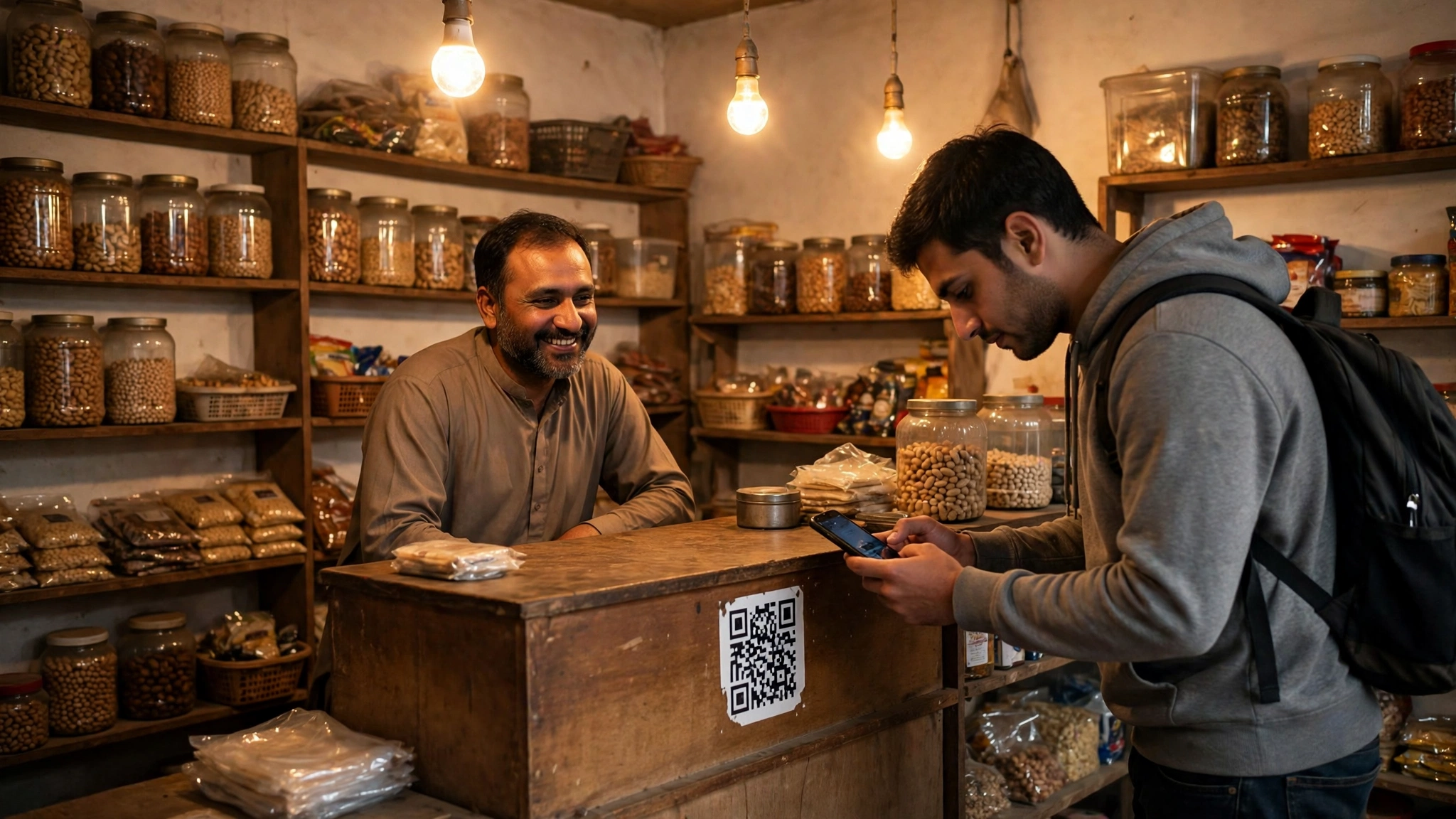
The little black-and-white square stuck to shop counters across Pakistan has become the symbol of the country’s payments revolution. The number of QR-enabled merchants in Pakistan jumped 245 percent during fiscal year 2025-26, reaching 3.8 million — up from just 1.1 million a year earlier, according to data from the State Bank of Pakistan (SBP).
The figures, published in the SBP’s Annual Payment Systems Review for FY2025-26, show not just rapid growth in merchant sign-ups but a genuine shift in how Pakistanis pay: those 3.8 million merchants processed around 297 million transactions worth Rs1.6 trillion during the year. That works out to roughly 0.8 million QR transactions every single day, with an average daily value of nearly Rs5.5 billion.
Key Takeaways
- QR-enabled merchants in Pakistan surged 245% to 3.8 million in FY2025-26, up from 1.1 million a year earlier, according to SBP data.
- These merchants processed 297 million transactions worth Rs1.6 trillion — about 0.8 million QR payments every day.
- A Rs3.5 billion government subsidy under the Cashless Pakistan Initiative helped fuel the boom; digital payments now make up over 92% of retail transactions by volume.
From 86 Million to 297 Million Transactions
The scale of the jump becomes clear when placed against the previous year. In FY25, QR-based payments stood at just over 86 million transactions with a combined value of Rs234 billion. In a single year, transaction volume more than tripled and value surged nearly sevenfold.
Behind the headline sits an even more striking milestone: digital payments now account for more than 92 percent of all retail payment transactions in Pakistan. Retail payment transactions overall grew 58 percent to 14.3 billion in FY26, up from 9.1 billion the year before. Digital channels handled 13.2 billion of those transactions, worth Rs257.1 trillion.
That said, there is an important caveat. Digital payments represent only 38 percent of total retail payment value — meaning that while Pakistanis make most of their small payments digitally, large-value transactions still move through cash and over-the-counter channels. Shifting those bigger payments — by businesses, government entities, and financial institutions — remains the central bank’s next big challenge.
What Powered the QR Boom
Three forces combined to drive the surge.
1. The government subsidy. Under the Prime Minister’s Cashless Pakistan Initiative, the government allocated Rs3.5 billion to subsidise QR transactions. The subsidy covered 0.5 percent of the value of each eligible transaction, capped at Rs100 per transaction, and was shared equally between the merchant’s acquiring bank and the customer’s issuing bank. Financial institutions were also permitted to charge merchants up to 0.25 percent of transaction value for onboarding and servicing. The design was deliberate: reward both sides of every transaction so that shops want to accept QR and customers want to use it.
2. Raast and low-cost infrastructure. The SBP’s instant-payment system Raast has been the backbone of the expansion, particularly through its Person-to-Merchant (P2M) platform. By the end of the third quarter of FY26 (January–March 2026), more than 2.6 million merchants had already been onboarded onto Raast P2M. Unlike conventional card machines, which require expensive point-of-sale terminals, QR payments need little more than a printed code and a smartphone — making them practical for the grocery store, pharmacy, roadside restaurant, and neighbourhood retailer that form the backbone of Pakistan’s retail economy.
3. Mobile-first adoption. Mobile-based payment services were the main engine of digital adoption overall, processing 11.1 billion transactions in FY26 — up 79 percent year-on-year. Mobile banking apps, branchless banking apps, e-wallets, and other mobile services accounted for 78 percent of all retail transactions. Branchless banking app users reached 99.1 million, mobile banking users rose to 30.4 million, and e-money wallet users grew 37 percent to 7.9 million. When the customers already have payment apps on their phones, the marginal step to scanning a QR code is a small one.
Beyond QR: The Wider Infrastructure Build-Out
The QR explosion is part of a broader build-out of Pakistan’s payment infrastructure. Point-of-sale terminals grew 49 percent to 337,791 by June 2026, and daily card payments through POS terminals approached 1.5 million, up from around 1 million in FY25. E-commerce merchants registered with banks more than doubled, from 9,584 to 23,356. The POS network itself reached 295,367 merchant locations.
Each channel reinforces the others. A consumer who pays digitally at a QR-enabled corner shop is more likely to pay digitally online — and 96 percent of e-commerce transactions through banking channels were already account-based.
The Cash Habit Isn’t Dead Yet
For all the momentum, the central bank is frank about what remains. Over-the-counter transactions through bank branches and branchless banking agents still reached Rs415.7 trillion — around 62 percent of total retail payment value. Cash that never enters the formal banking system sits entirely outside these statistics, and in much of Pakistan’s informal economy it remains king.
Small merchants themselves are ambivalent. While banks and policymakers celebrate the numbers, traders on the ground describe practical friction: unreliable connectivity, settlement delays, and customers who still prefer notes and coins. As one Lahore trader put it in recent coverage of the cashless drive, “cash is quick and trusted.” The subsidy has pulled merchants into the system; keeping them there will depend on whether digital payments genuinely work as well as cash does in daily life.
Why It Matters
The 245 percent surge is more than a statistic — it is evidence that Pakistan’s financial inclusion strategy is finally reaching the last mile. Every QR code on a shop counter is a merchant with a digital footprint: transaction records that can support credit scoring, tax documentation, and access to formal finance. For a country where millions of small businesses have historically operated entirely in cash, that is transformative.
Prime Minister Shehbaz Sharif has made a cashless economy one of his government’s stated goals, and an independent assessment of the cashless drive is expected in November. Analysts have already begun calling for the subsidy programme to continue, arguing that a wider QR network reduces cash-management costs for the economy and deepens financial inclusion.
The trajectory is clear. The question is no longer whether Pakistan is going digital — at 92 percent of retail transactions by volume, it already has. The question is how fast the remaining cash economy follows, and whether the infrastructure can keep pace with the ambition.